It’s been over a week since a group of masked men waving Russian flags appeared outside a Donetsk synagogue and began distributing a flier bearing the insignia of the separatist “Donetsk People’s Republic,” which called for all local Jews to register with the new authorities or face deportation. News of the fliers spread quickly, despite being dismissed as a provocation by both pro-Russia separatists and the Jewish community. Within days, the members the so-called Contact Group that met on April 17 in Geneva included a strong public condemnation of anti-Semitism in its public statement.
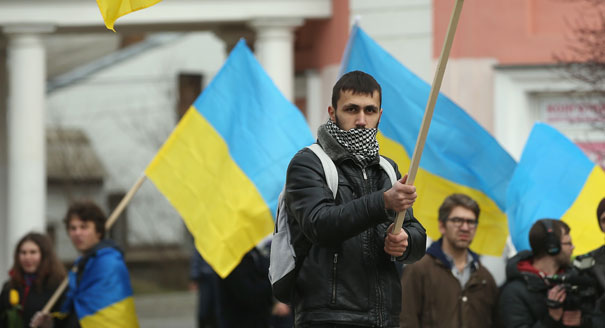
It is worth asking why accusations of anti-Semitism have played such a large political role in the Ukraine crisis. Moscow has long accused the post-Maidan interim government in Kyiv of being in thrall to radical nationalists and neo-Nazis. Russian official statements and media accounts have directed special attention at far-right political parties like Svoboda and Right Sector, both of which played important roles in the revolution yet contain unsavory elements. The Donetsk synagogue incident looks like an attempt by the supporters of the interim government to beat Russia at its own game, using accusations of anti-Semitism to discredit the separatists staging their own version of “Maidan” in the East.
But amid the competing volleys of anti-Semitism accusations, it’s easy to lose track of the truth: things are usually not quite what they seem in today’s Ukraine.
First, the popularity of far right parties in Ukraine is greatly overestimated. According to recent polls, candidates from Svoboda and Right Sector are projected to receive only 5-6 percent of the total vote in the parliamentary election. They are projected to fare even worse in the May 25 presidential election. And it bears repeating that both far-right groups owe their rise in part to none other than Viktor Yanukovych, who believed that by incubating ultra-nationalist parties he might steal nationalist votes from more mainstream parties and mobilize greater support from his traditional base in Eastern Ukraine.
Most importantly, the Ukrainian Jewish community is nowhere near as marginalized and oppressed as recent media coverage would suggest. Jewish public and political figures play important and varied roles in Ukrainian society, and the Jewish community has experienced a dramatic revival in recent years.
In Dnipropetrovsk, two Jewish billionaires financed a $70 million community center that houses a synagogue, businesses catering to observant Jews, the Israeli consulate, and a Holocaust museum. After the ouster of Yanukovych, one of those billionaires, Ihor Kolomoisky, was named the governor of Dnipropetrovsk oblast by the interim government. Even before the revolution, several figures of Jewish origin played prominent roles in Yanukovych’s Party of Regions—namely, Hennadiy Kernes, the mayor of Kharkiv, and Mikhailo Dobkin, the ex-governor of Kharkiv Province who is currently the Party of Regions candidate for president. Eduard Gurvits, also Jewish, served for years as mayor of Odessa, a city with close historical associations with the Jewish community, before being elected to parliament as a member of Vitali Klitschko’s opposition UDAR party in 2012. Another Jewish politician, Volodymyr Groisman, was appointed deputy prime minister for regional policy by the new government, after serving for eight years as the mayor of Vinnytsia. Ukrainian Jews were active participants in the Euromaidan protests, and one former IDF veteran turned Ukrainian businessman even teamed up with Svoboda fighters during the violent street battles that eventually brought down Yanukovych.
Unfortunately, the longer the Ukraine crisis drags on, the greater the risk of additional provocations and violence. The wave of kidnappings in Eastern Ukraine and attacks on journalists in recent days demonstrate just how dangerous and unpredictable the overall situation is. Ukraine’s Jews are, for now, not a central part of the political drama, but the repeated use of anti-Semitism as a tool in the country’s full-contact politics sends a worrying signal nonetheless.