

Paper
Douglas H. Paal
{
  "authors": [
    "Douglas H. Paal"
  ],
  "type": "legacyinthemedia",
  "centerAffiliationAll": "dc",
  "centers": [
    "Carnegie Endowment for International Peace",
    "Carnegie China"
  ],
  "collections": [
    "China’s Foreign Relations"
  ],
  "englishNewsletterAll": "asia",
  "nonEnglishNewsletterAll": "",
  "primaryCenter": "Carnegie Endowment for International Peace",
  "programAffiliation": "AP",
  "programs": [
    "Asia"
  ],
  "projects": [],
  "regions": [
    "North America",
    "United States",
    "East Asia"
  ],
  "topics": [
    "Security",
    "Military",
    "Foreign Policy"
  ]
}
Source: Getty
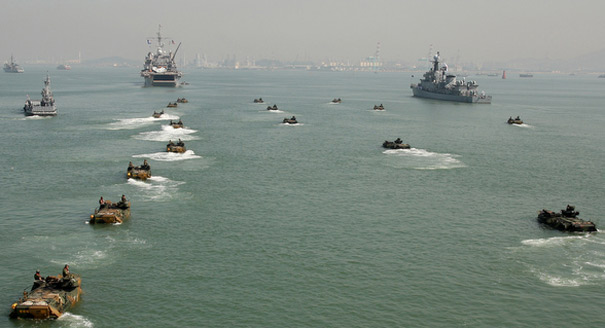
The Obama administration’s pivot to Asia has not emboldened America’s regional partners, nor has U.S. reluctance to directly intervene in territorial disputes signaled waning support for U.S. allies.
Source: CCTV America
Douglas Paal appeared on CCTV America to dismiss the myth that the Obama administration’s “pivot to Asia” has emboldened countries in the region. He asserted that such claims get the chronology wrong and that tensions in the region began to heat up following the 2008 Beijing Olympics, which led U.S. partners in the region to call for the pivot, which began in 2011. Similarly, he rejected the idea that the administration’s reluctance to intervene in the territorial disputes indicates an unwillingness to support American partners in the region, pointing out that the United States seems to be increasingly willing to transfer military equipment to Hanoi and Manila, to step up military-to-military cooperation, and to strengthen their technical capabilities.
Distinguished Fellow, Asia Program
Paal previously served as vice chairman of JPMorgan Chase International and as unofficial U.S. representative to Taiwan as director of the American Institute in Taiwan.
Recent Work
Douglas H. Paal


Douglas H. Paal, Tong Zhao, Chen Qi, …
Carnegie does not take institutional positions on public policy issues; the views represented herein are those of the author(s) and do not necessarily reflect the views of Carnegie, its staff, or its trustees.
Power assessments shape our perceptions of the limits of the possible, but quantitative rankings and dashboards can provide false confidence.
Nicholas Kitchen

The debate over AI and work too often centers on displacement. Facing aging populations and shrinking workforces, East Asian policymakers view AI not as a threat, but as a cross-sectoral workforce strategy.

Darcie Draudt-Véjares, Sophie Zhuang

In its version of an AI middle power strategy, Seoul is pursuing alignment with the United States not as an endpoint but as a strategy to build industrial and geopolitical leverage. Whether this balance holds remains an open question.
Darcie Draudt-Véjares, Seungjoo Lee

China’s rapid technological progress and its first-rate infrastructure are often cited as refuting the claim that China has been systematically overinvesting in non-productive projects for many years. In fact, as the logic of overinvestment and the many historical precedents show, the former is all-too-often consistent with the latter.

Michael Pettis
If Washington cannot adapt to the ongoing transformations of a multipolar world, its superiority will become a liability.

Amr Hamzawy