

Commentary
Uri Dadush
{
  "authors": [
    "Uri Dadush"
  ],
  "type": "legacyinthemedia",
  "centerAffiliationAll": "",
  "centers": [
    "Carnegie Endowment for International Peace"
  ],
  "collections": [],
  "englishNewsletterAll": "",
  "nonEnglishNewsletterAll": "",
  "primaryCenter": "Carnegie Endowment for International Peace",
  "programAffiliation": "",
  "programs": [],
  "projects": [],
  "regions": [
    "North America",
    "United States",
    "Western Europe",
    "France"
  ],
  "topics": [
    "Economy"
  ]
}
Source: Getty
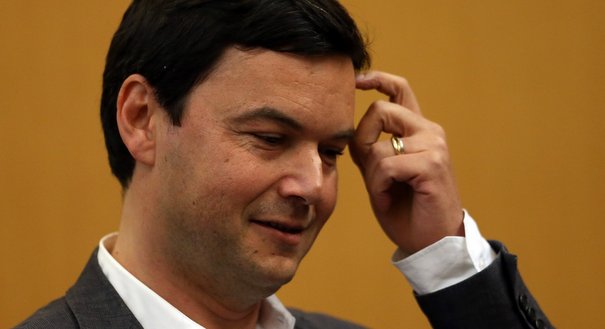
Thomas Piketty’s latest book is a masterpiece of historical and economic analysis, a book that, in ambition and originality, aspires to become an instant economic classic.
Source: Hill
How is it that a tome of 700 pages, full of statistics, endnotes, founded on equations — and written by a French academic — became a bestseller in the United States, more popular on Amazon.com than crime novels and spy stories? Part of the answer is that Thomas Piketty's Capital in the 21st Century is a masterpiece of historical and economic analysis, a book that, in ambition and originality, aspires to become an instant economic classic. And its theme — income inequality — is at center stage in American politics. It helps the general reader that Piketty is at once relentlessly pedagogical and entertaining, drawing his evidence not just from the research of the likes of Simon Kuznets but also from the adventures of elites in 19th-century England and France, as brought to life in the novels of Jane Austen and Honoré de Balzac.
Piketty's central messages are simple: Income inequality has historically been very high, with elites earning at least 30 or 40 times the average wage, and wealth — a combination of housing and financial assets — even more unequally distributed. While the top 10 percent own 60 percent (and sometimes up to 90 percent) of national wealth, the bottom half of the population owns practically nothing. But over at least the last two centuries — since reliable records became available first in France and then in England shortly after the French revolution — the rate of return to wealth (4 percent to 5 percent) has outstripped the rate of growth of national income (2 percent or so) by a wide margin, except during the war and Depression years of 1914 to 1945. Since the wealthy can live very well without consuming significant amounts of their wealth, it follows that wealth accumulates and grows faster than national income. Piketty shows that wealth relative to income is now — at around 5 to 6 times — not far from the records achieved in the 1920s, and its rising weight means that both wealth and income inequality are likely to become even more pronounced in the future.To complicate matters, a lot more wealth is inherited than earned. Such extreme and rising income inequality is inconsistent with democracy, and, Piketty argues, the political breaking point may soon be reached, as happened during periods of extreme inequality in the past. According to him, the most efficient policy response is the imposition of a progressive wealth tax, and such a tax has to be applied globally to avoid evasion. He acknowledges that his recommendation is utopian but insists on it as a necessary response, and one whose time may soon come, perhaps starting with an agreement among the European nations.
In Piketty's comprehensive historical account, the United States stands out in important ways from the general picture: It is even more unequal than Europe because, even though wealth is smaller relative to output (land is much more abundant in the U.S. and real estate is cheaper), wage inequality — fueled by the rise of hyper-remunerated "supermanagers" — is much greater. Moreover, the high cost of American education and healthcare, where the nongovernment sectors play a much bigger role than in Europe, and weaker American safety nets tend both to aggravate inequality and reduce social mobility relative to Europe.
Today, taxes on high incomes, capital gains and dividends in the United States are low by international comparison. This was not always so. In the post-war years, the United States introduced the world's highest income tax, one that Piketty describes as "confiscatory." Ironically, the United States — where talk of wealth tax is beyond the pale — today applies the world's most important wealth tax in the form of a levy on the value of real estate. However, unlike Piketty's wealth tax, real estate taxes are scarcely progressive and tend to apply to the population at large, while financial wealth is entirely exempt.
Piketty's thesis is painstakingly documented and carefully hedged, so it is not easy to attack, except of course by those who opine on it without bothering to carefully read the book, a not uncommon occurrence. In such a massive treatise, some of the facts and assumptions are bound to be challenged (as a Financial Times journalist has already done without much success), but Piketty's key findings are, in my view, unlikely to be disproven.
The main challenge to Piketty's arguments is that the return on capital is not bound to be higher than the growth rate forever, especially if capital — as he argues — becomes more abundant. This is a possibility he acknowledges but dismisses as a very distant prospect. As an observer of economic trends, I myself see little likelihood that in the era of mobile capital, the entry of workers in developing countries into world trade and requiring equipment and infrastructure, and the rise of a large global middle class, the return on capital will fall soon.
So while one can disagree with his policy prescriptions, Piketty's analysis is probably right, leaving American politicians of all stripes holding a gigantic hot potato.

Former Senior Associate, International Economics Program
Dadush was a senior associate at the Carnegie Endowment for International Peace. He focuses on trends in the global economy and is currently tracking developments in the eurozone crisis.
Recent Work
Uri Dadush
Uri Dadush
Carnegie does not take institutional positions on public policy issues; the views represented herein are those of the author(s) and do not necessarily reflect the views of Carnegie, its staff, or its trustees.

Before the next wave of EU enlargement takes place, the union needs to grapple with thorny questions of how power is distributed among its members.


Emil Sondaj Hansen, Ditte Brasso Sørensen

The real test may come after the leaders leave the room.



Sheena Chestnut Greitens, Oriana Skylar Mastro, Yukon Huang, …

The new U.S.–Denmark–Greenland agreement will help Washington exert political, economic, and financial dominance under the guise of security. Yet, it acknowledged Copenhagen’s and Nuuk’s sovereignty on the island.

Marc Pierini

The nuclear relationship between China and the United States is increasingly shaped by widening perception gaps rather than deliberate strategic design.

Tong Zhao
Washington needs to recognize that influence in the Western Hemisphere comes from presence, delivery, and reliability. It also must recognize that while the United States remains the key external actor, it no longer operates in a permissive environment and cannot presume deference from regional players who have other options, namely China.
Juan S. Gonzalez