

Research
- +6
Yasmine Farouk, Nathan J. Brown, Maysaa Shuja Al-Deen, …
{
  "authors": [
    "Michele Dunne"
  ],
  "type": "legacyinthemedia",
  "centerAffiliationAll": "dc",
  "centers": [
    "Carnegie Endowment for International Peace",
    "Malcolm H. Kerr Carnegie Middle East Center"
  ],
  "collections": [],
  "englishNewsletterAll": "menaTransitions",
  "nonEnglishNewsletterAll": "",
  "primaryCenter": "Carnegie Endowment for International Peace",
  "programAffiliation": "MEP",
  "programs": [
    "Middle East"
  ],
  "projects": [],
  "regions": [
    "Middle East",
    "Israel",
    "North Africa",
    "Egypt",
    "Palestine",
    "Levant"
  ],
  "topics": [
    "Security",
    "Foreign Policy"
  ]
}
Source: Getty
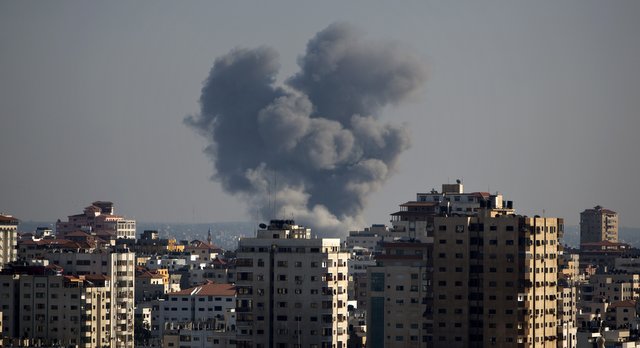
Egypt is a party to the Israeli-Palestinian conflict. It probably has to be part of the solution. But it can’t play the same kind of brokering role that it played in the past.
Source: NPR’s All Things Considered
ROBERT SIEGEL, HOST: Secretary of State John Kerry's mission to Cairo underscores the importance of Egypt in the conflict between Israel and Hamas. Gaza is a coastal strip of land that runs about 30 miles along the Mediterranean. Most of the entry points into it are from Israel, which has closed them. But at its southern end in the city of Rafah, Gaza borders Egypt. Egypt has kept the Rafah crossing closed too and it has cracked down on tunnels used for smuggling into Gaza. Hamas rejected the cease-fire proposal that Egypt made last week as we heard from Hamas spokesman Ihab al-Hussein.
IHAB AL-HUSSEIN: What we saw from the Egyptian initiative - it didn't include what the Palestinians want. It was worse than the agreement in 2012. And I know if the American didn't asked them to make this initiative - they didn't - and they will just continue to watch us getting killed here in Gaza.
SIEGEL: And as former U.S. diplomat Martin Indyk put it, the Egyptians do not want to see Hamas emerge as any kind of a victor from this conflict.
MARTIN INDYK: Hamas is seen as it were the bastard child of the Muslim Brotherhood. And just as the Egyptian regime is strongly opposed to the Muslim Brotherhood, so too are they strongly opposed to Hamas.
SIEGEL: So what might the Egyptians do? And what sort of broker can they be in this conflict? Well, joining us to talk about that is Michele Dunne of the Carnegie Endowment for International Peace. Welcome...
MICHELE DUNNE: Thank you, Robert.SIEGEL: ...To the program. There are fierce battles, airstrikes, Palestinian civilian casualties, more Hamas rocket fire. How does all this look to the government of Egyptian President Sisi?
DUNNE: The most important thing for the Egyptian government is that they don't end up with primary responsibility for Gaza and they don't end up with the Rafah end of Gaza being opened into Egypt. They have a very unstable situation in the Sinai and they don't want people and goods, especially flowing from Gaza, into Egypt. They have cut off and destroyed many of the tunnels that were there and over the last year, they've kept the Egyptian side of the border sealed pretty closely. So that's their main concern here and I'm sure they would like to see Hamas defeated by Israel.
SIEGEL: The Palestinian political scientist Mkhaimar Abusadah, who's based in Gaza City, told me last week that it's not just proximity to Gaza or the Rafah crossing that make Egypt (unintelligible) necessary. Egypt in his words has been in charge of the Palestinians cause since 1948. Does President Sisi or do the Egyptians still see themselves as being in charge of the Palestinians cause?
DUNNE: Egypt has been preoccupied with its domestic affairs for a long time and has played a less active role in the - in Arab politics in general for quite a long time. But even under Hosni Mubarak, as well as under the deposed President Mohamed Morsi, who had come from the Muslim Brotherhood, the Palestinians, including Hamas, viewed Egypt as - let's say evenhanded enough to mediate their disputes - disputes between Hamas and the Palestinian Authority, as well as between Hamas and Israel. All of that changed a year ago since this very harsh crackdown in Egypt on the Muslim Brotherhood. And so what it means is that right now, Egypt is a party to this conflict. It probably has to be part of the solution. But it can't play the same kind of brokering role that it played in the past.
SIEGEL: So when Egypt put out a truce proposal, a cease-fire proposal and Israel instantly accepted and then Hamas rejected - that reflects who trusts whom at this - among those three parties.
DUNNE: Well, the way that cease-fire proposal played out seems to reflect also how the Egyptians played it. Usually in the past, they would broker with both sides of the conflict. It seems as though that this was not coordinated with Hamas at all - that it was coordinated with the Israelis and then announced. And I think, you know, it was an attempt maybe to put Hamas in a corner. Maybe there was a hope that they would be forced to accept it, but Hamas did not. They were still in a position to reject it.
SIEGEL: But as you say, even though another country might be more apt mediators in this case - no matter what happens, Egypt remains a party to the agreement, not just a mediator because it borders Gaza.
DUNNE: That's right. Egypt has something that the Palestinians of Gaza want very much, which is access to the outside world. And frankly, I think they know that the Egyptian side of the border will probably never be as tightly controlled as the Israeli side and therefore they want to make sure they have more than one outlet. They don't want to be completely dependent on Israel for access to the outside world.
SIEGEL: If the problem with Egypt as a mediator is that Hamas just doesn't trust them and the other side of the coin is the Israelis do seem to trust them - what about Turkey and Qatar? Do they enjoy any kind of mutual trust here?
DUNNE: Neither Turkey nor Qatar has particularly good relations with Israel at this point. And Egypt also very much opposes either Turkey or Qatar getting too involved in the mediation and as it were usurping Egypt's role. It perhaps will be more acceptable to Egypt to see the U.N. Secretary-General or the United States playing this role. So it seems for the moment that Qatar is mostly speaking with the Hamas leadership and then these international parties might have to sort of stitch this together between Israel, Hamas, Egypt and to some extent the Palestinian Authority.
SIEGEL: Michele Dunne of the Carnegie Endowment for International Peace - thank you very much for talking with us.
DUNNE: Thank you, Robert.
This interview was originally aired on NPR’s All Things Considered.

Former Nonresident Scholar, Middle East Program
Michele Dunne was a nonresident scholar in Carnegie’s Middle East Program, where her research focuses on political and economic change in Arab countries, particularly Egypt, as well as U.S. policy in the Middle East.
Recent Work



Yasmine Farouk, Nathan J. Brown, Maysaa Shuja Al-Deen, …
Robert Springborg, Emile Hokayem, Becca Wasser, …
Carnegie does not take institutional positions on public policy issues; the views represented herein are those of the author(s) and do not necessarily reflect the views of Carnegie, its staff, or its trustees.

The books, podcasts, and films that explain the world it made.

Andrew Leber
U.S. trading partners in Asia are closely watching the dispute for signs of how it may affect their own interests.
Barbara Weisel

The aftermath of the Ceuta crisis shows Europe has drawn the wrong lessons. Rather than doubling down on failed migration policies, the EU needs to address the underlying roots of such episodes.

Richard Youngs
By abandoning past U.S. pro-democracy policies and adopting several lines of pro-autocratic action, the Trump administration has fundamentally repositioned the United States vis-à-vis democracy in the world.

Thomas Carothers
Chinese strategists are once again debating whether American power is declining and whether U.S. hegemony is experiencing irreversible decay.
Wu Xinbo