

Commentary
Dmitri Trenin
{
  "authors": [
    "Dmitri Trenin"
  ],
  "type": "legacyinthemedia",
  "centerAffiliationAll": "",
  "centers": [
    "Carnegie Endowment for International Peace",
    "Carnegie Russia Eurasia Center"
  ],
  "collections": [],
  "englishNewsletterAll": "",
  "nonEnglishNewsletterAll": "",
  "primaryCenter": "Carnegie Russia Eurasia Center",
  "programAffiliation": "",
  "programs": [],
  "projects": [],
  "regions": [
    "North America",
    "United States",
    "Russia",
    "Eastern Europe",
    "Ukraine",
    "Western Europe"
  ],
  "topics": [
    "Security",
    "Military",
    "Foreign Policy"
  ]
}
Source: Getty
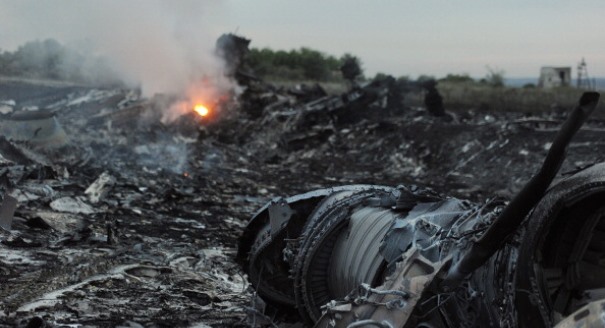
An independent inquiry into the Malaysia Airlines plane crash over eastern Ukraine and an immediate ceasefire by all sides could be the first step in a process to reverse the trend toward mutual destruction within Ukraine and beyond.
Source: Guardian
President Barack Obama, in his televised address on Friday, called for a careful investigation into the downing of the Malaysia Airlines MH17 plane over eastern Ukraine. He left little doubt, however, as to whom he and the US government considered responsible. The Malaysian plane was hit by an air defence missile, he said, fired from the territory held by rebels backed and armed by Russia.
Russian president Vladimir Putin, addressing senior government officials last Thursday, put the responsibility for the loss of almost 300 innocent lives on the government of Ukraine. Had there been peace in Ukraine, or at least, had there been no resumption of fighting recently in the Donbass region, this tragedy would have never occurred. Putin's general comment, however, was not accompanied by any specific accusation. Instead both Putin and the Russian foreign minister, Sergei Lavrov, insisted on a thorough international investigation.
It appears likely at this point that the Malaysian plane was shot down by a missile fired by the system known in Nato as SA-11 and designated "Buk" in the Soviet Union, which developed and produced it. These medium-range air defence systems are now owned by both Russia and Ukraine. The separatist "Donetsk People's Republic" denies that it has any, but both Ukrainian and US officials believe such systems have been transferred to it from Russia.The Russian defence ministry, for its part, points the finger at the Ukrainian armed forces, saying that they have deployed Buk systems in the parts of Donbass which Kiev controls. While Ukrainian and western experts note that the separatists have recently downed several Ukrainian military aircraft, including transport planes, and suggest that they may have mistaken the Malaysian Boeing for a Ukrainian IL-76, Russian experts point to Ukraine possibly preparing to shoot down Russian aircraft in case of a war between the two countries, and "pushing the wrong button" while practising. Indeed, many in Kiev a week ago believed that 15 or 16 July would be the date of a large-scale Russian military invasion of Ukraine.
Each side bases its theories on historical analogies. For many in the west old enough to remember the cold war, the nearest parallel is to the downing of the Korean Air Lines Flight KAL007 by a Russian fighter jet off Sakhalin in 1983. For many in Russia, a more pertinent case is the shooting of the Siberia Airlines flight from Tel Aviv to Novosibirsk in 2001 by a Ukrainian S-200 missile fired during an exercise in Crimea.
There is also a mutual history of denial. It took the Soviet Union several days to admit to having shot down a passenger jet – which the Soviet military took for a US military reconnaissance plane. The Ukrainians, despite a very different environment, balked at admitting their responsibility, despite the massive evidence, pointing out that the missile itself was never found. The former Ukrainian president, Leonid Kuchma, in remarks played again and again on Russian television during the past few days, also sought to minimise the importance of what had occurred, saying something along the lines of: "Stuff happens."
Because so many people from several countries aboard MH17 were senselessly killed, an international investigation is an absolute priority. Russia insists on it, it says – both as a means to calm down anti-Russian emotions, which are running very high, and as a means to establish all the relevant facts. One may infer from Putin's words that the context is as important, if not more, than the actual firing of the missile. The investigation will not prove easy for a number of reasons, including the failure to close off the area immediately after the crash and the overall security and political situation in the Donetsk region. However, it should not be limited to the site of the crash and should examine data reflecting the activities of relevant military groups in both Ukraine and Russia.
The MH17 tragedy raises the wider issue of responsibility in armed conflicts. If, indeed, the missile that downed the Malaysian airliner has been fired by the rebels supported by Russia, Moscow will not escape its share of the blame. It has been giving various kinds of support – political, moral, and material – to militants fighting the elected authority in Kiev. It has also been in constant contact with the leaders of the self-proclaimed republics. If it becomes established that it provided them with the Buk system which downed the passenger plane, the self-inflicted blow to Russia's international position in the west and Asia will be enormous. Moscow would have to accept full responsibility for placing powerful weaponry in the hands of a non-state actor, and exercising no control over its use.
The context which Putin focuses upon is no less important, however. The west fully supports a Ukrainian government which originated from a revolution that toppled an elected – if obviously corrupt – president. True, the new president, Petro Poroshenko, has a solid popular mandate. Yet the referendums held in Donetsk and Luhansk two weeks prior to the presidential poll – and no less illegal than the Maidan revolution in Kiev – reflected a very high degree of dissatisfaction in eastern Ukraine with the deal they were getting from central government.
The legitimacy of the "people's republics" is questionable, of course, but the Ukrainian government's "anti-terrorist operation", resulting in an ever-rising toll of civilian lives, does not do much to endear Kiev to the easterners. The west's tendency to treat one's allies more leniently than one's adversaries – while sticking to the same high principles throughout – can and does backfire.
In Ukraine, a lot is at stake today. First, for the Ukrainians themselves, wherever they may live. The fate of their country remains in the balance – not just because of the armed conflict in the east, but as a result of the dire economic situation and an uncertain political future. Russia, too, is profoundly affected. Having clashed with the United States over Ukraine, it is now facing increasingly serious consequences in a number of areas – above all, in economy and finance.
For Europe, Ukraine represents a security risk far higher than the one it faced in the Balkans in the 1990s. In the US, Russia may have come to be seen as a nasty nuisance rather than a worthy competitor or a real threat. Yet there is an impression that the punishment already administered is not supported by a realistic strategy leading to a credible goal. If so, it could lead to a very different outcome from the one that the US might desire.
Outwardly, Presidents Obama and Putin are united in the need for an independent inquiry and for an immediate ceasefire by all sides in Ukraine. This should be the basis for an approach that could possibly reverse the trend toward mutual destruction within Ukraine and beyond.
The verdict of the investigation should not be pre-judged, and, once pronounced, should be accepted. A ceasefire, monitored by the Organisation for Security and Co-operation in Europe, needs to be followed up by an inclusive political process aimed at establishing a proper place and role for all Ukrainian regions in a united Ukrainian state.
The Contact Group, a forum which includes Europeans and Russians, should help steer that process. If there is political progress, the EU and Russia should start a dialogue on their economic relations with Ukraine, and possible assistance for it. Joint and shared responsibility should be the guiding principle. There is an alternative, of course. It is so obvious – and so obviously horrific – that it hardly needs to be spelled out.
Former Director, Carnegie Moscow Center
Trenin was director of the Carnegie Moscow Center from 2008 to early 2022.
Recent Work
Dmitri Trenin
Dmitri Trenin
Carnegie does not take institutional positions on public policy issues; the views represented herein are those of the author(s) and do not necessarily reflect the views of Carnegie, its staff, or its trustees.
If it proves impossible for the Russian authorities to avoid a gasoline deficit, the question then becomes how they will organize the distribution of a scarce resource.

Sergey Vakulenko
This year’s wars have made alternative routes to transit through Russia no less risky for Central Asian countries.

Galiya Ibragimova
By burying disagreements in imprecision, the new deal risks same fate as its predecessors.

James M. Acton
The United States and Israel may have unwittingly revived the Islamic Republic’s “zombie regime.”



Suzanne Maloney, Aaron David Miller, Karim Sadjadpour
Natural disasters are no longer local incidents but sources of systemic risk that threaten vital infrastructure and the economy—and public support for international engagement.

Leonardo Martinez-Diaz