• Research
  • Emissary
  • About
  • Experts
Carnegie Global logoCarnegie lettermark logo
DemocracyIran
  • Donate
{
  "authors": [
    "James M. Acton",
    "Catherine Dill",
    "Jeffrey Lewis"
  ],
  "type": "legacyinthemedia",
  "centerAffiliationAll": "dc",
  "centers": [
    "Carnegie Endowment for International Peace",
    "Carnegie Russia Eurasia Center"
  ],
  "collections": [],
  "englishNewsletterAll": "ctw",
  "nonEnglishNewsletterAll": "",
  "primaryCenter": "Carnegie Endowment for International Peace",
  "programAffiliation": "NPP",
  "programs": [
    "Nuclear Policy"
  ],
  "projects": [],
  "regions": [
    "East Asia",
    "China"
  ],
  "topics": [
    "Nuclear Policy"
  ]
}

Source: Getty

In The Media

Crashing Glider, Hidden Hotspring

On August 7, China conducted a test of a hypersonic weapon. Open-source information about what happened that day in a remote part of Inner Mongolia allows for a few observations.

Link Copied
By James M. Acton, Catherine Dill, Jeffrey Lewis
Published on Sep 4, 2014
Program mobile hero image

Program

Nuclear Policy

The Nuclear Policy Program aims to reduce the risk of nuclear war. Our experts diagnose acute risks stemming from technical and geopolitical developments, generate pragmatic solutions, and use our global network to advance risk-reduction policies. Our work covers deterrence, disarmament, arms control, nonproliferation, and nuclear energy.

Learn More

Source: Arms Control Wonk

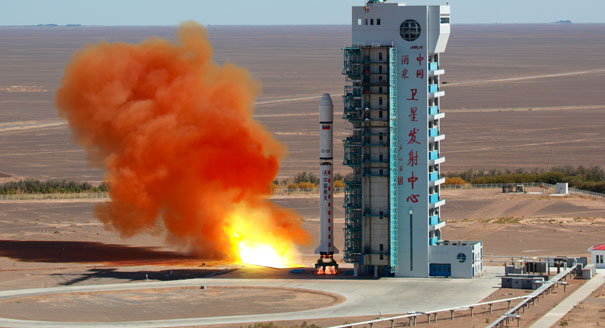
By a lake in an Inner Mongolian desert, about 200 km south-east of Ordos—the oft-described ghost city that hosted the Miss World contest in 2012—lies a Chinese resort called the Bulong Hu Hot Springs Resort (布龙湖温泉度假区). On August 7, at about 11am, tourists in the resort were presumably doing what tourists at a lake-side spa do. Maybe a young couple from Beijing was soaking in the hot springs, enjoying a luxurious end to a hot and dusty trek around Inner Mongolia. Perhaps a retiree from Ordos, bored of watching Miss World highlights on Good Morning Ordos, was enjoying the relative excitement of fishing on the lake. Maybe a shepherd was grazing his sheep in the cultivated land just outside the resort. What we can safely assume is that none of them knew what was, almost literally, about to hit them.

The noise—a thundering crash—must have been the first terrifying indication of what had happened. Fortunately, we don’t have to speculate about what they saw because some of them photographed it: huge clouds of red smoke billowing up from the desert. Someone even got near enough to the crash site to take photos of it. Even to his or her (presumably) untrained eye, it must have been clear that the debris littering the area was from some sort of a rocket.

These cell phone images appeared online almost immediately. However, they seem to have been suppressed and quickly vanished from the Chinese websites where they first appeared.  But this is the internet, so nothing can be deleted.

Almost immediately, Chinese internet sources connected the rocket with a test of what the Pentagon calls the WU-14—a hypersonic glider, launched by a rocket, that China is known to have tested at least once before, in January 2014. (Technically, the term “WU-14” probably refers to the whole package of booster and glider, but it’s become the glider’s de-facto name).

Bill Gertz, of the Washington Free Beacon, picked up on these rumors and on, August 19, published a somewhat alarmist article, which appears to have been largely based on Chinese internet sources—although he also reported that two anonymous U.S. officials had confirmed that the test did involve the WU-14. Three days later, the South China Morning Post reported that the test was a failure. Chinese internet sources had said the same thing but Gertz did not, implying that such debris was to be expected.

It turns out that there is a wealth of open-source information about the August 7 test. It has allowed us to find the exact location of the crash site, and to make several important observations about what happened that day in a remote part of Inner Mongolia: the WU-14 hypersonic vehicle was almost certainly tested, but the test was probably a failure. More generally, our analysis indicates that the Chinese hypersonic glider program is probably significantly less ambitious than the U.S. Advanced Hypersonic Weapon—a U.S. hypersonic glider that was tested 18 days after the WU-14 and also failed.

Read the full article on Arms Control Wonk.

About the Authors

James M. Acton

Jessica T. Mathews Chair, Co-director, Nuclear Policy Program

Acton holds the Jessica T. Mathews Chair and is co-director of the Nuclear Policy Program at the Carnegie Endowment for International Peace.

Catherine Dill

Jeffrey Lewis

Authors

James M. Acton
Jessica T. Mathews Chair, Co-director, Nuclear Policy Program
James M. Acton
Catherine Dill
Jeffrey Lewis
Nuclear PolicyEast AsiaChina

Carnegie does not take institutional positions on public policy issues; the views represented herein are those of the author(s) and do not necessarily reflect the views of Carnegie, its staff, or its trustees.

More Work from Carnegie Endowment for International Peace

  • Shipping port at dawn from above
    Commentary
    Emissary
    The U.S. Export-Import Bank Was Built for a Different Era. Here's How to Fix It.

    Five problems—and solutions—to make it actually work as a tool of great power competition.

      • Afren Akhter

      Afreen Akhter

  • Article
    Leveraging Internal Security Cooperation with Vietnam Offers a Glimpse of Future Chinese Diplomacy with Southeast Asia

    Despite long-standing differences, China and Vietnam are reinforcing common ground for collaboration, especially in public security. This internal security–centered diplomacy offers a strengthened road map for how China moves forward with Southeast Asia.

      Sophie Zhuang

  • A demonstrator holds a tablet displaying a message as they occupy a road in protest against plans by the main opposition Kuomintang (KMT) and the Taiwan People's Party (TPP) to expand the parliamentary powers during the vote for the Parliament reform bill, outside the Parliament in Taipei on May 24, 2024. T
    Article
    Digital Hegemony and the Reification of Taiwan’s “Unification-Independence” Dichotomy

    Governments now deploy online platforms to shape public opinion and influence collective cognition. This is acutely apparent between China and Taiwan.

      • An Asian man with glasses wearing a sky blue collared shirt and black sweater stands in front of a statue of an antelope with a city skyline in the background

      Frank Cheng-Shan Liu

  • Commentary
    China’s Energy Security Doesn’t Run Through Hormuz but Through the Electrification of Everything

    Across Asia, China is better positioned to withstand energy shocks from the fallout of the Iran war. Its abundant coal capacity can ensure stability in the near term. Yet at the same time, the country’s energy transition away from coal will make it even less vulnerable during the next shock.


      • Damien Ma

      Damien Ma

  • Commentary
    Emissary
    In Its Iran War Debate, Washington Has Lost the Plot in Asia

    The United States ignores the region’s lived experience—and the tough political and social trade-offs the war has produced—at its peril.

      Evan A. Feigenbaum

Get more news and analysis from
Carnegie Endowment for International Peace
Carnegie global logo, stacked
1779 Massachusetts Avenue NWWashington, DC, 20036-2103Phone: 202 483 7600Fax: 202 483 1840
  • Research
  • Emissary
  • About
  • Experts
  • Donate
  • Programs
  • Events
  • Blogs
  • Podcasts
  • Contact
  • Annual Reports
  • Careers
  • Privacy
  • For Media
  • Government Resources
Get more news and analysis from
Carnegie Endowment for International Peace
© 2026 Carnegie Endowment for International Peace. All rights reserved.