

In The Media
Lina Khatib
{
  "authors": [
    "Lina Khatib"
  ],
  "type": "legacyinthemedia",
  "centerAffiliationAll": "dc",
  "centers": [
    "Carnegie Endowment for International Peace",
    "Malcolm H. Kerr Carnegie Middle East Center"
  ],
  "collections": [],
  "englishNewsletterAll": "menaTransitions",
  "nonEnglishNewsletterAll": "",
  "primaryCenter": "Malcolm H. Kerr Carnegie Middle East Center",
  "programAffiliation": "MEP",
  "programs": [
    "Middle East"
  ],
  "projects": [],
  "regions": [
    "Gulf",
    "Levant",
    "Syria",
    "Iraq",
    "Middle East"
  ],
  "topics": [
    "Political Reform",
    "Security",
    "Foreign Policy"
  ]
}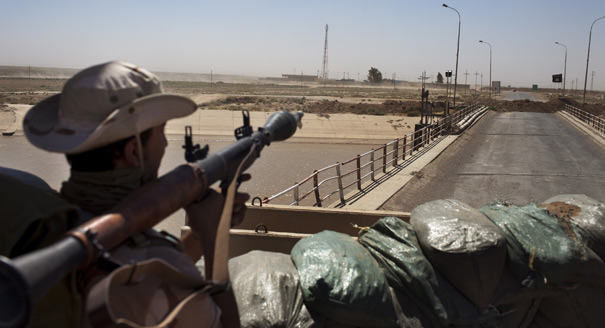
Source: Getty
If Obama’s strategy to defeat the Islamic State is to work, the Saudis and Iranians must cooperate.
Source: ABC Radio National’s Late Night Live
Speaking on ABC Radio National’s Late Night Live, Carnegie’s Lina Khatib discussed U.S. President Obama’s strategy speech to defeat the Islamic State. Khatib said that “the speech marked a significant turn in U.S. foreign policy towards the Syrian conflict, because this is the first time that we’ve seen declaration of intention on part of the United States to engage in this conflict militarily.” Khatib added that the speech was also very positive, because Obama stated that Arab countries “are also responsible for taking part in securing the region against Islamism with international cooperation.”
Khatib pointed out that Obama spoke about a broad coalition, leaving the door open for Iranian involvement further down the line. She clarified that back channel talks had been already taking place between Saudi Arabia and Iran, which are driven by the shared concern over the Islamic State—an enemy to both countries. However, Khatib continued, “we don’t know what the nature of compromise or cooperation between Saudi Arabia and Iran might be. However...I think we can expect to see Iranian involvement—whether direct or indirect—sometime in the future.”
Khatib concluded that Obama’s campaign against the Islamic State would be a long-term campaign. “Had the United States intervened diplomatically very early on in the Syrian uprising ,” said Khatib, “we would not be where we are right now. However, speaking pragmatically, the speech and strategy that’s presented is certainly better than the alternative, which is doing nothing and allowing Syria to fall back into the hands of the Islamic State and the Assad regime and expand further in Iraq.”
This interview was originally broadcasted on ABC Radio National’s Late Night Live.
Former Director, Middle East Center
Khatib was director of the Carnegie Middle East Center in Beirut. Previously, she was the co-founding head of the Program on Arab Reform and Democracy at Stanford University’s Center on Democracy, Development, and the Rule of Law.
Recent Work
Lina Khatib
Lina Khatib
Carnegie does not take institutional positions on public policy issues; the views represented herein are those of the author(s) and do not necessarily reflect the views of Carnegie, its staff, or its trustees.

The books, podcasts, and films that explain the world it made.

Andrew Leber

U.S. trading partners in Asia are closely watching the dispute for signs of how it may affect their own interests.
Barbara Weisel

The aftermath of the Ceuta crisis shows Europe has drawn the wrong lessons. Rather than doubling down on failed migration policies, the EU needs to address the underlying roots of such episodes.

Richard Youngs
By abandoning past U.S. pro-democracy policies and adopting several lines of pro-autocratic action, the Trump administration has fundamentally repositioned the United States vis-à-vis democracy in the world.

Thomas Carothers
Chinese strategists are once again debating whether American power is declining and whether U.S. hegemony is experiencing irreversible decay.
Wu Xinbo