

Paper
Yezid Sayigh
{
  "authors": [
    "Yezid Sayigh"
  ],
  "type": "legacyinthemedia",
  "centerAffiliationAll": "dc",
  "centers": [
    "Carnegie Endowment for International Peace",
    "Malcolm H. Kerr Carnegie Middle East Center"
  ],
  "collections": [],
  "englishNewsletterAll": "menaTransitions",
  "nonEnglishNewsletterAll": "",
  "primaryCenter": "Malcolm H. Kerr Carnegie Middle East Center",
  "programAffiliation": "MEP",
  "programs": [
    "Middle East"
  ],
  "projects": [],
  "regions": [
    "Levant",
    "Syria",
    "Middle East"
  ],
  "topics": [
    "Political Reform",
    "Security",
    "Foreign Policy"
  ]
}
Source: Getty
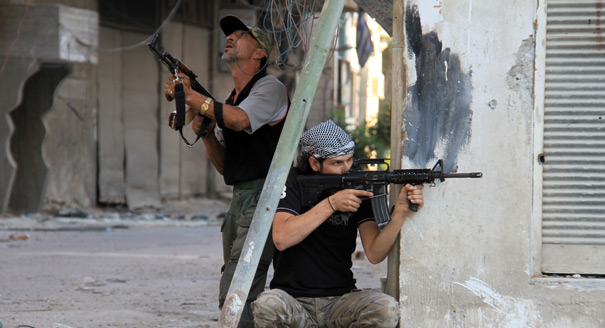
U.S.-led air raids have struck Syrian rebels not linked to the Islamic State, expanding the coalitions raids for the second time to other groups fighting in Syria, including Ahrar al-Sham and the Nusra Front.
Source: Al Jazeera English
The United States coalition has targeted two powerful al-Qaeda related groups in Syria, Nusra Front and Ahrar al-Sham in Aleppo and in Idlib province in the northwest of Syria. It is the second time groups other than the Islamic State have been hit by the coalition, as the Nusra Front has been making headway in Idlib in the past week, pushing U.S.-supported rebel groups from their stronghold in the province.
Speaking on Al Jazeera English, Carnegie’s Yezid Sayigh said that “if the situation is not brought under control, Nusra Front potentially could end up controlling at least one—if not both—of the last two border crossings open to the moderate opposition into Turkey, through which they receive the flow of recruits, trainees, weapons and munitions, and international humanitarian assistance. Everything that the liberated areas rely on now, that is based in Turkey, works through these two border crossings.”

Senior Fellow, Malcolm H. Kerr Carnegie Middle East Center
Yezid Sayigh is a senior fellow at the Malcolm H. Kerr Carnegie Middle East Center in Beirut, where he leads the program on Civil-Military Relations in Arab States (CMRAS). His work focuses on the comparative political and economic roles of Arab armed forces, the impact of war on states and societies, the politics of postconflict reconstruction and security sector transformation in Arab transitions, and authoritarian resurgence.
Recent Work
Yezid Sayigh
Yezid Sayigh
Carnegie does not take institutional positions on public policy issues; the views represented herein are those of the author(s) and do not necessarily reflect the views of Carnegie, its staff, or its trustees.

It should address the shortcomings of previous crisis communication efforts and adapt to the demands of frontier AI.

Lucy Luo

If the Russian-speaking community in Latvia cannot articulate their interests without being seen as disloyal, they could end up embracing a pro-Kremlin agenda.

Sergejs Potapkins
The Zaidi government’s objective to collect weapons is constrained by regional conflict, but it can take certain measures at home.
Ali Al-Mawlawi

Washington’s decision to support some UN functions while letting others wither is pulling the organization apart at the seams.

Stewart Patrick, Theodore Zaritsky

Are Germany’s economic, industrial, and political struggles becoming a liability for the EU’s ability to rise to the geopolitical moment?

Rym Momtaz, ed.