

Article
C. Raja Mohan, Darshana M. Baruah
{
  "authors": [
    "C. Raja Mohan"
  ],
  "type": "legacyinthemedia",
  "centerAffiliationAll": "dc",
  "centers": [
    "Carnegie Endowment for International Peace",
    "Carnegie India"
  ],
  "collections": [],
  "englishNewsletterAll": "ctw",
  "nonEnglishNewsletterAll": "",
  "primaryCenter": "Carnegie India",
  "programAffiliation": "SAP",
  "programs": [
    "South Asia"
  ],
  "projects": [],
  "regions": [
    "South Asia",
    "India",
    "North America",
    "United States"
  ],
  "topics": [
    "Domestic Politics",
    "Foreign Policy",
    "Political Reform"
  ]
}
Source: Getty
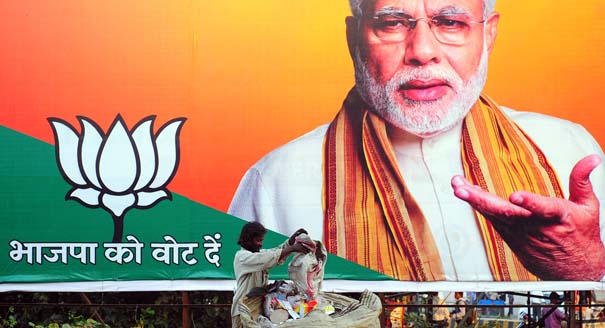
Prime Minister Narendra Modi is changing the nature of India’s world view, recasting its self-image, and altering the character of its diplomacy.
Source: Indian Express
In serenading US President Barack Obama at the Republic Day celebrations and unveiling some break-through agreements, Prime Minister Narendra Modi is changing the nature of India’s world view, recasting its self-image and altering the character of its diplomacy.
Modi’s bet on discarding the entrenched domestic political skepticism about America is about to pay off, as senior officials from the two sides dot the i’s and cross the t’s on a range of bilateral agreements from civil nuclear cooperation to climate change to defence cooperation.
In imagining a comprehensive partnership with the US, Modi is departing from the Indian self-perception as a weak Third World nation that is afraid of engaging America. Modi, in contrast, wants Delhi to see itself as an emerging power and deal with Washington with self-assurance.If the UPA government panicked at the thought of America assisting India’s rise to great power status, Modi wants to test the seriousness of American intent. As he articulates India’s strategic ambitions, Modi would like Obama to endorse them explicitly.
Knee-jerk anti-Americanism that has long animated India’s traditional elites no longer resonates with the new generation of Indians who have grown up in the era of economic reform and globalisation.
Much in the manner that Deng Xiaoping altered China’s destiny by partnering America in the late 1970s, Modi believes an American connection is critical for transforming India’s economy and international standing.
If the UPA government’s mismanagement of the nuclear liability legislation created a huge problem for the future of India’s nuclear power programme, it did not seem to have the political resolve or the diplomatic skill to get around it. Modi is now on the cusp of removing the last obstacles for the expansion of the nuclear power programme and completing the integration of India into the global nuclear order.
The emerging prospect for greater cooperation between India and the US on the contentious question of climate change is again a consequence of Modi’s readiness to innovate. Conscious of India’s growing isolation in the international forums on climate change, and recognising the need to urgently address the emerging environmental crisis at home, Modi has looked for win-win solutions that could be outlined on Sunday.
On defence, Modi has seen the long-standing American offers of cooperation as a means to expand India’s high technology industrial base, improve India’s ability to shape the Asian balance of power and expand its leverage with other powers in the region.
Like Prime Minister Indira Gandhi, who did not let the shibboleths of non-alignment come in the way of a strategic partnership with the Soviet Union in the 1970s, Modi is not going to allow ideological slogans come in the way of India’s security calculus.
This article was originally published in the Indian Express.
Former Nonresident Senior Fellow, Carnegie India
A leading analyst of India’s foreign policy, Mohan is also an expert on South Asian security, great-power relations in Asia, and arms control.
Recent Work

C. Raja Mohan, Darshana M. Baruah


Alexander Gabuev, Paul Haenle, C. Raja Mohan, …
Carnegie does not take institutional positions on public policy issues; the views represented herein are those of the author(s) and do not necessarily reflect the views of Carnegie, its staff, or its trustees.
The EU had to compromise to adopt a twenty-first sanctions package against Russia, exposing growing cracks in the union’s resolve. Is this latest, weaker round worth it to keep pressure on Moscow?

Rym Momtaz, ed.

Two divergent trends—Putin’s hardline vision of how to prosecute the war in Ukraine, and a growing desire for change in Russia—could tear the regime apart.

Tatiana Stanovaya
Ultimately, Zelensky sided neither with the reform camp nor with the military establishment as such, but with political control.

Balázs Jarábik
Despite the agreement’s uncertainty, it’s still a significant development in regional and nuclear policy.


Andrew Leber, Jane Darby Menton
His challenge will come in balancing domestic priorities with a sharpening geopolitical environment.


Luke Cavanaugh, Scott Singer