• Research
  • Emissary
  • About
  • Experts
Carnegie Global logoCarnegie lettermark logo
DemocracyIran
  • Donate
{
  "authors": [
    "Judy Dempsey"
  ],
  "type": "legacyinthemedia",
  "centerAffiliationAll": "dc",
  "centers": [
    "Carnegie Endowment for International Peace",
    "Carnegie Europe"
  ],
  "collections": [],
  "englishNewsletterAll": "ctw",
  "nonEnglishNewsletterAll": "",
  "primaryCenter": "Carnegie Europe",
  "programAffiliation": "EP",
  "programs": [
    "Europe"
  ],
  "projects": [],
  "regions": [
    "Europe",
    "Western Europe",
    "Germany",
    "Iran"
  ],
  "topics": [
    "EU",
    "Security"
  ]
}
Source: Getty

In The Media
Carnegie Europe

Pegida Goes Europe: Fear Is the Key

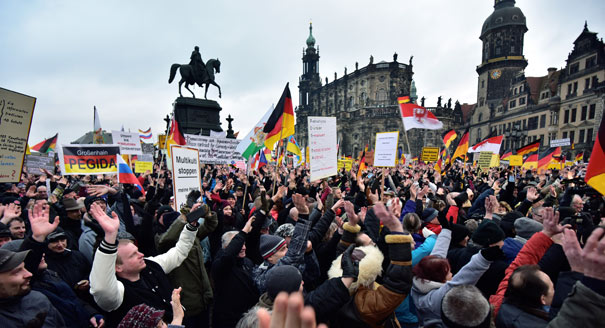
The Pegida movement has awoken Germany, but Islamophobia is a Europe-wide phenomenon whose roots lie in the alienation of citizens from politics.

Link Copied
By Judy Dempsey
Published on Jan 22, 2015
Program mobile hero image

Program

Europe

The Europe Program in Washington explores the political and security developments within Europe, transatlantic relations, and Europe’s global role. Working in coordination with Carnegie Europe in Brussels, the program brings together U.S. and European policymakers and experts on strategic issues facing Europe.

Learn More

Source: Deutsche Welle

Speaking to Deutsche Welle’s Quadriga, Judy Dempsey argued that the Pegida movement of “Patriotic Europeans against the Islamization of the West” has awoken German society.

“The public space is changing in Germany,” warned Judy Dempsey. “Germany is not unique. . . . There is the fear of the other, the fear of the foreigner. . . . This is a European phenomenon.” In fact, Germany is only the latest country in Europe to tap into the surrounding atmosphere of Islamophobia.

As for the underlying causes of this surge, Dempsey explained that one of the problems is that “with the bureaucratization of politics and globalization, the feeling of identity between politicians and citizens is widening.” The mainstream political parties “haven’t adapted to the postmodernization of Europe, to globalization, and to [the need to] adapt policies and politics to society and its citizens.” The question of alienation between the state, political parties, and society is one of Europe’s biggest problems today.

This broadcast was originally aired on Deutsche Welle.

About the Author

Judy Dempsey

Nonresident Senior Fellow, Carnegie Europe

Dempsey is a nonresident senior fellow at Carnegie Europe

    Recent Work

  • Commentary
    Europe Needs to Hear What America is Saying

      Judy Dempsey

  • Commentary
    Babiš’s Victory in Czechia Is Not a Turning Point for European Populists

      Judy Dempsey

Judy Dempsey
Nonresident Senior Fellow, Carnegie Europe
Judy Dempsey
EUSecurityEuropeWestern EuropeGermanyIran

Carnegie does not take institutional positions on public policy issues; the views represented herein are those of the author(s) and do not necessarily reflect the views of Carnegie, its staff, or its trustees.

More Work from Carnegie Endowment for International Peace

  • Trump and Netanyahu speaking
    Commentary
    Emissary
    The Diverging U.S. and Israeli Goals in Iran Are Making the Endgame Even Murkier

    The cracks between Trump and Netanyahu have become more pronounced, particularly over energy and leadership targets.

      • Eric Lob

      Eric Lob

  • Seoul traffic at night
    Commentary
    Emissary
    How the Hormuz Closure Is Testing the Korean President’s Progressive Agenda

    The crisis is not just a story of energy vulnerability. It’s also a complex, high-stakes political challenge.

      Darcie Draudt-Véjares

  • Commentary
    Diwan
    What Does the Strait of Hormuz’s Closure Mean?

    In an interview, Roger Diwan discusses where the global economy may be going in the third week of the U.S.-Israeli war with Iran.

      Nur Arafeh

  • Commentary
    Strategic Europe
    Russia’s Imperial Retreat Is Europe’s Strategic Opportunity

    The war in Ukraine is costing Russia its leverage overseas. Across the South Caucasus and Middle East, this presents an opportunity for Europe to pick up the pieces and claim its own sphere of influence.

      William Dixon, Maksym Beznosiuk

  • apan's Prime Minister Sanae Takaichi (L) reacts as US President Donald Trump delivers a speech in front of US Navy personnel on board the US Navy's USS George Washington aircraft carrier at the US naval base in Yokosuka on October 28, 2025.
    Article
    Takaichi’s Security Agenda After the Landslide Election

    Backed by a new LDP supermajority, Prime Minister Takaichi aspires to revise Japan’s long-standing security doctrine. Ahead of her visit to Washington, she faces fiscal hurdles for her proposed defense spending while needing to navigate President Trump’s request for naval assets to the Strait of Hormuz.

      • Harukata Takenaka

      Harukata Takenaka

Get more news and analysis from
Carnegie Endowment for International Peace
Carnegie global logo, stacked
1779 Massachusetts Avenue NWWashington, DC, 20036-2103Phone: 202 483 7600Fax: 202 483 1840
  • Research
  • Emissary
  • About
  • Experts
  • Donate
  • Programs
  • Events
  • Blogs
  • Podcasts
  • Contact
  • Annual Reports
  • Careers
  • Privacy
  • For Media
  • Government Resources
Get more news and analysis from
Carnegie Endowment for International Peace
© 2026 Carnegie Endowment for International Peace. All rights reserved.