

Report
- +3
James M. Acton, Alexey Arbatov, Vladimir Dvorkin, …
{
  "authors": [
    "Petr Topychkanov"
  ],
  "type": "legacyinthemedia",
  "centerAffiliationAll": "",
  "centers": [
    "Carnegie Endowment for International Peace",
    "Carnegie Russia Eurasia Center"
  ],
  "collections": [],
  "englishNewsletterAll": "",
  "nonEnglishNewsletterAll": "",
  "primaryCenter": "Carnegie Russia Eurasia Center",
  "programAffiliation": "",
  "programs": [],
  "projects": [],
  "regions": [
    "North America",
    "United States",
    "Russia"
  ],
  "topics": [
    "Security",
    "Military",
    "Foreign Policy",
    "Nuclear Policy",
    "Arms Control",
    "Global Governance"
  ]
}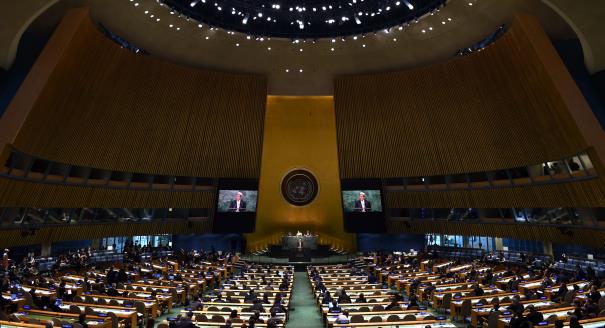
Source: Getty
Russia is unlikely to withdraw from the INF Treaty any time soon, because Moscow believes that the negative effects of a withdrawal would be greater than any potential benefits.
Source: European Leadership Network
We should not be misled by President Vladimir Putin’s special message to the participants of the 2015 Review Conference of the Nuclear Non-Proliferation Treaty. Russia did not try to have a strong voice at the conference, as proven by the level of the Russian representation. The delegation was led by Mikhail Ulyanov, who has a diplomatic rank of minister extraordinary and plenipotentiary and is a director of the Department for non-proliferation and arms control at the Russian Ministry of Foreign Affairs.
In comparison to the ministerial or ambassadorial level of many representatives of other states at the conference, Russia’s unwillingness to send a minister, deputy minister or an ambassador stands out. Whatever the reasons behind the decision to make Mr. Ulyanov an acting head of the Russian delegation, it looked as if the Russian high-level officials were avoiding attending this particular conference.
Despite the fact that Russia decided to limit its presence at the 2015 NPT RevCon, the conference was still used by the Russian side to deliver a message from Moscow. The overall message, in short, is that Russia is in full adherence to its commitments under the NPT. But, for two reasons, the most interesting part of the message was related to the continued relevance of the INF Treaty. The first reason is the issue of the alleged violations of this treaty by Russia, made public by the United States last summer, regarding probable testing, producing, and possessing ground-based cruise missiles with the range of 500 to 5,500 km. Already after the end of the 2015 NPT RevCon, the State Department published the 2015 edition of the report “Adherence to and Compliance with Arms Control, Nonproliferation, and Disarmament Agreements and Commitments,” which repeated these allegations one more time.The second reason why the Russian position on the INF Treaty was intriguing was a number of statements by high-level Russian officials regarding the possibility of Russia’s withdrawal from the Treaty. The last of these statements was made by Chairman of the Federation Council's Defense and Security Committee Viktor Ozerov, who said that "Russia has enough strength and means for an adequate response (to the probable deployment of the U.S. missiles in Eastern Europe – P.T.) – starting from the withdrawal from the INF Treaty and deploying "Iskanders" along our Western borders". Though this statement did not make clear what kind of missiles the United States was planning to deploy in Europe, Senator Ozerov was probably referring to the interceptors of the ballistic missile defense system installations in Romania.
In contradiction to the U.S. allegations and regardless of some Russian officials’ statements, the Russian position on the INF Treaty was very clearly pronounced at the 2015 NPT RevCon: “The Treaty is still in force. It remains an important factor of maintaining international security and strategic stability. The Russian Federation remains committed to the Treaty and fully complies with its obligations.” Was it a Russian attempt to calm the international community, concerned about the future of the INF Treaty? Or was it an attempt by Moscow to do business as usual and covertly impose new rules of European and global security?
These explanations could not reflect the reality behind the Russian position on the INF Treaty. If the INF Treaty ceases to be in the national security interest of Russia, Russia will undoubtedly decide to withdraw. After all, the United States decided to withdraw from the ABM Treaty when this decision was seen as essential for the national security of this country. This however, is not yet the case. Neither the U.S. allegations nor statements coming from Russia should make us think that Russia plans to withdraw from the INF Treaty any time soon. Moscow’s strategic calculations are that today the negative effects from its withdrawal from the INF Treaty would be greater than any benefits from this decision. The action-reaction chain, initiated by such a decision, would lead to growing missile threats to Russia in Europe and to further erosion of the arms control regime, if not its total destruction, which is not in Moscow’s interest. For the United States, Russia’s withdrawal from the INF Treaty would mean the removal of a ban to deploy its nuclear missiles of medium range in Europe, since there would be no reason to continue to abide by the Treaty. These calculations explain the Russian statement at the 2015 NPT RevCon about its commitment to the INF.
There is no reason to believe that this assessment will be changed even after the planned deployment of the U.S. missile defence interceptors in Romania, even though it will pose a serious security challenge for Russia (primarily from a political viewpoint, and only secondarily from a military one). Russia has two ways of reacting to further development of the European part of the U.S. ballistic missile defense system. The first way is to upgrade its BMD suppression capabilities. According to Academician Yuri Solomonov, one of the leading missiles engineers in Russia, new land- and sea-based IBMs of Russia can suppress any current or project missile defense systems of any country. The second way is to seek an agreement between Russia and the United States on confidence building measures in the field of ballistic missile defense. To many it sounds unrealistic due to the current political environment in Europe, yet there are several experts in both Russia and the United States, who continue to argue for the need for a dialogue between Moscow and Washington on BMD. A long tradition of arms control, built by the American and Soviet/Russian sides, should not be abrogated by the current political tensions between Russia and the West over Ukraine.
This article originally appeared on the European Leadership Network site.
Former Fellow, Nonproliferation Program, Moscow Center
Topychkanov was a fellow in the Carnegie Moscow Center’s Nonproliferation Program.
Recent Work


James M. Acton, Alexey Arbatov, Vladimir Dvorkin, …
Petr Topychkanov
Carnegie does not take institutional positions on public policy issues; the views represented herein are those of the author(s) and do not necessarily reflect the views of Carnegie, its staff, or its trustees.
Nuclear and maritime communities face a long and challenging journey to deploy commercial nuclear applications at sea.


Jamie Kwong, Toby Dalton
Japan’s revision of its three strategic documents reflects an intention to keep the United States engaged in the region while Japan fills any vacuums of U.S. power to preserve the Indo-Pacific order.

Ryo Sahashi

In the discussions made possible by the State Duma election campaign, one question is being asked more and more loudly. “What next?”

Andrey Pertsev
Over the past decade, China has moved from marginal player to major producer of all things batteries. The United States, Europe, and others are aiming to balance the market.

Milo McBride

A look at how public opinion influences the credibility of coercive nuclear threats,and how it enables and constrains strategies of nuclear coercion.

Lauren Sukin, Samuel Seitz