Source: Global Integrity, Sunlight Foundation, and The Electoral Integrity Project
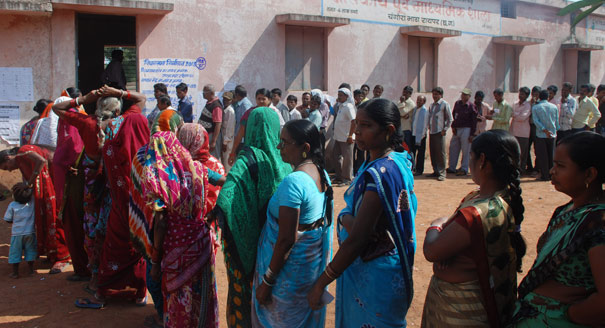
In India, the state’s strong involvement in the economy, together with costly elections, has incentivized shadowy links between business, the criminal underworld, and politicians, exacerbating corrupt practices. With an electorate of nearly 850 million, India is often celebrated as the world’s largest democracy. Despite gains in transparency, the current state of India’s political finance regime is deeply problematic, eroding the quality of democracy.
India has struggled to regulate political finance in ways that would both contain the costs of elections as well as minimize impropriety in their funding. Estimates of the money spent on India’s 2014 general election hover around US$5 billion, second only to the 2012 U.S. presidential elections, which is symptomatic of an election finance regime that is deeply out of sync with prevailing realities.
Crudely speaking, post-Independence India has seen two distinct political regimes (Gowda and Sridharan 2012).
Unregulated campaign finance
From Indian independence until the contemporary era, all aspects of elections were regulated and executed by the independent Election Commission of India (ECI). Political finance was characterized by candidate spending limits, private donations, and lack of transparency, measures the ECI struggled to enforce. Innumerable government-sponsored and independent commissions evaluated India’s opaque political finance regime over the years, but reforms failed to curb the increasing cost of elections or illicit party funding. Third party expenditures on behalf of candidates remained unregulated and public funding was nonexistent, as were intra-party transparency and democracy. This had detrimental effects on Indian elections. The influx of political candidates with criminal connections, growing links between businessmen and politics, and the perpetuation—and deepening—of dynastic (or family) politics resulted in a growing criminalization of politics (Vaishnav 2012; Vaishnav & Smogard 2014). Moreover the blatant disregard for political finance regulations undermined people’s faith in democracy, as well as their belief in the rule of law.
Growing transparency
The second era (since 2003) introduced some of the most significant political finance reforms in decades, aimed at strengthening transparency and stricter disclosure requirements. Pioneered by civil society and media pressures, the reforms have been bolstered by supportive judicial rulings, and usually resisted by all major political parties, who tend to fear change in the status-quo.
Two key regulations have been implemented. The first was a candidate affidavit regime requiring political candidates to disclose their criminal, educational and financial details. The records presented to the public exposed the poisonous relation between money, criminality and electoral success. In 2014, 34% of India’s MPs faced criminal charges, and the average wealth of winning candidates was US$0.5 million, which increased to US$0.65m for those with serious criminal records (Sastry 2014). The second measure was the Election and Other Related Laws Amendment Act, which incentivized transparency for donors by making party contributions 100% tax-deductible, and mandating disclosure of large political contributions.
Most notable is the Right to Information movement, which has made considerable headway in India. The landmark 2005 Right to Information Act obliges “any public authority” to respond to citizens’ information requests within 30 days or face financial penalties (Roberts 2010). It led to an important ruling in 2008, compelling parties to publicly release their income and expenditure records — an eye-opener in a country where the sources of 75% of all party funds collected by the six national parties are unknown (ADR 2013).
Lessons for policymakers
While the disclosure reforms have shed light on the finances of both political parties and candidates, several major factors have obstructed progress: weak enforcement, a state-dominated economy which incentivizes illicit funding, and lack of political will for reform.
India’s Constitution established a sound foundation for the conduct of elections and instated the ECI, one of the more autonomous election agencies in the world and constitutionally independent. Yet it also suffers from serious gaps in its enforcement powers, as it is not authorized to take action against entities that defy its orders. It needs new powers, many of which require legislation.
Moreover more than two decades following economic liberalization, the state retains a large amount of discretionary authority over the Indian economy, especially in lucrative sectors such as the land, natural resources, real estate, and defense sectors. Until the Indian state retreats and gives way to market forces, politicians and business will perpetuate a system of trading policy and regulatory favors for payments and anonymous campaign donations. Incumbents benefit from the status quo and are hence unwilling to disturb it, which means that any attempt at deepening regulation is perceived as aiding opposition parties and challengers. Unless this situation changes, political finance regulation is unlikely to have much impact.
References
Association for Democratic Reforms (ADR). 2013. Sources of funding of national political parties for FY 2004-05 to 2011-12. Accessed September 1, 2014.
Roberts, Alasdair (2010), ‘A great and revolutionary law? The first four years of India’s Right to Information Act.’ Public Administration Review, 70(6): 925-933.
Sastry, Trilochan. 2014. ‘Towards decriminalisation of elections and politics.’ Economic and Political Weekly, 49(1): 34-41.
Vaishnav, Milan. 2012. ‘The merits of money and ‘muscle’: Essays on criminality, elections and democracy in India.’ PhD Dissertation. Columbia University.
Vaishnav, Milan and Danielle Smogard. 2014. A new era in Indian politics. Carnegie Endowment for International Peace. Accessed June 12, 2014.
This brief was originally published by Global Integrity, the Sunlight Foundation, and the Electoral Integrity Project.