

Commentary
Farea Al-Muslimi
{
  "authors": [
    "Farea Al-Muslimi"
  ],
  "type": "legacyinthemedia",
  "centerAffiliationAll": "dc",
  "centers": [
    "Carnegie Endowment for International Peace",
    "Malcolm H. Kerr Carnegie Middle East Center"
  ],
  "collections": [],
  "englishNewsletterAll": "menaTransitions",
  "nonEnglishNewsletterAll": "",
  "primaryCenter": "Malcolm H. Kerr Carnegie Middle East Center",
  "programAffiliation": "MEP",
  "programs": [
    "Middle East"
  ],
  "projects": [],
  "regions": [
    "Gulf",
    "Yemen",
    "Middle East"
  ],
  "topics": [
    "Political Reform"
  ]
}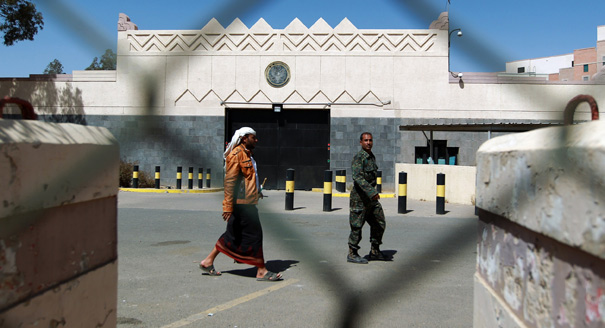
Source: Getty
The appointment of Ahmed Awad Bin Mubarak as Yemeni Ambassador to the United States puts an end to a three-year vacuum in the Yemeni foreign service. But his new role as a diplomat raises many questions.
Source: National
This month, Yemen’s exiled president, Abdrabu Mansur Hadi, received a letter indicating that his choice for ambassador to the United States, Ahmed Awad Bin Mubarak, had been approved by the United States government.
The confirmation puts an end to a three-year vacuum in the Yemeni foreign service, dating back to 2011 when former ambassador Abdulwahab Al Hijri—who was well known in diplomatic and social circles in Washington and was former president Ali Abdullah Saleh’s son-in-law—stepped down.
Bin Mubarak is relatively new to diplomacy. However, he has played a key role in the Yemeni government, serving as secretary general of the National Dialogue Conference, and, later, as chief of staff in Hadi’s office.It is all a long way from his student days working with the Baath party in Iraq.
Washington was a sponsor of the now-failed transitional process in Yemen after the fall of Saleh, and Bin Mubarak had been one of its key figures. His new role as a diplomat has raised many questions in Yemen and beyond.
Bin Mubarak quickly came to prominence following the Arab Spring in Yemen. He had close relations with western embassies, and—until their relationship soured earlier this year—had the ear of the former UN envoy to Yemen, Jamal Benomar.
On January 17, the Houthis began their coup in Yemen by kidnapping Bin Mubarak and holding him captive for 10 days. He was kept isolated from the world and was not even aware of the events that led to the resignation of Hadi and his prime minister Khaled Bahah.
In an interview in Riyadh last month, he recalled the experience with a great amount of anger towards the Houthis, describing it as “worse than being killed.”
The Houthis have since tried to justify the abduction as a stand against the widely unpopular draft constitution drawn up by Bin Mubarak and Hadi. Among other things, it called for the division of Yemen into six regions, contrary to the Peace and National Partnership Agreement, which was agreed to by the Houthis last September.
When a committee about regional divisions was formed after the Conference of National Dialogue last year, Hadi presented its members with the draft of the division of regions, and gave them just one day to sign it.
This contributed to further tensions in the country—a small step in the series of events that would eventually push Yemen to the brink. Bin Mubarak has since denied any role in the regional division, stating that he “was only implementing what political leaders agreed on.”
But the Houthis’ problem with Bin Mubarak isn’t exclusive to the draft constitution or other outcomes of the National Dialogue Conference. Before that, last September, they vetoed his appointment as prime minister.
It is still not clear whether the Houthis took this stance due to a request from Iran or one from their ally, former president Saleh. Iran’s problem with Bin Mubarak isn’t solely related to his close relations with the West. More important to them is his past association with the Baath party in Iraq.
Following his release by the Houthis, Bin Mubarak left Yemen for Saudi Arabia. One month later, he was joined by Hadi, who escaped from house arrest in Sanaa. Since Hadi’s arrival in Riyadh, Bin Mubarak has been helping to manage the president’s affairs, although he is not officially attached to the presidential office. After there lose of power in Yemen and fleeing to Saudi Arabia, the two men now use sponsored pages on Facebook attempting to reach to Yemenis.
There are also rumors—which Bin Mubarak denies—of tension between the new ambassador and the defence minister, Mahmoud Al Subayhi, who was captured by the Houthis several months ago and is still in their custody.
The appointment of Dr Bin Mubarak to a diplomatic post in Washington certainly puts an end to any political aspirations he may have had in Yemen.
And with fighting continuing in that country—including Houthi shelling in Aden that claimed at least 45 civilian lives on Sunday—the myth of Yemen’s “model transition” in the aftermath of the Arab Spring is well and truly dead.
Research fellow at Chatham House’s Middle East and North Africa Programme
Farea Al-Muslimi is a research fellow at Chatham House’s Middle East and North Africa Programme.
Recent Work
Farea Al-Muslimi
Farea Al-Muslimi
Carnegie does not take institutional positions on public policy issues; the views represented herein are those of the author(s) and do not necessarily reflect the views of Carnegie, its staff, or its trustees.

Ex-president Gurbanguly Berdimuhamedov remains interested in politics, but his son Serdar, Turkmenistan’s current president, is becoming increasingly independent and willing to break with his father’s legacy. If their covert rivalry goes too far, both risk losing power.

Galiya Ibragimova

A notable degree of participative democracy has firmly arrived in Europe. But to have more far-reaching impact, democratic deliberation needs to move into a radically new phase.

Richard Youngs

Sergei Kiriyenko used Russia’s parliamentary vote to further hone his strategy of corporate mobilization that is designed to maximize votes for United Russia.

Andrey Pertsev

Before the next wave of EU enlargement takes place, the union needs to grapple with thorny questions of how power is distributed among its members.


Emil Sondaj Hansen, Ditte Brasso Sørensen

The Horn of Africa countries are among those facing a new security calculus.


Andrew Leber, Lesley Anne Warner