

Commentary
Judy Dempsey
{
  "authors": [
    "Judy Dempsey"
  ],
  "type": "legacyinthemedia",
  "centerAffiliationAll": "dc",
  "centers": [
    "Carnegie Endowment for International Peace",
    "Carnegie Europe"
  ],
  "collections": [
    "EU Integration and Enlargement"
  ],
  "englishNewsletterAll": "ctw",
  "nonEnglishNewsletterAll": "",
  "primaryCenter": "Carnegie Europe",
  "programAffiliation": "EP",
  "programs": [
    "Europe"
  ],
  "projects": [],
  "regions": [
    "Europe",
    "Western Europe",
    "Iran"
  ],
  "topics": [
    "Foreign Policy",
    "EU",
    "Migration"
  ]
}
Source: Getty
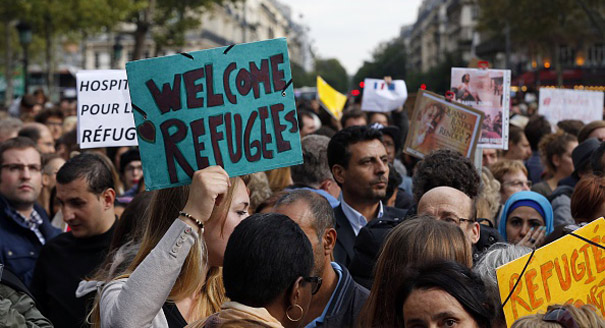
The refugee crisis is already having major damaging effects on Europe. Tensions and divisions among EU member states are good news for Russian President Vladimir Putin.
Source: The Moscow Times
Despite a recent agreement by European Union leaders that each member state take a certain number of Syrian refugees, this policy is not going to stick.
Hungarian, Slovak, Czech and Polish leaders — although Warsaw has somewhat softened its stance — have problems not only in accepting refugee quotas. They do not want to accept Muslims. They say their stance is about defending Europe's Christian values, regardless of what Christian values say about helping others in need.They also resent what Hungarian Prime Minister Viktor Orban calls the "moral imperialism" of some EU leaders. Orban was referring to German Chancellor Angela Merkel, who unilaterally opened Germany's doors to the refugees — a departure from her usual cautious approach.
A few days later, under pressure from her own conservative bloc, Germany introduced border controls. Hungary had already sealed its border with Serbia.
The inexorable logic of the Central Europe position, behind which several other EU countries hide, is a "fortress" Europe — as if that were possible in the age of globalization that demands that the EU be as open and competitive as possible.
These divisions are good news for Russian President Vladimir Putin. A strong and united Europe is not in Putin's interest. He already saw that Merkel managed to rally all the other 27 EU member states to impose sanctions on Russia after its annexation of Crimea in March last year.
That unity surprised the Kremlin. In the past, Russia had managed to play off the member states against each other. So far, the EU has stood firm over sanctions.
The EU's euro zone members have also held together despite the huge cost of bailing out Greece, whose economic recovery is far from certain.
Europe, however, is not so lucky when it comes to the refugee crisis. If anything, this crisis could either force EU leaders to recognize why they need a stronger and more integrated Europe or failing that, Europe will decline in importance globally. For the moment, all the divisions and recriminations suit Putin.
The refugee crisis is already having three major damaging effects on Europe.
First, the divisions inside Europe over accepting the refugees are manna for the bloc's Euroskeptics. From Budapest to London, there are calls for tighter border controls but also for suspending the Schengen system that for most EU countries meant a borderless Europe which allowed people and goods to crisscross it without controls.
Schengen was one of the great and tangible gains of European integration, not that any EU leader is today talking about more integration. The word has become extremely unpopular even though further integration is needed more now than ever before. For Euroskeptics, it's as if Schengen — an open Europe — was responsible for the refugee crisis, not the wars in Syria, Iraq or Afghanistan.
Second is a creeping illiberalism fueled by the Euroskeptics who question many of the values that the EU is supposed to represent and who reflect some of Putin's political stances. Orban, among other Euroskeptic leaders, has challenged Europe's liberal values. His outlook puts great store on traditional values, such as the family as well as national and religious identity, while tolerance for rights for homosexuals, integrating the Roma people, or accepting Muslim refugees get short shrift.
Third, and this is a big worry: Germany. Until the refugee crisis, Merkel was the undisputed leader of Europe and highly popular back home. The refugee crisis has exposed her vulnerability.
Her conservative bloc consisting of the Christian Democratic Union and Christian Social Union parties have criticized the way in which she unilaterally opened Germany's borders to the refugees without guarantees that other EU countries would take their fair share.
She has also been criticized by the Czech Republic, Hungary, Poland and Slovakia precisely because she criticized them for not showing solidarity over the refugees. They resented being lectured by a German chancellor.
These tensions have a price. Bratislava, Budapest and Prague opposed the EU sanctions on Russia, although they never voted against them.
Nevertheless, if Merkel is not convinced that the Minsk agreement forged last February in order to end the fighting in eastern Ukraine, is fully implemented, she will push hard for the prolongation of the sanctions.
For that, she will need the support of the Czech Republic, Hungary and Slovakia. Merkel can ill afford to alienate them to such a degree that they will take their revenge against Berlin. She will have to mend fences with her eastern neighbors.
Meanwhile, the number of refugees and migrants wanting to reach Europe will not diminish.
Whatever the outcome of the talks between Putin and U.S. President Barack Obama over trying to negotiate a political solution to end the war in Syria, the conflicts in Iraq, Libya and Afghanistan will force people to leave these countries for Europe.
The consequences of these wars could make or break Europe.
Russia faces its own pending refugee crisis. The North Caucasus is so combustible that it is only a matter of time before Islamic State supporters and a plethora of fundamentalists wreak havoc along Russia's southern flanks.
Indeed, Russia's bombing of Islamic State fighters in Syria is not going to bring stability to the North Caucasus just as it won't end the flow of refugees and migrants wanting to reach Europe.

Nonresident Senior Fellow, Carnegie Europe
Judy Dempsey is a nonresident senior fellow at Carnegie Europe
Recent Work
Judy Dempsey
Judy Dempsey
Carnegie does not take institutional positions on public policy issues; the views represented herein are those of the author(s) and do not necessarily reflect the views of Carnegie, its staff, or its trustees.

The acknowledgment has sparked fears of a new arms race with China and Russia.

Chris O’Meara
Smaller powers cannot go it alone, but Canadian history shows that integration with the United States will not always be benign.
Paul Samson

The European Commissioner for Trade is headed to China. But after President Xi’s bridge-building visit to Washington, can a more isolated EU overcome Beijing’s stranglehold on critical raw materials? Who will blink first?

Rym Momtaz, ed.

The summit may be remembered as a fatal blunder, when Washington, Beijing, and the AI industry collectively chose ceremony over action.

Jeffrey Prescott

European NATO countries are wrestling with the possibility of U.S. disengagement from the alliance. With the continent’s security increasingly uncertain, governments must restore the credibility of their collective defense.



Hans-Dieter Lucas, Adam Thomson, Pierre Vimont