

Research
- +5
Alper Coşkun, Fatih Ceylan, Tacan İldem, …
{
  "authors": [
    "Sinan Ülgen"
  ],
  "type": "legacyinthemedia",
  "centerAffiliationAll": "dc",
  "centers": [
    "Carnegie Endowment for International Peace",
    "Carnegie Europe"
  ],
  "collections": [
    "Turkey’s Transformation"
  ],
  "englishNewsletterAll": "ctw",
  "nonEnglishNewsletterAll": "",
  "primaryCenter": "Carnegie Europe",
  "programAffiliation": "EP",
  "programs": [
    "Europe"
  ],
  "projects": [],
  "regions": [
    "Middle East",
    "Europe",
    "Türkiye",
    "Iran"
  ],
  "topics": [
    "Democracy"
  ]
}
Source: Getty
The prevailing degree of polarization is inimical to Turkey and its democracy. The November election provides an opportunity for the country to redress this environment of acrimony.
Source: National Interest
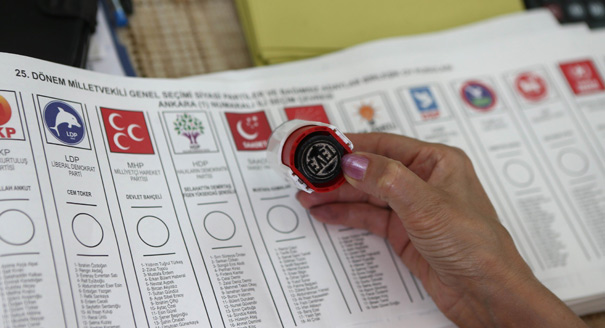
Five months after voting for a new parliament, Turks are again going to the polls this weekend. Yet the stakes could not be more different for the two elections taking place within half a year of each other.
In the June elections, the key question was whether the pro-Kurdish HDP would clear the 10 percent national threshold. Linked to that was whether the ruling AK Party would get a constitutional majority, which would have allowed President Erdogan to drive his agenda of constitutional change and introduce the presidential system. This time around, the key question is whether the ruling AK Party can win back the majority it lost in June, and linked to that, whether there is a third round of elections looming in the horizon.
The latest opinion polls demonstrate that a very similar outcome is expected from the November elections, with four parties getting representation in Parliament, each with very similar support levels to the June elections and no single-party majority. This may seem a surreal expectation given the momentous events that have affected Turkey’s domestic environment. The resurgence of the military conflict between the government and the PKK, the Islamic State–perpetrated suicide bombings in Ankara that have led to more than 100 casualties, the rise in Syrian refugees now surpassing the 2.2 million benchmark: none of these dynamics have apparently swayed voting patterns in Turkey.
An explanation for this surprising behavior is the acute degree of political polarization that has ossified allegiances. In today’s Turkey, political competition has turned into a contest driven by cultural identities with clearly delineated and deep divisions between the nationalist, Kurdish, religious and secular constituencies. Turkish society seems to have been taken prisoner by this upsurge of identity politics, and is utterly powerless to transcend these cleavages.
This exceptionalism is also demonstrated by the shallowness of the ongoing political campaigning. Unlike past elections, when Turks were exposed to a myriad of party flags in every street corner, noisy minivans broadcasting political party slogans and jingles and countless mass rallies, this time around there is scant indication that a critical election will take place within days. It is as if, cognizant of the deep divisions, the body politic has also given up hope that campaigning will bring about any change.
Yet the prevailing degree of polarization is clearly inimical to Turkey and its democracy. It eliminates all prospects for consensus-driven rational policy making even where core strategic and security interests are involved. The reaction of the Turkish political class to the heinous Ankara bombing is a case in point; instead of displaying even for a brief moment a proclivity for national unity, their instinct was to engage in games of recrimination. But polarization has also proven to be detrimental to another aspect of Turkish democracy, as it has killed any pretense of accountability. There is no more room for self-criticism in Turkish politics, for fear that it will be abused by the competition. Again, the reaction to the Ankara bombings, where no government minister showed responsibility and resigned, is illustrative of this deficit.
The November elections provide an opportunity for Turkey to redress this environment of acrimony. The emergence of another divided parliament with no clear majorities should, under current circumstances, be viewed positively. It will mean the end of majority rule. And the establishment of a broad-based coalition government will force the Turkish political class to relearn the art of consensus politics. But this more optimistic scenario will emerge only if there is an understanding among Turkey’s political leaders, including President Erdogan, that the country has indeed entered the era of coalitions after thirteen years of single-party rule. The tantamount fear is that this particular lesson of the two consecutive elections will go unheeded and Turkey will enter yet another electoral cycle in the first months of the new year, with disastrous consequences for this critical country’s political and economic stability.
This article was originally published by the National Interest.

Senior Fellow, Carnegie Europe
Sinan Ülgen is a senior fellow at Carnegie Europe in Brussels, where his research focuses on Turkish foreign policy, transatlantic relations, international trade, economic security, and digital policy.
Recent Work

Alper Coşkun, Fatih Ceylan, Tacan İldem, …
Carnegie does not take institutional positions on public policy issues; the views represented herein are those of the author(s) and do not necessarily reflect the views of Carnegie, its staff, or its trustees.

As the U.S. stumbles in its war with Iran, we are likely to see an acceleration of its disengagement from the region.

Michael Young

If the Russian-speaking community in Latvia cannot articulate their interests without being seen as disloyal, they could end up embracing a pro-Kremlin agenda.

Sergejs Potapkins

Are Germany’s economic, industrial, and political struggles becoming a liability for the EU’s ability to rise to the geopolitical moment?

Rym Momtaz, ed.
Despite myriad challenges and occasional stumbles, the new Hungarian government is moving ahead with energy and conviction to uproot years of illiberalism and corruption and rebuild Hungarian democracy.

Thomas Carothers

European Commission President Ursula von der Leyen is about to give her annual address on the state of the EU. Here’s what she won’t—but should—say.
Rym Momtaz