

Article
Hans-Dieter Lucas, Adam Thomson, Pierre Vimont
{
  "authors": [
    "Pierre Vimont"
  ],
  "type": "other",
  "centerAffiliationAll": "dc",
  "centers": [
    "Carnegie Endowment for International Peace",
    "Carnegie Europe"
  ],
  "collections": [
    "Transatlantic Cooperation",
    "Europe’s Southern Neighborhood"
  ],
  "englishNewsletterAll": "ctw",
  "nonEnglishNewsletterAll": "",
  "primaryCenter": "Carnegie Europe",
  "programAffiliation": "EP",
  "programs": [
    "Europe"
  ],
  "projects": [],
  "regions": [
    "Europe",
    "North America",
    "United States",
    "Western Europe",
    "France",
    "Iran"
  ],
  "topics": [
    "Security"
  ]
}
Source: Getty
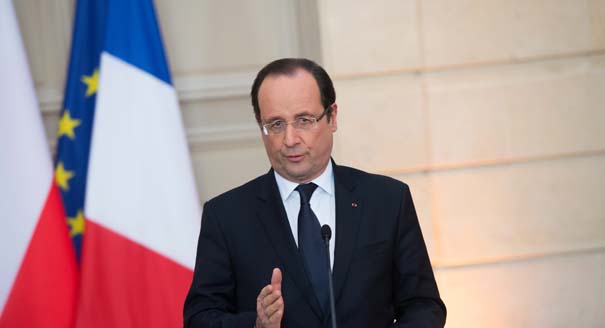
France will call for improved military and intelligence cooperation among the different actors in the anti–Islamic State coalition, but deploying troops in Syria is not on France’s agenda.
Source: Deutsche Welle
MICHAEL KNIGGE: During his visit to the White House, French President Hollande wants to push President Obama towards a more robust military strategy against the Islamic State in Syria. Do you think Hollande can convince Obama who has opposed repeated calls for a larger US military role in Syria to change course now?
PIERRE VIMONT: It depends on what one means by a robust coalition. If it is about better coordination, more sharing of intelligence among all the different actors in the coalition, I think both sides agree on this and have made some progress there. If you try to look at other aspects of the coalition then that can become a bit more difficult. One is about whether there should be boots on the ground. I think on this issue not only the American administration, but the French government itself is somewhat worried about such a perspective. I think it's not in the intention of the French government and President Hollande to move along that line.Then it's the whole issue about other participants in the coalition, about Turkey and the role they could play, about Saudi Arabia and the support they have given to other militias inside Syria and then this becomes a more political dimension for the coalition. I think it is there where there could be interesting and useful discussions in Washington between President Obama and President Hollande.
To follow up again, if this visit is supposed to be more than a public solidarity gesture, what concrete steps then can the US take to help France against ‘Islamic State'?
From a military view, the US has played a major part and set up the coalition and time and again convened the partners to improve cooperation. But now that we have had those terrible terrorist attacks in Paris the need for improved cooperation has become much more pressing. The first thing is to share information and intelligence much more closely with a stronger participation on both sides in order to coordinate the airstrikes in a much better way to be more effective on the ground. That's the two key first things: sharing information and coordinating military action. This is what can be done and that is why President Hollande is travelling to Washington with the military officers responsible for the French intervention at the moment in Syria. I think this is where a lot more can be done in a very concrete and practical way, so there is much better cooperation and coordination which was not exactly the case so far.
Washington meanwhile is worried about Hollande reaching out to Moscow, where the French President will meet with Russian President Putin later this week to discuss military cooperation between Russia and France against the Islamic State. The US is concerned that Paris may be open to ease sanctions against Russia for its behavior vis-à-vis Ukraine in return for Russian military help in Syria. What's your stance on a possible nexus between Ukraine and Syria?
I honestly don't think there is a nexus between Ukraine and Syria. I think the reality of diplomatic action at the moment is that for the time being at least these things are quite different – two different crises and two crises on which work needs to be done on its own merits. Discussions here in Brussels at the moment among the 28 EU member states are very much focused on the implementation of the Minsk agreements and whether there is de-escalation on the ground. The situation, as you know, is still very fragile, so the trend at the moment among the 28 member states is much more in favor of extending the sanctions for the time being rather than changing course there. Heads of state and governments will discuss this in December. But Ukraine is being looked at on its own merits.
As to Syria, I think it is a totally different crisis. And here on the discussion that President Hollande could and will have with President Putin in Moscow, the issue will be much more on whether both sides now focus their efforts much more on striking ISIS than the Russians are doing at the moment. If President Hollande is able to convince President Putin to move in that direction, I don't see why Washington should feel unhappy with that because this is something they also have been asking Moscow to do for some time.
President Hollande has called for an international coalition against the Islamic State. Do you think such a coalition is realistic given the still very different interests of key players like the US, Russia, Iran, Saudi Arabia or Turkey in Syria?
I think to some extent everybody agrees that they want to fight ISIS – even Turkey and Saudi Arabia would agree on this. The problem is that quite often they have different priorities. Turkey is focusing much more on the Kurdish issue and Saudi Arabia is thinking much more about its difficult relationship with Iran. So it is trying to convince these different partners to focus for the time being on the fight against ISIS and then maybe later again revert back to their other priorities. I agree with you that it is still a very difficult task that President Hollande has in front of him. But it's not because it is difficult that you should not try to convince your partners of your own opinions.

Senior Fellow, Carnegie Europe
Pierre Vimont is a senior fellow at Carnegie Europe. His research focuses on the European Neighborhood Policy, transatlantic relations, and French foreign policy.
Recent Work


Hans-Dieter Lucas, Adam Thomson, Pierre Vimont
Pierre Vimont
Carnegie does not take institutional positions on public policy issues; the views represented herein are those of the author(s) and do not necessarily reflect the views of Carnegie, its staff, or its trustees.

The EU can impose sanctions but struggles to enforce them without the United States. With Washington increasingly disinterested in backing European interests, the bloc must now fend for itself.


Nicu Popescu, Tiago Antunes

Rubio’s recent visit brought welcome attention, but more capital requires governance changes that may be a hard sell for regional governments.

Jennifer B. Murtazashvili
America’s foreign-policy objectives have grown more demanding while Americans have demanded greater focus on their own affairs.

Stephen Wertheim

Japan’s long-term security policy is driven by concerns about China, and there is little appetite for (or interest in) pursuing a confrontation with Moscow.

James D.J. Brown

Russia is testing the waters of NATO’s mutual defense clause. What do strikes in Romanian territorial waters mean for the alliance’s posture toward Moscow?

Dimitar Bechev