

Article
C. Raja Mohan, Darshana M. Baruah
{
  "authors": [
    "C. Raja Mohan"
  ],
  "type": "legacyinthemedia",
  "centerAffiliationAll": "dc",
  "centers": [
    "Carnegie Endowment for International Peace",
    "Carnegie India"
  ],
  "collections": [],
  "englishNewsletterAll": "ctw",
  "nonEnglishNewsletterAll": "",
  "primaryCenter": "Carnegie India",
  "programAffiliation": "SAP",
  "programs": [
    "South Asia"
  ],
  "projects": [],
  "regions": [
    "South Asia",
    "India",
    "France"
  ],
  "topics": [
    "Foreign Policy"
  ]
}
Source: Getty
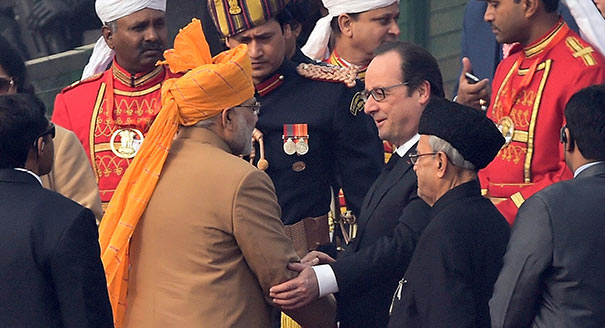
The participation of French troops in the Republic Day parade marks the emergence of France as India’s most trusted international partner.
Source: Indian Express
The participation of French troops in the Republic Day parade on Tuesday — the first ever by a foreign contingent on Rajpath since Independence — is doubly significant. It marks the end of India’s prolonged military isolationism and unveils the emergence of France as India’s most trusted international partner.
Although India’s joint military exercises and memorandums of understanding on defence cooperation multiplied since the early 1990s, New Delhi seemed incapable of imagining the role of India’s armed forces beyond territorial defence.The ghosts of military isolationism seemed difficult to dislodge from the ministry of defence.
Since he took charge in May 2014, Prime Minister Narendra Modi has been bearing down on South Block to recognise the potential of military partnerships in modernising India’s defence-industrial base and enhancing India’s strategic weight in the international system. The marching of the French contingent down Rajpath suggests the effort has begun to pay off.
Back in 2008, France had indeed invited India to send its troops to join the 2008 Bastille Day parade. That decision was an acknowledgement of India’s historic contribution to securing western Europe in World War I and contributing to the Allied victory in World War II. It was also a recognition of India’s new military possibilities on the global stage.
The UPA government’s bold decisions in 2005, when it unveiled military and nuclear cooperation with America and new strategic partnerships with China and Japan, seemed to justify Paris betting on Delhi’s new international potential. But in its second incarnation (2009-14), the UPA government’s military diplomacy went cold again, as then Defence Minister A.K. Antony threw a wet blanket around it. Resuscitating India’s defence diplomacy and global security engagement has been at the centre of the Modi government’s foreign policy.
That a French president is gracing the Republic Day celebrations for a record fifth time underlines the repeated efforts over the last many decades to transform the ties between Delhi and Paris. The value that each country had put on developing independent foreign policies drew Delhi and Paris together, despite being on opposite sides of the Cold War divide.
France became an early and valuable partner for India in building its nuclear and space programmes. Its leaders — Francois Mitterrand in the 1980s, Jacques Chirac in the 1990s, and Nicolas Sarkozy in the 2000s — made repeated efforts to construct a special political-strategic relationship with India.
The French support to resolving the tangle with the US over fuel supplies for the Tarapur nuclear power station in the 1980s, limiting international sanctions against India in the wake of Pokhran 2, and conceiving a political carve-out for India from the global nuclear rules stand out as examples of exceptional French interest in India. Continuing that tradition, President Francois Hollande is eager to consolidate the strategic partnership with India and implement the many key agreements that remain in limbo.
Despite the longstanding interest in the French connection, Delhi never really responded in full measure to initiatives from Paris. Thanks to bureaucratic pettifogging in Delhi, no major French overture could be consummated. It required the direct intervention of Modi, during his visit to France last April, to move forward the discussions on the acquisition of the French fighter aircraft Rafale. That the negotiations couldn’t be concluded by the time Hollande landed nine months later, in Chandigarh on Sunday, shows how difficult the task is.
Modi, however, appears determined to deepen the French partnership. The PM, who has spent the last 20 months in office reviving India’s engagement with all the great powers, sees a special role for Paris in Delhi’s global calculus for three important reasons.
One, India’s relations with America, Britain and China will always retain different degrees of difficulty given their dalliance with the Pakistan army. Russia, which unambiguously backed India against China and Pakistan in the Cold War, has drawn closer to the former and is wooing the latter. France, in contrast, has made a clear choice in favour of India.
As China rises, Russia asserts, Britain retrenches, Europe dithers, and America is torn by self-doubt, France becomes critical for India in promoting a measure of balance on the Eurasian landmass. As the only credible military power with undiminished political will and a historic presence in the Indo-Pacific, France can be a privileged partner for India in strengthening peace and security in the maritime domain.
Third, while India’s quest for multi-polarity has often drawn it closer to China and Russia, Delhi is painfully aware of the dangers of jumping from the frying pan into the fire. Exchanging American global primacy for Chinese domination makes little sense for Delhi. As a leading Western power with shared political values, France is a more credible partner for India in constructing a more equitable world order through a new concert of major powers. Modi gets the big idea on France. His problem is in getting Delhi to translate it into action.
This article was originally published in the Indian Express.
Former Nonresident Senior Fellow, Carnegie India
A leading analyst of India’s foreign policy, Mohan is also an expert on South Asian security, great-power relations in Asia, and arms control.
Recent Work

C. Raja Mohan, Darshana M. Baruah


Alexander Gabuev, Paul Haenle, C. Raja Mohan, …
Carnegie does not take institutional positions on public policy issues; the views represented herein are those of the author(s) and do not necessarily reflect the views of Carnegie, its staff, or its trustees.
The summit may be remembered as a fatal blunder, when Washington, Beijing, and the AI industry collectively chose ceremony over action.
Jeffrey Prescott
European NATO countries are wrestling with the possibility of U.S. disengagement from the alliance. With the continent’s security increasingly uncertain, governments must restore the credibility of their collective defense.


Hans-Dieter Lucas, Adam Thomson, Pierre Vimont

Cargo traffic through Russia’s Northern Sea Route has increased because of the disruption caused by the conflict in the Middle East, the Ukraine war, and U.S.-China tensions.

Mikhail Korostikov

The domestic impacts of how long it is taking to end the war in Ukraine have pushed the French electorate to the political extremes and compromised the country’s diplomatic capacity.

Rym Momtaz
Soft power on its own is insufficient to meet U.S. national security needs, but hard power also has its limits. Soft power allows for more effective and efficient use of hard power than hard power alone, as it encourages cooperation and compliance which deters the need for hard power.

Sarah Yerkes