

Paper
Yezid Sayigh
{
  "authors": [
    "Yezid Sayigh"
  ],
  "type": "legacyinthemedia",
  "centerAffiliationAll": "dc",
  "centers": [
    "Carnegie Endowment for International Peace",
    "Malcolm H. Kerr Carnegie Middle East Center"
  ],
  "collections": [],
  "englishNewsletterAll": "menaTransitions",
  "nonEnglishNewsletterAll": "",
  "primaryCenter": "Malcolm H. Kerr Carnegie Middle East Center",
  "programAffiliation": "MEP",
  "programs": [
    "Middle East"
  ],
  "projects": [],
  "regions": [
    "Egypt",
    "Gulf",
    "Levant",
    "Maghreb",
    "Middle East",
    "North Africa"
  ],
  "topics": [
    "Political Reform",
    "Security"
  ]
}
Source: Getty
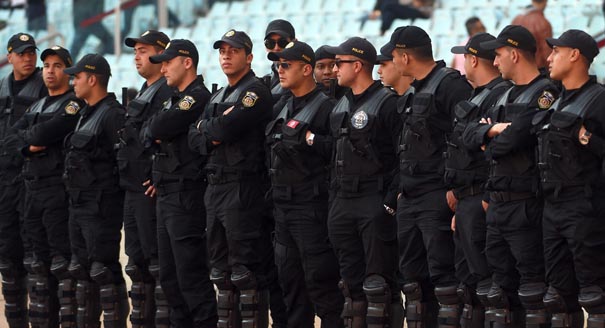
Restoring effective policing in Arab states is crucial in order to rebuild social peace, resume economic development and growth, and reintegrate deeply divided political systems and broken state institutions.
Source: Al-Jazeera
The fifth anniversary of the uprisings that challenged autocratic rulers in six Arab states in 2011 has generated many retrospective reflections.
Some commentators insist that analysis of ongoing social and political processes cannot be reduced to simple "success or failure," as these terms understate the transformation of every dimension of the region's politics.
Others conclude that the uprisings and their aftermath should be re-labeled an Arab Winter, rather than Spring. Instead of delivering on hopes for political reform and social justice, most governments have responded with "more war and violence", as Amnesty International summarised it, "and a crackdown on people who dare to speak out for a fairer, more open society."Renewed repression of dissent stands in stark contrast to the eruption of pent-up anger in 2011, which focused on abusive police forces and internal security services.
But while most thoughtful commentators agree that authoritarian rule has intensified in all cases except Tunisia, they also note the severely degraded institutional cohesion and capacity that is bringing into question the resilience and very survival of several Arab Spring states - and of others that underwent earlier forms of transition in the wake of armed conflict and occupation.
Governing political structures are more closed to dialogue and their coercive agencies harsher than ever, blocking any meaningful reforms, but the states they run are also more brittle.
Nowhere is the connection between intensified authoritarianism and state brittleness more evident than in what we loosely label policing: law enforcement and the maintenance of public order.
Policing, along with the related formal criminal justice system, was already in serious disrepair even before 2011, but has degenerated far further amidst tumultuous transitional politics.
The challenge now is to rebuild and reform security sectors-police, security, and paramilitary agencies and others such as customs departments - that have retreated into sullen passivity or else retrenched in aggressive hostility towards citizens and activists.
But the generic frameworks through which Western governments and international organisations conventionally approach the task are inadequate.
These focus heavily on providing security sectors with technical training, management skills, codes of conduct, and procedural rules to ensure "democratic governance" and "civilian oversight" through financial transparency and legal and political accountability.
These outcomes are indisputably desirable, but remain highly nebulous in practice.
Indeed, the overwhelming emphasis on technical approaches risks improving security sector ability to deploy coercive tactics and equipment more efficiently, while reducing still further any incentives to comply with the rule of law and respect human and citizens' rights.
In a context in which the social contract, national identity, and the state itself are broken or being renegotiated - often amid intervention by regional and international powers - the very nature and purpose of policing, which is a defining function of modern states, are in doubt.
Three kinds of dilemmas stand in the way of security sector reform.
The first is "hyperpoliticization": every aspect of transition becomes a zero-sum contest between rival political camps, paralysing governance.
For large numbers of citizens, government legitimacy is determined by its ability to repress political or social actors that are seen as threatening - rather than on its readiness to deliver democracy, rule of law, and human rights - resulting in a restoration of authoritarian practices.
As a result, violence becomes the "currency" through both governance and opposition are exercised.
The high financial cost of modernising and professionalising security sectors poses a second, "political economy" dilemma.
Trimming grossly inflated security sectors impacts unemployment negatively, adding to social strains. But ending the extensive involvement of security sectors in corruption and criminal economic activities poses a greater challenge.
These trends evolved from over two decades or more of crony economic liberalisation and predatory privatisation, but have intensified sharply as transitions in Arab states weakened regulatory frameworks and oversight mechanisms, "democratising" corruption.
And finally, Arab transitions have revealed the divergence of views and expectations within society regarding the purpose of policing.
We think of the police mainly as crime-fighters and guardians of public peace in the streets; but more important is their role in maintaining the dominant social and economic order and curbing dissent.
The breakdown of social contracts and manipulation of constitutional order has deepened divergences within society over the values and moral economy to be upheld by the police, and prompted growing resort to informal providers of security and customary law, including so-called Islamic and tribal forms.
Restoring effective policing is crucial in order to rebuild social peace, resume economic development and growth, and reintegrate deeply divided political systems and broken state institutions - anchoring them in credible constitutional frameworks.
But as these dilemmas show, divergences over what constitutes an acceptable social order, moral economy, and shared national identity have become fundamental.
Unless they are bridged and enable genuinely reformed policing, Arab states in transition are condemned to descend into ever deepening civil strife.

Senior Fellow, Malcolm H. Kerr Carnegie Middle East Center
Yezid Sayigh is a senior fellow at the Malcolm H. Kerr Carnegie Middle East Center in Beirut, where he leads the program on Civil-Military Relations in Arab States (CMRAS). His work focuses on the comparative political and economic roles of Arab armed forces, the impact of war on states and societies, the politics of postconflict reconstruction and security sector transformation in Arab transitions, and authoritarian resurgence.
Recent Work
Yezid Sayigh
Yezid Sayigh
Carnegie does not take institutional positions on public policy issues; the views represented herein are those of the author(s) and do not necessarily reflect the views of Carnegie, its staff, or its trustees.

Before the next wave of EU enlargement takes place, the union needs to grapple with thorny questions of how power is distributed among its members.


Emil Sondaj Hansen, Ditte Brasso Sørensen

The Horn of Africa countries are among those facing a new security calculus.


Andrew Leber, Lesley Anne Warner

The European far right might fail to steer EU policy in the direction Russia wants, but they will create enough chaos inside Europe to benefit the Kremlin.

Dimitar Bechev

The new U.S.–Denmark–Greenland agreement will help Washington exert political, economic, and financial dominance under the guise of security. Yet, it acknowledged Copenhagen’s and Nuuk’s sovereignty on the island.

Marc Pierini

A summer of escalation in the Black Sea has hurt Ukraine economically and is exacerbating world food security. A truce is needed—as is a broader reframing of Europe’s Ukraine strategy.

Thomas de Waal