

Paper
Yezid Sayigh
{
  "authors": [
    "Yezid Sayigh"
  ],
  "type": "legacyinthemedia",
  "centerAffiliationAll": "dc",
  "centers": [
    "Carnegie Endowment for International Peace",
    "Malcolm H. Kerr Carnegie Middle East Center",
    "Carnegie Russia Eurasia Center"
  ],
  "collections": [
    "Arab Awakening"
  ],
  "englishNewsletterAll": "menaTransitions",
  "nonEnglishNewsletterAll": "",
  "primaryCenter": "Malcolm H. Kerr Carnegie Middle East Center",
  "programAffiliation": "MEP",
  "programs": [
    "Middle East"
  ],
  "projects": [],
  "regions": [
    "Levant",
    "Syria",
    "Middle East",
    "Caucasus",
    "Russia"
  ],
  "topics": [
    "Political Reform",
    "Security",
    "Foreign Policy"
  ]
}
Source: Getty
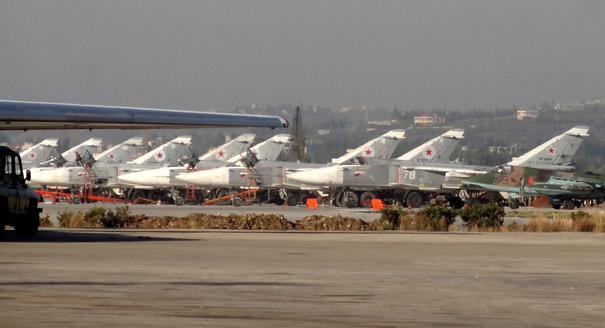
The partial Russian military pull-out from Syria announced by President Vladimir Putin on March 14 continues to generate considerable commentary.
Source: Al-Hayat
The partial Russian military pull-out from Syria announced by President Vladimir Putin on March 14 continues to generate considerable commentary. Three interpretations stand out. The first sees Putin as cutting Russian losses, a view echoed by members of the Syrian opposition who have portrayed the pull-out as the result of its armed resistance, although there is little evidence for this claim. The second interpretation, which correctly notes that Russia retains a significant combat deployment in Syria that can be easily expanded again, instead argues that Putin’s primary motivation is to exercise leverage, whether over the U.S. or Syrian President Bashar al-Assad, in order to compel acceptance of Russian terms for a peace deal ending the Syrian conflict. A third view is that Putin has already achieved the foreign and domestic policy objectives that prompted the intervention in Syria, and is satisfied with pocketing the gains.
An alternative interpretation is that Putin does not see a peace deal on Syria as imminent, and that this is what made a choice about whether and how to continue Russia’s military intervention both pertinent and necessary. Forcing Russian terms for a deal on the U.S. and other external supporters of the Syrian opposition would require a significant escalation of the intervention, incurring far greater material costs and risks of geopolitical confrontation than Putin is apparently willing to accept. But clearly, maintaining the previous level of combat operations indefinitely without clear expectation of additional political returns made little sense either. Indeed, it would risk squandering any credit Russia had earned for engineering both the potentially workable diplomatic framework contained in the Vienna statement of November 14, 2015, and the cessation of hostilities that went into effect on February 27, 2016.
The partial pull-out from Syria accordingly repositions Russia militarily and diplomatically to minimize costs if a political settlement ending the conflict remains unattainable, while maximizing its staying power and its ability to continue to shape events on the ground and respond flexibly to future developments no matter what form or direction they take.In turn, if Putin indeed regards chances for a political settlement as remote at present, then this is partly because he has discovered the limits of Russian leverage over Assad and the rest of his regime. The latter has repeatedly touted its sovereignty and independence since the cessation of hostilities was announced on February 22: first by decreeing that parliamentary elections will be held on April 13, in defiance of the provisions and timetable set out in the Vienna statement, and then by insisting that Assad’s status is not negotiable and that the government seeks total victory and will not talk to those it deems to be terrorists, which includes the Syrian opposition. If Putin hoped to persuade Assad to entertain concessions that would enable a Russian-brokered peace deal, then the partial Russian pull-out was not a prelude to the attempt, as some have argued, but a reflection of its failure.
Assad no doubt calculates that Putin cannot significantly reduce, let alone end, Russian support for his regime without running a very real risk of bringing it down altogether. Obviously this would defeat the main Russian objective in Syria and waste all the military and economic assistance sent there since 2011. Putin clearly has no intention of abandoning the regime, but any hope he might have of using Russia’s longstanding relationship with the Syrian army to win its support and acquire leverage over Assad is unlikely to succeed either. The formal command structure with which Russia deals does not wield as much authority over the rank-and-file as the regime’s parallel networks within the army do, and so it has little autonomy and cannot offer Russia a means of influence.
Ironically, Russia cannot achieve more in Syria without the additional leverage and resources that the other principal external actors—Iran on the regime side, but also the U.S., Turkey, and Saudi Arabia—can bring to bear. This is especially true if Putin concurs with the need to find some formula that ensures Assad’s departure from the presidency by the end of a transition. But the attention of the other external actors, like Russia’s, is increasingly focused on other challenges, including the Islamic State.
This leaves Syria in a state of “suspended conflict,” with the cessation of hostilities likely to hold for the next few months, in parallel to peace talks in Geneva that will almost certainly remain desultory despite UN Special Staffan de Mistura’s publicly expressed hope of moving from discussion of principles to actual political substance.
The question then is whether political dynamics and military trends inside Syria will evolve in ways that affects the balance in the meantime. Already, armed groups affiliated to the Islamic State in southern Syria have gone on the offensive to expand their zone of control in villages to the west and north of the provincial capital Daraa. Regime forces have retaken the desert city of Palmyra, an important gain, and could seek to push further towards the besieged enclave around the eastern city of Deir az-Zor or to pressure the Islamic State’s remaining strongholds east of Aleppo in the north. The Kurdish Democratic Union Party has responded to its exclusion from the Geneva talks by announcing its intention to declare a federal region, and is competing with the regime, Islamic State, and Syrian opposition to form alliances with the Arab clans of the north and northeast.
Progress in the fight against the Islamic State in neighboring Iraq, or lack of it, will also bear on developments in Syria. Success will tend to work in the Assad regime’s favour, by giving it a relative military advantage along its long frontlines with the Islamic State, but if the anti-Islamic State campaign stalls this merely leaves Syria in its present status quo, which also tends to favor the regime. Meanwhile the regime continues to press besieged or beleaguered communities in Syria, especially to the south of Damascus and north of Homs, to submit to local truces that leave armed opposition groups in place but free up army units for action elsewhere. Coupled with the forthcoming parliamentary elections, Assad will seek to consolidate his claim to be pacifying the country and achieving reconciliation. The opposition, conversely, is heavily dependent on peace talks to which the regime is not genuinely committed, and is threatened with the loss of political and military initiative.
On present trends, the Assad regime will remain slightly ahead, as it always has since the start of the Syrian crisis. But this was never enough to achieve the total victory over the opposition that it still seeks, nor to prompt the U.S. to enter an unconditional anti-Islamic State partnership that leaves Assad in the presidency and in full control of the army and internal security. Conversely, even with its own presidential elections approaching and the possibility of a more assertive administration coming to office, the U.S. is less likely than ever to undertake the sort of diplomatic effort, let alone military intervention, necessary to impose a better peace deal. With neither the U.S. nor Russia having enough at stake strategically to break the deadlock, Syria’s entry into a state of suspended conflict looks certain.

Senior Fellow, Malcolm H. Kerr Carnegie Middle East Center
Yezid Sayigh is a senior fellow at the Malcolm H. Kerr Carnegie Middle East Center in Beirut, where he leads the program on Civil-Military Relations in Arab States (CMRAS). His work focuses on the comparative political and economic roles of Arab armed forces, the impact of war on states and societies, the politics of postconflict reconstruction and security sector transformation in Arab transitions, and authoritarian resurgence.
Recent Work
Yezid Sayigh
Yezid Sayigh
Carnegie does not take institutional positions on public policy issues; the views represented herein are those of the author(s) and do not necessarily reflect the views of Carnegie, its staff, or its trustees.

It should address the shortcomings of previous crisis communication efforts and adapt to the demands of frontier AI.

Lucy Luo

If the Russian-speaking community in Latvia cannot articulate their interests without being seen as disloyal, they could end up embracing a pro-Kremlin agenda.

Sergejs Potapkins
The Zaidi government’s objective to collect weapons is constrained by regional conflict, but it can take certain measures at home.
Ali Al-Mawlawi

Washington’s decision to support some UN functions while letting others wither is pulling the organization apart at the seams.

Stewart Patrick, Theodore Zaritsky

Are Germany’s economic, industrial, and political struggles becoming a liability for the EU’s ability to rise to the geopolitical moment?

Rym Momtaz, ed.