

Article
C. Raja Mohan, Darshana M. Baruah
{
  "authors": [
    "C. Raja Mohan"
  ],
  "type": "legacyinthemedia",
  "centerAffiliationAll": "dc",
  "centers": [
    "Carnegie Endowment for International Peace",
    "Carnegie India"
  ],
  "collections": [],
  "englishNewsletterAll": "ctw",
  "nonEnglishNewsletterAll": "",
  "primaryCenter": "Carnegie India",
  "programAffiliation": "SAP",
  "programs": [
    "South Asia"
  ],
  "projects": [],
  "regions": [
    "United States",
    "Asia",
    "North America",
    "East Asia",
    "Japan"
  ],
  "topics": [
    "Foreign Policy",
    "Security",
    "Nuclear Policy"
  ]
}
Source: Getty
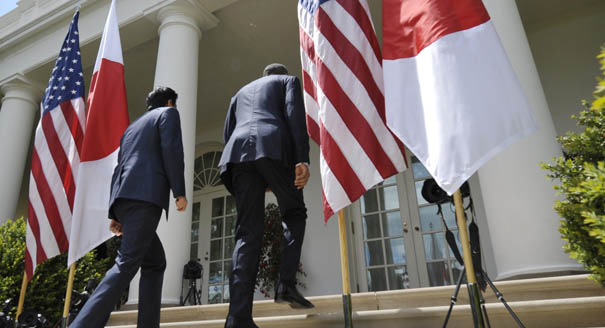
America’s leaders have drawn attention to a deep paradox of Japan’s nuclear story.
Source: Indian Express
In very different ways and for very different reasons, US President Barack Obama and the presumptive presidential nominee of the Republican Party, Donald Trump, have broken long-established taboos on Japan’s nuclear story. If Obama is asking America to meditate on the tragic nuclear bombing of Japan in 1945, Trump is preparing America to consider the prospect of a nuclear-armed Japan.
In a bold decision, Obama is travelling to Hiroshima later this month at the end of his visit to Japan to participate in the annual gathering of Western leaders. Obama will be the first US president to visit the city, where America dropped a nuclear bomb on August 6, 1945, killing about 80,000 people instantaneously.Obama’s decision hasn’t come as a total surprise. Secretary of State John Kerry travelled to Hiroshima last month, visited the memorial in the city for the victims of the nuclear bomb and called it a “gut-wrenching” reminder of the need to get rid of nuclear weapons.
For Obama, the passage to Hiroshima consolidates his political legacy in promoting nuclear disarmament, for which he won the Nobel peace prize in 2009. Meanwhile, Trump has moved the argument in an entirely different direction. He set off a political storm at the end of March by declaring that he would have no issue with Japan if it acquired nuclear weapons in order to secure itself.
The question of Japan’s nuclear weapons had come up in the context of Trump’s argument that America’s allies in Europe and Asia are not doing enough to share the burden of their defence by the US. In Europe, he said, Nato had long outlived its utility and would need to be thoroughly overhauled.
On Asia, Trump affirmed that Japan and South Korea must either pay more for the cost of the US military presence there or countenance the withdrawal of US troops. Trump has been unfazed when confronted with the question that the downsizing of the American military presence in Asia would result in the allies acquiring nuclear weapons. “Now, wouldn’t you rather in a certain sense have Japan have nuclear weapons when North Korea has nuclear weapons?” Trump said in a counter to the conventional nuclear wisdom in America.
Both Obama and Trump have come for much criticism. In the US, Obama’s Hiroshima visit is reigniting the controversy about the wisdom of using nuclear weapons against Japan in 1945. The dominant view in America is that the nuclear bombing of Hirsohima and Nagasaki helped bring World War II in Asia to an early close and saved many lives that would have been lost in an invasion of Japan. A small group of revisionist historians in America, however, has long insisted that the dropping of the bombs was entirely unnecessary and that the emperor’s surrender was at hand. Some analysts have seen the decision as the first act of the Cold War against the Soviet Union rather than the last act in the war against Japan. They suggest the bomb helped demonstrate America’s new military power and prevented an expansive role for Moscow in shaping post-war Asia.
Obama is not going to revisit President Harry Truman’s decision to drop nuclear weapons on Hiroshima and Nagasaki. Although the White House has clarified that there will be no speeches by Obama in Hiroshima, his critics insist his very presence will be seen in Japan as an apology.
Trump, in turn, has come in for criticism in the US for his readiness to upend the American alliance system in Asia, undermine the global non-proliferation regime by encouraging Japan to acquire atomic weapons, and encourage a nuclear arms race in Asia. Trump, however, has argued that the present order, where the US bears a large portion of the burden of defending two of the richest countries of Asia, is simply not sustainable.
Obama and Trump, if only inadvertently, have drawn attention to the deeper paradox of Japan’s nuclear story. Although Japan was the first and only victim of atomic weapons, its post-war security has depended on the American “nuclear umbrella”. Long before Trump, the credibility of the US’s extended deterrence had come under some questioning in Asia. Some in the region doubted if the alliance and the nuclear system designed against the Soviet threat would work against the current challenges from a rising China.
If China’s growing military power is putting pressure on America’s forward military presence in the Pacific, Beijing’s central role in the world economy and its new political weight are testing the durability of American alliances in Asia. One way out of this conundrum is for Japan to strengthen its own defences, embark on a more active regional security role and reconsider its nuclear-weapon option if the American alliance becomes unreliable.
Under Prime Minister Shinzo Abe, Japan has already adopted the first two propositions, but an open and serious discussion of the nuclear question remains quite controversial in Japan. But as the old taboos break down, such a Japanese discourse seems more likely in the years ahead.
Former Nonresident Senior Fellow, Carnegie India
A leading analyst of India’s foreign policy, Mohan is also an expert on South Asian security, great-power relations in Asia, and arms control.
Recent Work

C. Raja Mohan, Darshana M. Baruah


Alexander Gabuev, Paul Haenle, C. Raja Mohan, …
Carnegie does not take institutional positions on public policy issues; the views represented herein are those of the author(s) and do not necessarily reflect the views of Carnegie, its staff, or its trustees.

The acknowledgment has sparked fears of a new arms race with China and Russia.

Chris O’Meara
Smaller powers cannot go it alone, but Canadian history shows that integration with the United States will not always be benign.
Paul Samson

The European Commissioner for Trade is headed to China. But after President Xi’s bridge-building visit to Washington, can a more isolated EU overcome Beijing’s stranglehold on critical raw materials? Who will blink first?

Rym Momtaz, ed.

The summit may be remembered as a fatal blunder, when Washington, Beijing, and the AI industry collectively chose ceremony over action.

Jeffrey Prescott

European NATO countries are wrestling with the possibility of U.S. disengagement from the alliance. With the continent’s security increasingly uncertain, governments must restore the credibility of their collective defense.



Hans-Dieter Lucas, Adam Thomson, Pierre Vimont