

Paper
Renad Mansour, Faleh A. Jabar
{
  "authors": [
    "Renad Mansour"
  ],
  "type": "legacyinthemedia",
  "centerAffiliationAll": "",
  "centers": [
    "Carnegie Endowment for International Peace",
    "Malcolm H. Kerr Carnegie Middle East Center"
  ],
  "collections": [],
  "englishNewsletterAll": "",
  "nonEnglishNewsletterAll": "",
  "primaryCenter": "Malcolm H. Kerr Carnegie Middle East Center",
  "programAffiliation": "",
  "programs": [],
  "projects": [],
  "regions": [
    "Levant",
    "Iraq",
    "Middle East"
  ],
  "topics": [
    "Political Reform",
    "Security"
  ]
}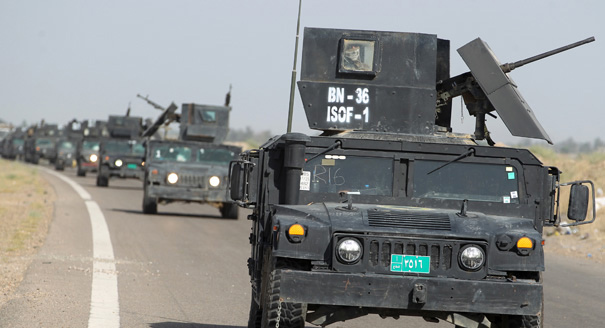
Source: Getty
The Iraqi Army is facing some significant challenges as it seeks to retake Fallujah from the self-proclaimed Islamic State.
Source: Al Jazeera
Carnegie’s Renad Mansour spoke with Laura Kyle on Al Jazeera’s Inside Story, alongside Matthew Glanville, former special adviser to the governor of Anbar Province, and Matthew Henman, head of IHS Jane’s Terrorism and Insurgency Centre, to discuss the Iraqi army’s offensive to retake Fallujah from the self-proclaimed Islamic State.
Mansour argued that Mosul was more of a symbolic target to retake than Fallujah. Previously, he explained, strategists thought that the way to defeat the Islamic State was to retake Mosul and then move onwards, given that the Islamic State had declared it’s self-described caliphate after taking the Mosul. Iraqi military strategies have had to change, however, with the Islamic State’s return to asymmetric warfare tactics, such as suicide bombings and targeting Baghdad directly.
Mansour pointed out that Fallujah is a somewhat of a quagmire and that occupiers have often faced difficulties in retaking the city. He argued that Iraqi state forces must find a way to win the hearts and minds of Fallujah residents. A significant amount of the Fallujah population support the Islamic State, he explained, which means that a viable alternative needs to be established and the Iraqi forces must convince the population that it is a better option.
Mansour added that there are lessons to be learned from Ramadi, particularly with regards to reconciliation. He argued that the Shia paramilitary groups, particularly those close to Maliki and Iran, cannot serve a large role in reconciliation or liberation, and that there should be a renewed focus on emergining leaders.
Former El-Erian Fellow, Middle East Center
Mansour was an El-Erian fellow at the Carnegie Middle East Center, where his research focuses on Iraq, Iran, and Kurdish affairs.
Recent Work
Renad Mansour, Faleh A. Jabar
Renad Mansour
Carnegie does not take institutional positions on public policy issues; the views represented herein are those of the author(s) and do not necessarily reflect the views of Carnegie, its staff, or its trustees.

Sergei Kiriyenko used Russia’s parliamentary vote to further hone his strategy of corporate mobilization that is designed to maximize votes for United Russia.

Andrey Pertsev

Before the next wave of EU enlargement takes place, the union needs to grapple with thorny questions of how power is distributed among its members.


Emil Sondaj Hansen, Ditte Brasso Sørensen

The Horn of Africa countries are among those facing a new security calculus.


Andrew Leber, Lesley Anne Warner

The European far right might fail to steer EU policy in the direction Russia wants, but they will create enough chaos inside Europe to benefit the Kremlin.

Dimitar Bechev

The new U.S.–Denmark–Greenland agreement will help Washington exert political, economic, and financial dominance under the guise of security. Yet, it acknowledged Copenhagen’s and Nuuk’s sovereignty on the island.

Marc Pierini