• Research
  • Emissary
  • About
  • Experts
Carnegie Global logoCarnegie lettermark logo
DemocracyIran
  • Donate
{
  "authors": [
    "Cory McKenzie",
    "William Ossoff"
  ],
  "type": "legacyinthemedia",
  "centerAffiliationAll": "dc",
  "centers": [
    "Carnegie Endowment for International Peace"
  ],
  "collections": [
    "Iranian Proliferation",
    "The United States and Japan in Asia"
  ],
  "englishNewsletterAll": "asia",
  "nonEnglishNewsletterAll": "",
  "primaryCenter": "Carnegie Endowment for International Peace",
  "programAffiliation": "AP",
  "programs": [
    "Asia",
    "Nuclear Policy"
  ],
  "projects": [],
  "regions": [
    "East Asia",
    "Japan"
  ],
  "topics": [
    "Nuclear Policy"
  ]
}

Source: Getty

In The Media

Tokyo-Tehran Ties and the U.S.-Japan Alliance

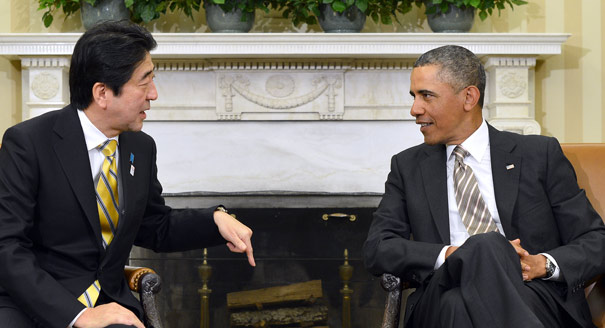
While Japan is not a party to the Iran nuclear deal, it played an important role in its conclusion and could prove influential in its implementation.

Link Copied
By Cory McKenzie and William Ossoff
Published on May 4, 2016
Program mobile hero image

Program

Asia

The Asia Program in Washington studies disruptive security, governance, and technological risks that threaten peace, growth, and opportunity in the Asia-Pacific region, including a focus on China, Japan, and the Korean peninsula.

Learn More
Program mobile hero image

Program

Nuclear Policy

The Nuclear Policy Program aims to reduce the risk of nuclear war. Our experts diagnose acute risks stemming from technical and geopolitical developments, generate pragmatic solutions, and use our global network to advance risk-reduction policies. Our work covers deterrence, disarmament, arms control, nonproliferation, and nuclear energy.

Learn More

Source: Diplomat

While Japan is not a party to the Joint Comprehensive Plan of Action (JCPOA), popularly known as “the Iran nuclear deal,” it played an important role in the conclusion of this international agreement and could be influential in its implementation. The global sanctions regime that helped drive Iran to the negotiating table depended upon the participation of major economic players like Japan. In concert with its U.S. ally and the rest of the international community, Japan endured economic costs in pursuit of shared nuclear nonproliferation principles and broader national interests. The JCPOA is an underappreciated example of cooperation between the United States and Japan on this front.

However, as the one-year anniversary of the JCPOA approaches in July, U.S. and Japanese interests are showing signs of divergence. Japan is expanding investment in Iran’s energy sector while the United States remains at odds with Iran over non-nuclear issues. How will Japan’s deepening economic partnership with Iran impact international nonproliferation efforts and the U.S.-Japan Alliance?...

Read the full article at the Diplomat.

About the Authors

Cory McKenzie

Former Junior Fellow, Asia Program

William Ossoff

Former Junior Fellow, Nuclear Policy Program

Authors

Cory McKenzie
Former Junior Fellow, Asia Program
William Ossoff
Former Junior Fellow, Nuclear Policy Program
Nuclear PolicyEast AsiaJapan

Carnegie does not take institutional positions on public policy issues; the views represented herein are those of the author(s) and do not necessarily reflect the views of Carnegie, its staff, or its trustees.

More Work from Carnegie Endowment for International Peace

  • Commentary
    Strategic Europe
    Europe on Iran: Gone with the Wind

    Europe’s reaction to the war in Iran has been disunited and meek, a far cry from its previously leading role in diplomacy with Tehran. To avoid being condemned to the sidelines while escalation continues, Brussels needs to stand up for international law.

      Pierre Vimont

  • An elderly woman walks past a poster at a health centre in Gunwi, some 200 kilometres south of Seoul
    Paper
    Governing Aging Economies: South Korea and the Politics of Care, Safety, and Work

    South Korea’s rapid demographic transition previews governance challenges many advanced and middle-income economies will face. This paper argues that aging is not only a care issue but a structural governance challenge—reshaping welfare, productivity, and fiscal sustainability, and reorganizing responsibilities across the state, private sector, and society.

      Darcie Draudt-Véjares

  • Commentary
    Strategic Europe
    Macron Makes France a Great Middle Power

    France has stopped clinging to notions of being a great power and is embracing the middle power moment. But Emmanuel Macron has his work cut out if he is to secure his country’s global standing before his term in office ends.

      • Rym Momtaz

      Rym Momtaz

  • Escalation Dynamics Under the Nuclear Shadow—India’s Approach
    Paper
    Escalation Dynamics Under the Nuclear Shadow—India’s Approach

    An exploration into how India and Pakistan have perceived each other’s manipulations, or lack thereof, of their nuclear arsenals.

      • Rakesh Sood

      Rakesh Sood

  • Commentary
    Carnegie Politika
    For Putin, Increasing Russia’s Nuclear Threat Matters More Than the Triad’s Modernization

    For Putin, upgrading Russia’s nuclear forces was a secondary goal. The main aim was to gain an advantage over the West, including by strengthening the nuclear threat on all fronts. That made growth in missile arsenals and a new arms race inevitable.

      Maxim Starchak

Get more news and analysis from
Carnegie Endowment for International Peace
Carnegie global logo, stacked
1779 Massachusetts Avenue NWWashington, DC, 20036-2103Phone: 202 483 7600Fax: 202 483 1840
  • Research
  • Emissary
  • About
  • Experts
  • Donate
  • Programs
  • Events
  • Blogs
  • Podcasts
  • Contact
  • Annual Reports
  • Careers
  • Privacy
  • For Media
  • Government Resources
Get more news and analysis from
Carnegie Endowment for International Peace
© 2026 Carnegie Endowment for International Peace. All rights reserved.