

Paper
Yezid Sayigh
{
  "authors": [
    "Yezid Sayigh"
  ],
  "type": "legacyinthemedia",
  "centerAffiliationAll": "dc",
  "centers": [
    "Carnegie Endowment for International Peace",
    "Malcolm H. Kerr Carnegie Middle East Center"
  ],
  "collections": [
    "Arab Awakening",
    "Conflict and Refugees"
  ],
  "englishNewsletterAll": "menaTransitions",
  "nonEnglishNewsletterAll": "",
  "primaryCenter": "Malcolm H. Kerr Carnegie Middle East Center",
  "programAffiliation": "MEP",
  "programs": [
    "Middle East"
  ],
  "projects": [],
  "regions": [
    "Levant",
    "Syria",
    "Middle East"
  ],
  "topics": [
    "Political Reform",
    "Economy"
  ]
}
Source: Getty
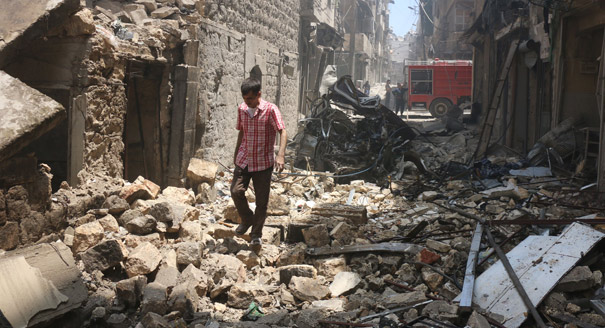
When the time comes, new approaches to economic reconstruction are needed in Syria.
Source: Al Jazeera
In late May the World Bank ran a feature story on “The Importance of Planning Syria’s Eventual Reconstruction,” which advocated innovative use of satellite imagery and social media analytics to assess physical damage and prepare not for “the day after,” but for “the day before.” Of course, the Syrian conflict is far from over and there is little prospect yet of the kind of orderly, integrated, and timely policy interventions that the World Bank and similar agencies specialize in. The blueprints they may devise will inevitably be overtaken by events and have to be redesigned. But planning is crucial, because it compels political as well as technocratic actors to identify needs and priorities and to develop the skills and resources that will be necessary for such a momentous task.
However, although forward-looking approaches of the kind advocated by the World Bank are absolutely necessary, they need to break out of the mold of international practice to date. Post-conflict reconstruction evolved into a distinct field of policy praxis following the end of the Cold War, but its track record since then in bringing real “peace dividends,” generating security (or preventing a renewal of armed conflict), creating jobs, and building the basis for genuine, equitable, and sustained economic growth has been very uneven.
Not only have there been more failures than success stories – think Afghanistan, Democratic Republic of Congo, Iraq, Lebanon, Libya, and Palestine – but the failures have left populations in the affected post-conflict countries worse off then before in social and economic terms. (For those who regard some of these instances as qualified successes, they are at best in a state of suspended conflict, characterized by intensified economic cronyism, rampant corruption, and deep state erosion.)For effective reconstruction to be even remotely possible in Syria, relevant local and international actors and agencies must think through the dynamics that will shape the actual course and outcomes of any effort they invest there. Planners, policy- and decision-makers, and activists alike must look beyond bricks and mortar and the macro-economic or sectoral level of design needs. Too often, the focus is on physical reconstruction, and the provision of associated technical and managerial skills. But no less important are the intangibles – social, political, and institutional dynamics – that will be generated by – and shape – post-conflict reconstruction in Syria and the associated repatriation of refugees and internally displaced persons.
Numerous challenges stand in the way, but three stand out.
First is to alter how international donors and national elites conceive the task, in ways the take their perspectives and interests as the primary reference point. Despite endless talk of “lessons learned,” international donors tend to reapply the same policies and strategies as in previous post-conflict reconstruction efforts in other countries. A principal example is their tendency – welcomed by local national elites – to focus on strengthening central state institutions in order to deliver results effectively and swiftly. But claimed gains in efficiency are rarely borne out.
In Syria, especially, devolving and decentralizing decision-making, program design and priority-setting, and command of resources may be more effective. Certainly it is more likely to reflect better the particular needs of vulnerable sectors such as women, refugees, and rural communities or clans – who risk being more marginalized by the end of reconstruction processes than at the start – and to produce better societal buy-in.
The risk that national elites or powerful networked actors will skew resource flows and use their control to increase their power reveals the second challenge: enabling local communities to exercise meaningful governance. Western donors tend to approach reconstruction with a basket of ready labels such as “stakeholders,” “ownership,” “accountability,” “transparency,” and “best practice,” but often these are a poor guide to how governance – a much-abused term – is actually conducted.
The complex make-up of Syrian society necessitates building any governance model around the highly localized nature of social dynamics, economic opportunity and access, and institutions that deliver services and governance. Devolving responsibility for choosing priorities and managing implementation to local communities across Syria may be the most effective way to achieve meaningful legitimacy and accountability, and also to mute sectarian and ethnic differences. Whatever the precise detail, reconstruction programs should be designed around genuine “ownership” by, and accountability to, Syrians – not by and to donors, which is far and away the predominant pattern.
Third, as with any area of policy or program design, a central question is who actually sets the agenda? To take a paramount example, most political actors involved in the Syrian crisis formally avow free-market economics. But preferences and expectations differ widely among urban versus rural communities, the merchant class versus the state salariat, and established parties such as the Muslim Brotherhood versus newcomers such as the Salafists. No less pertinently, both international and regional actors will use the offer of reconstruction aid and investments to promote their own commercial interests, generating potentially dysfunctional dynamics and counter-productive incentive structures in the post-conflict political economy of Syria.
With Bashar al-Assad looking set to remain in power for the foreseeable future, it may seem premature to think too ambitiously about reconstruction. But as and when it becomes feasible, the challenges raised above must be addressed. Otherwise reconstruction will simply empower those who already possess key political levers and social capital, and produce skewed results in terms of reintegration of refugees and displaced persons, societal reconciliation, and sustainable, equitable economic development.

Senior Fellow, Malcolm H. Kerr Carnegie Middle East Center
Yezid Sayigh is a senior fellow at the Malcolm H. Kerr Carnegie Middle East Center in Beirut, where he leads the program on Civil-Military Relations in Arab States (CMRAS). His work focuses on the comparative political and economic roles of Arab armed forces, the impact of war on states and societies, the politics of postconflict reconstruction and security sector transformation in Arab transitions, and authoritarian resurgence.
Recent Work
Yezid Sayigh
Yezid Sayigh
Carnegie does not take institutional positions on public policy issues; the views represented herein are those of the author(s) and do not necessarily reflect the views of Carnegie, its staff, or its trustees.

In the discussions made possible by the State Duma election campaign, one question is being asked more and more loudly. “What next?”

Andrey Pertsev
Lee’s tour shows how Seoul is reorganizing its diplomacy away from Pyongyang and toward industrial networks and the geography of the compute economy.

Darcie Draudt-Véjares
Most migrants may have left Ceuta, but the effects may linger.


Alejandro Martin Rodriguez, Sarah Yerkes
Saied’s main accomplishment has been to destroy a decade’s worth of democratic progress.
Sarah Yerkes
The targeting of Damietta Port appears to be more than a mere security message.

Amr Hamzawy