

Article
Hans-Dieter Lucas, Adam Thomson, Pierre Vimont
{
  "authors": [
    "Pierre Vimont"
  ],
  "type": "legacyinthemedia",
  "centerAffiliationAll": "dc",
  "centers": [
    "Carnegie Endowment for International Peace",
    "Carnegie Europe"
  ],
  "collections": [
    "Europe’s Southern Neighborhood",
    "Conflict and Refugees"
  ],
  "englishNewsletterAll": "ctw",
  "nonEnglishNewsletterAll": "",
  "primaryCenter": "Carnegie Europe",
  "programAffiliation": "EP",
  "programs": [
    "Europe"
  ],
  "projects": [],
  "regions": [
    "Middle East",
    "Europe",
    "North Africa",
    "Western Europe",
    "Iran"
  ],
  "topics": [
    "EU",
    "Migration",
    "Democracy"
  ]
}
Source: Getty
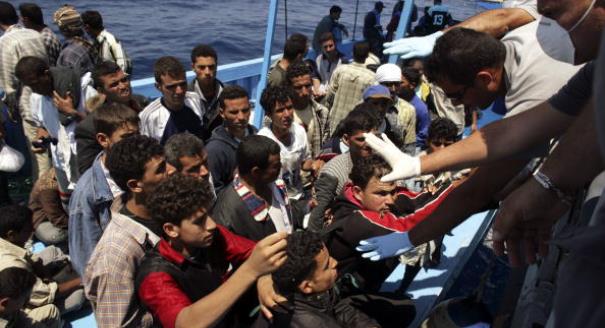
Thousands of African refugees and migrants risk their lives every day to reach Europe, but what can be done to persuade them not to take this perilous journey?
Source: Al Jazeera’s Inside Story
Speaking to Al Jazeera’s Inside Story, Pierre Vimont was asked to comment on Europe’s refugee crisis and what should be done to deter refugees from crossing the Mediterranean Sea. He was joined by Patricia Danzi, the Red Cross’s regional director for Africa, and Sara Tesorieri, policy and advocacy adviser for the Norwegian Refugee Council.

Senior Fellow, Carnegie Europe
Pierre Vimont is a senior fellow at Carnegie Europe. His research focuses on the European Neighborhood Policy, transatlantic relations, and French foreign policy.
Recent Work


Hans-Dieter Lucas, Adam Thomson, Pierre Vimont
Pierre Vimont
Carnegie does not take institutional positions on public policy issues; the views represented herein are those of the author(s) and do not necessarily reflect the views of Carnegie, its staff, or its trustees.

The truth of the strategic situation is that Europe and Russia are extremely unlikely to be able to “turn the page” on their confrontation within the next two decades.
Arkady Moshes

It signals a new era of tech diffusion and warfare.

Steve Feldstein

With its public finances in shambles, the far right polling at 35 percent ahead of the 2027 presidential election, and a growing protest movement, is France’s crisis a threat to the EU’s geopolitical awakening?

Rym Momtaz, ed.

Ahead of a tough winter for Ukraine, Donald Trump’s swing back toward Russia bodes ill. But instead of panicking, Kyiv’s European allies are focusing on action.
Rym Momtaz

Funding Ukraine remains a priority for European leaders. As Russia’s war of aggression heads into another winter, two feasible options to mobilize support for Kyiv should be fast-tracked.


Vladyslav Rashkovan, Gregory P. Wilson