
A conflict launched in the name of American security is producing the opposite effect.
Sarah Yerkes
{
"authors": [
"Sharanya Rajiv"
],
"type": "legacyinthemedia",
"centerAffiliationAll": "",
"centers": [
"Carnegie Endowment for International Peace",
"Carnegie India"
],
"collections": [],
"englishNewsletterAll": "",
"nonEnglishNewsletterAll": "",
"primaryCenter": "Carnegie India",
"programAffiliation": "",
"programs": [],
"projects": [],
"regions": [
"South Asia",
"India",
"Europe"
],
"topics": [
"Foreign Policy"
]
}Source: Getty
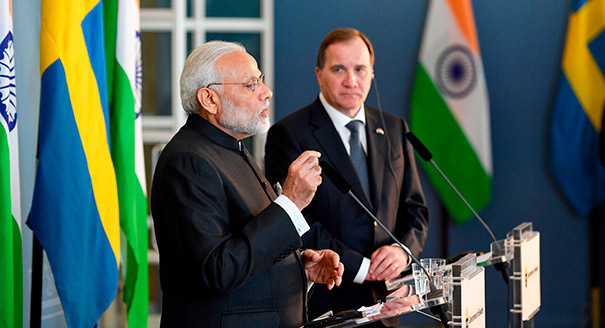
The India-Nordic Summit, which explored areas for practical cooperation and strategic convergence between both sides, represents a fundamentally new approach toward the relationship.
Source: Diplomat
During Prime Minister Narendra Modi’s visit to Stockholm last week, the first in 30 years, in addition to bilateral meetings with the prime ministers of Denmark, Finland, Iceland, Norway, and Sweden (the Nordic states), India and Sweden also co-hosted the first ever India-Nordic Summit. The summit, which explored areas for practical cooperation and strategic convergence between both sides, represents a fundamentally new approach toward the relationship.
Sharanya Rajiv
Carnegie does not take institutional positions on public policy issues; the views represented herein are those of the author(s) and do not necessarily reflect the views of Carnegie, its staff, or its trustees.
A conflict launched in the name of American security is producing the opposite effect.
Sarah Yerkes
Donald Trump has demanded that European allies send ships to the Strait of Hormuz while his war of choice in Iran rages on. He has constantly berated NATO while the alliance’s secretary-general has emphatically supported him.
Rym Momtaz, ed.
The continent needs to improve conditions for production of complete AI robotic systems and preserve its edge in hardware.
Pavlo Zvenyhorodskyi
Trump 2.0 has unsettled India’s external environment—but has not overturned its foreign policy strategy, which continues to rely on diversification, hedging, and calibrated partnerships across a fractured order.
Milan Vaishnav, ed., Sameer Lalwani, Tanvi Madan, …
Lukashenko is willing to make big sacrifices for an invitation to Mar-a-Lago or the White House. He also knows that the clock is ticking: he must squeeze as much out of the Trump administration as he can before congressional elections in November leave Trump hamstrung or distracted.
Artyom Shraibman








