

Commentary
Are Germany’s economic, industrial, and political struggles becoming a liability for the EU’s ability to rise to the geopolitical moment?
Rym Momtaz, ed.
{
  "authors": [
    "Dalia Ghanem",
    "Raquel Barras Tejudo",
    "Giovanni Faleg",
    "Yahia H. Zoubir"
  ],
  "type": "other",
  "centerAffiliationAll": "dc",
  "centers": [
    "Carnegie Endowment for International Peace",
    "Malcolm H. Kerr Carnegie Middle East Center"
  ],
  "collections": [],
  "englishNewsletterAll": "menaTransitions",
  "nonEnglishNewsletterAll": "",
  "primaryCenter": "Malcolm H. Kerr Carnegie Middle East Center",
  "programAffiliation": "MEP",
  "programs": [
    "Middle East"
  ],
  "projects": [],
  "regions": [
    "Maghreb",
    "North Africa"
  ],
  "topics": [
    "Security"
  ]
}
Source: Getty
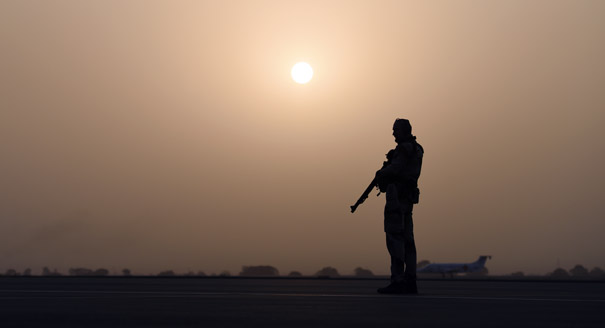
The Sahel is a source of high instability for the Maghreb and by extension for Europe.
Source: EuroMeSCo
Over the last decade, the EU’s engagement in the Sahel region has dramatically increased and is now more than ever focused on security. The Sahel has been suffering from a multidimensional crisis, such as poor governance, corruption, structural weaknesses and underdevelopment, while challenges such as droughts and famine affect all levels of society and can lead to strikes, revolts and violence. One must also add criminality, illicit trafficking and the rise of Jihadism. As a result, the Sahel is a source of high instability for the Maghreb and by extension for Europe.
The EU has been fostering bilateral and multilateral initiatives with Sahelian countries and tried to improve the dire socioeconomic conditions and the security situation. Despite all these efforts, the Sahel remains a quagmire and is likely to continue to be for the next decade. To stop the dangers coming from the Sahel, the EU must harmonise its multiple approaches to the region and ensure the ownership of Sahelian states over what happens and what is being undertaken, notably through the African Union and the Economic Community of West African States. Moreover, the EU has to treat regional partners such as Algeria like fully-fledged partners in Sahelian affairs.
The Joint Policy Study is composed of four chapters. The first chapter assesses the Jihadist threat in the Sahel; the second the impacts of foreign interventions; the third weighs the importance of including Algeria, an indisputable military power and peace broker; and, finally, the fourth assesses climate and demographic challenges for Sahelian security. All four chapters provide EU policy-makers with a set of policy recommendations to better approach what have become Europe’s African borders.
This Joint Policy Study was written in the framework of the EuroMeSCo Working Package “Sahel and Security in the Mediterranean”, led by Dr. Dalia Ghanem-Yazbeck, Resident Scholar at Carnegie Middle East Centre.
Former Senior Resident Scholar, Malcolm H. Kerr Carnegie Middle East Center
Dalia Ghanem was a senior resident scholar at the Malcolm H. Kerr Carnegie Middle East Center in Beirut, where her research focuses on Algeria’s political, economic, social, and security developments. Her research also examines political violence, radicalization, civil-military relationships, transborder dynamics, and gender.
Raquel Barras Tejudo
Giovanni Faleg
Yahia H. Zoubir
Carnegie does not take institutional positions on public policy issues; the views represented herein are those of the author(s) and do not necessarily reflect the views of Carnegie, its staff, or its trustees.

Are Germany’s economic, industrial, and political struggles becoming a liability for the EU’s ability to rise to the geopolitical moment?

Rym Momtaz, ed.

China’s police training infrastructure construction projects provide benefits to recipient countries, promote China’s image as a major global security provider, and are likely to reinforce alignment between Beijing’s security priorities and those of countries in the Global South.


Cameron Waltz, Sheena Chestnut Greitens, Kim Nguyen, …
They face an uphill climb, but they could draw on a strategy that other diplomats have used in the past.


Shana Tabak, Alejandro Martin Rodriguez

Understanding the climatic pain points is necessary for policymakers hoping to minimize the war’s negative environmental consequences.


Alejandro Martin Rodriguez, Joy Arkeh, Sarah Yerkes

The books, podcasts, and films that explain the world it made.

Andrew Leber