

Research
- +10
Rosa Balfour, Frances Z. Brown, Yasmine Farouk, …
{
  "authors": [
    "Moisés Naím"
  ],
  "type": "legacyinthemedia",
  "centerAffiliationAll": "",
  "centers": [
    "Carnegie Endowment for International Peace"
  ],
  "collections": [],
  "englishNewsletterAll": "",
  "nonEnglishNewsletterAll": "",
  "primaryCenter": "Carnegie Endowment for International Peace",
  "programAffiliation": "",
  "programs": [],
  "projects": [],
  "regions": [
    "North America",
    "United States",
    "South America",
    "Russia"
  ],
  "topics": [
    "Political Reform",
    "Foreign Policy",
    "Global Governance"
  ]
}
Source: Getty
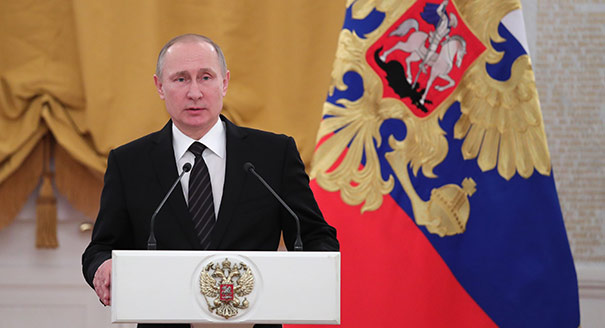
The best antidote to an opaque world is an independent media. The Kremlin-controlled media is an effective user of new options offered by an increasingly blurred world.
Source: Global Observer
Crimea was not invaded by the Russian Army, but rather by armed civilian militias. In February 2014, they rose up against the Ukrainian government in order to “free the region” and annex it to the Russian motherland. That, anyway, is the official version of events according to the Kremlin-controlled media. Never mind that there is irrefutable proof that the “patriots” who took Crimea by force were, in fact, Russian troops who were ordered to remove any identifying badges and insignia from their uniforms, tanks, and equipment just before the invasion.
Something similar is happening in the world of finance. Forty percent of the world’s foreign direct investment is essentially fictitious. When a company or person invests in tangible assets (machines, buildings, etc.) in another country, they are making a foreign direct investment. But it turns out that 40% of all these investments are, like Crimea’s “civilian patriots,” a deception. Economists Jannick Damgaard and Thomas Elkjaer have just published the results of their research on “phantom investments.” They discovered that “a stunning $12 trillion…is completely artificial: it consists of financial investment passing through empty corporate shells with no real activity.” This movement of funds is used to hide fortunes, launder assets, or avoid taxes. Despite regulators’ best efforts, the international financial system remains opaque. With the emergence of cryptocurrencies such as Bitcoin, Ethereum and others, carrying out financial transactions anonymously has become easier than ever.
With the emergence of cryptocurrencies such as Bitcoin, Ethereum and others, carrying out financial transactions anonymously has become easier than ever
The proliferation of entities that claim to be one thing, but which in reality are another, also occurs in non-governmental organizations (NGOs) that presumably have philanthropic purposes and purport to help others. Often, they do nothing of the sort. They are vehicles used to surreptitiously defend particular interests and non-benevolent causes. Some governments also use them to act without being seen. These types of organizations are called GONGOs: government-organized non-governmental organizations. An example of this is a non-profit called World Without Nazism. It is based in Moscow, run by a politician linked to Vladimir Putin, and its mission is to spread anti-fascist ideology in former Soviet republics. In fact, it’s a propaganda tool to back the Kremlin's international line.
Vladimir Putin’s government is an enthusiastic and effective user of the many new options offered by our increasingly opaque world. “Pope Francis surprises the world and endorses Donald Trump for the US presidency.” This was one of the “news” headlines that went viral on social media just before the 2016 election. It was false, of course. But it was only one of the millions of messages aimed at voters that, according to US intelligence agencies, were part of a deliberate attack by Moscow. In January 2017, these same agencies announced that they were certain that the Kremlin favored Donald Trump to win the elections and that President Vladimir Putin personally ordered an “influence campaign” aimed at weakening Hillary Clinton and intended “to undermine public faith in the US democratic process.” In November 2017 Spain accused Russia of intervening in the Catalan crisis by surreptitiously disseminating false information. The British government also denounced Russian interference in its recent elections. All of these operations were done covertly.
The most worrisome aspect of the rise in opacity is the wholesale destruction of the editorial independence of the very media outlets that warn us of the plots and misdeeds of the bad guys
Naturally, the best antidote to an opaque world is an independent media that operates without the interference of governments, political parties, private companies, or criminal cartels. We depend on them to find out what lies hidden behind the innocent-looking fronts used by organizations and individuals who are really out to harm society. That’s why the most worrisome aspect of the rise in opacity is the wholesale destruction of the editorial independence of the very media outlets that warn us of the plots and misdeeds of the bad guys. In Russia, Hungary, Turkey, Venezuela, and many other autocracies that try to pass themselves off as democracies, the furtive takeover of a newspaper, magazine, radio, or television station by “private investors” who are in fact government allies and fund their investment with public funds is now the rule.
The danger is that this trick is also becoming common in countries that still have functioning democracies.
Preventing the proliferation of this and similar practices that make the world more opaque is one of the most important and defining struggles of our time.

Distinguished Fellow
Moisés Naím is a distinguished fellow at the Carnegie Endowment for International Peace, a best-selling author, and an internationally syndicated columnist.
Recent Work



Rosa Balfour, Frances Z. Brown, Yasmine Farouk, …
Moisés Naím
Carnegie does not take institutional positions on public policy issues; the views represented herein are those of the author(s) and do not necessarily reflect the views of Carnegie, its staff, or its trustees.

A notable degree of participative democracy has firmly arrived in Europe. But to have more far-reaching impact, democratic deliberation needs to move into a radically new phase.

Richard Youngs

Much has been said of the changes Brussels is trying to make to the EU enlargement process. Here’s why gradual integration might—or might not—be the answer.

Dimitar Bechev
Economic recovery has brought Sri Lanka a modicum of stability, but domestic strains and great-power rivalry could test how long it lasts.
Avinash Paliwal
Policy proposals on sovereign debt must both match the scale of the challenge and be implementable within existing political constraints.
David McNair

Despite a new textbook, an influx of Russian teachers and managers, and an end to the teaching of Ukrainian, the Kremlin is unlikely to have “reprogrammed” locals.

Konstantin Skorkin