

Commentary
Amid celebrations of bilateral ties was a deeper focus on stability in the Middle East.
Amr Hamzawy
{
  "authors": [
    "Shi Zhiqin"
  ],
  "type": "legacyinthemedia",
  "centerAffiliationAll": "",
  "centers": [
    "Carnegie Endowment for International Peace",
    "Carnegie China"
  ],
  "collections": [
    "China’s Foreign Relations"
  ],
  "englishNewsletterAll": "",
  "nonEnglishNewsletterAll": "",
  "primaryCenter": "Carnegie China",
  "programAffiliation": "",
  "programs": [],
  "projects": [],
  "regions": [],
  "topics": [
    "Economy"
  ]
}
Source: Getty
Despite the established comprehensive strategic partnership between China and the EU, mutual trust is still lacking.
Source: Global Times
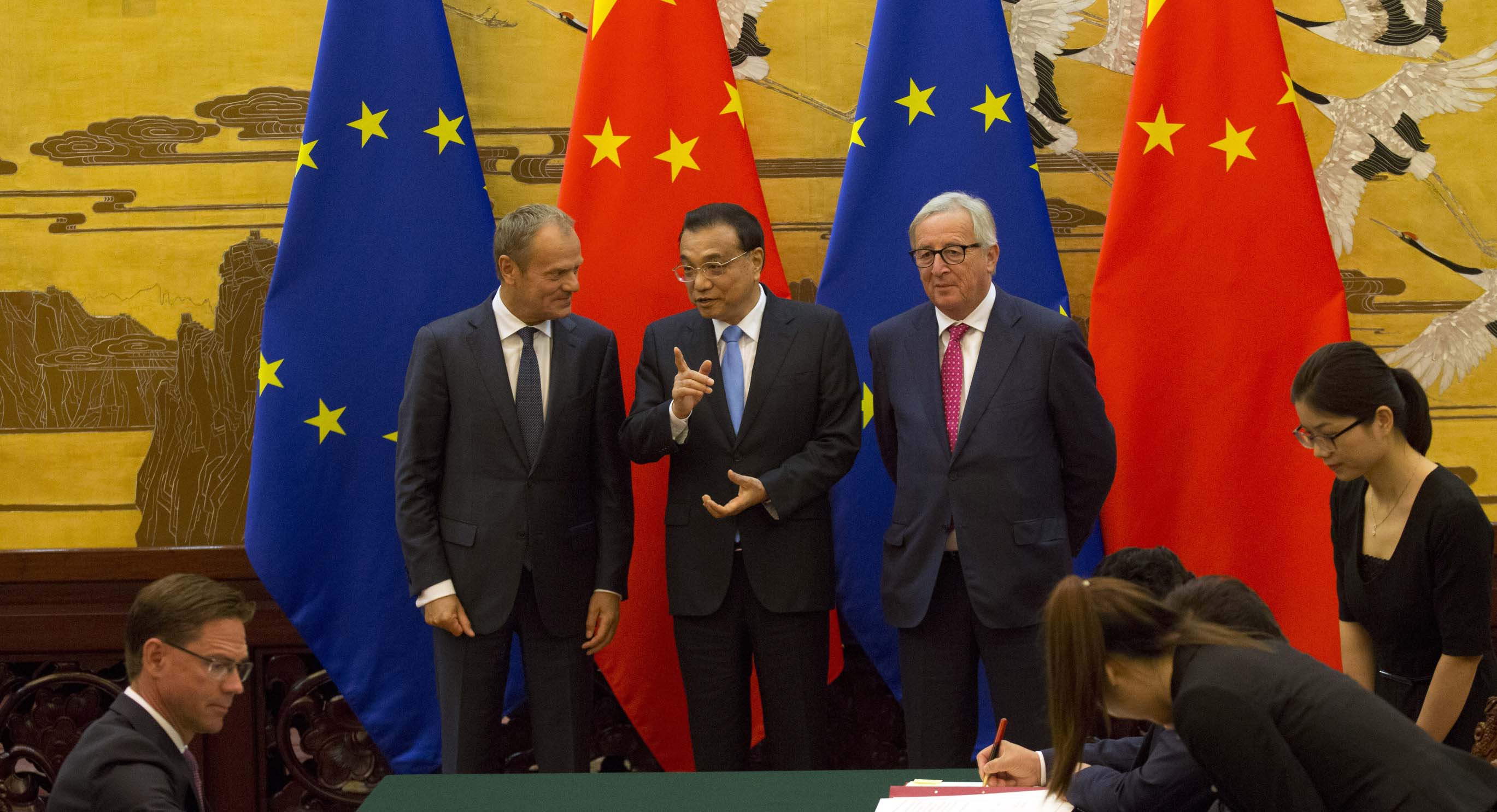
Premier Li Keqiang is making his trip to Europe merely two weeks after President Xi Jinping visited the continent.
It is undoubtedly of immense diplomatic significance that a country’s head of state and head of government visited the same region in such a short period of time.
As the 2019 European Parliament election looms, the situation in Europe remains uncertain. In general, state and regional leaders prefer not to organize important diplomatic activities prior to elections. Nonetheless, Li’s visit to the EU happens to precede the election, indicating mature China-EU relations and the irreversible trend of bilateral cooperation regardless of the election results.
Facing the accumulated problems in Europe, most mainstream European political parties failed to offer effective solutions. If nationalist parties make breakthroughs in the election, European politics is likely to see significant changes. But one thing is for certain: In the age of globalization, China and EU, the two major economies in the world, will deepen cooperation no matter which parties take the lead in the European Parliament.
Besides, the Brexit deadlock poses a great challenge to Europe, but may bring about new possibilities in China-UK cooperation. During the Brexit process, the UK must decide where to go without the European market, and has to seek other good partners for international trade, which may provide a favorable opportunity for China-UK ties.
Be that as it may, challenges in China-EU relations still remain.
First, despite the established comprehensive strategic partnership between China and the EU, mutual trust is still lacking. China has always supported a stable, prosperous and united process of European integration. While the United States and other Western countries bad-mouthed Europe during the European debt crisis, it was China that expressed confidence and support for European integration. China also purchased bonds to help European countries like Greece weather the financial storm.
Second, some European politicians and scholars have always been hyping up a conspiracy theory. When we deal with Europe, on one hand, we value the relations with the European Commission; on the other, we also lay stress on ties with other European powers. Europe suspects that we try to divide them. China's participation in the 16+1 mechanism to cooperate with Central and Eastern European countries is suspected as meddling in Europe's internal affairs and seeking its own geopolitical purposes.
In Europe, some opinions say the China-proposed Belt and Road Initiative is profitable not for Europe, but for China. Such an argument hurts China-Europe cooperation every now and then. Some European countries think China violates human rights on the pretext of internal affairs, such as ethnic and religious issues.
Third, in normal trade cooperation, the EU often accuses China of not following EU rules or international regulations and lacking market transparency. It also claims that China deals with Europe in an unsustainable way. Some believe China does not seek mutual benefits in its cooperation with Europe, but does it only for its own interests.
Faced with these problems, the most important thing is to increase mutual trust on both sides. But how to achieve it?
First, China and Europe should insist on established cooperation mechanism, such as the EU-China summit at the moment. The two sides need to continue to strengthen high-level visits and strategic dialogue. Moreover, the people-to-people exchanges, including among governments, scholars, ordinary people, can be increased. All this can help augment bilateral understanding and respect.
Second, China and Europe should also mutually adapt and seek common ground while shelving differences. Both sides have different histories, cultures and social and political systems. Under such circumstances, we need to adapt to each other, making cooperation as the ultimate goal and direction.
China has always emphasized continuous opening-up and promotion of reforms. China always makes it a point to increase transparency based on international rules. When cooperating with Europe, China seeks to follow international rules and EU rules, as well as promote mutual understanding.
Shi Zhiqin
Former Resident Scholar, Carnegie-Tsinghua Center for Global Policy
Shi Zhiqin was a resident scholar at the Carnegie-Tsinghua Center until June 2020.
Carnegie does not take institutional positions on public policy issues; the views represented herein are those of the author(s) and do not necessarily reflect the views of Carnegie, its staff, or its trustees.
Amid celebrations of bilateral ties was a deeper focus on stability in the Middle East.

Amr Hamzawy

Xi, Putin, and other regional leaders are back-slapping in Bishkek, but the SCO has yet to answer the most serious questions about continental Asia's economic future.

Evan A. Feigenbaum

The conflict has sent economic and political shock waves through a country with no representation at the negotiating table—and Kenya is not alone.

Georgia Schaefer-Brown, Jane Munga

China’s banking crisis in the 2000s was resolved by transferring the costs to households through financial repression—a decision that recapitalized the banks while exacerbating the structural imbalances that continue to shape the Chinese economy today.

Michael Pettis
Lee’s tour shows how Seoul is reorganizing its diplomacy away from Pyongyang and toward industrial networks and the geography of the compute economy.

Darcie Draudt-Véjares