

Research
- +10
Rosa Balfour, Frances Z. Brown, Yasmine Farouk, …
{
  "authors": [
    "Moisés Naím"
  ],
  "type": "legacyinthemedia",
  "centerAffiliationAll": "",
  "centers": [
    "Carnegie Endowment for International Peace"
  ],
  "collections": [],
  "englishNewsletterAll": "",
  "nonEnglishNewsletterAll": "",
  "primaryCenter": "Carnegie Endowment for International Peace",
  "programAffiliation": "",
  "programs": [],
  "projects": [],
  "regions": [
    "North America",
    "United States",
    "South America",
    "Western Europe",
    "United Kingdom"
  ],
  "topics": [
    "Political Reform",
    "Democracy",
    "Foreign Policy",
    "Global Governance"
  ]
}
Source: Getty
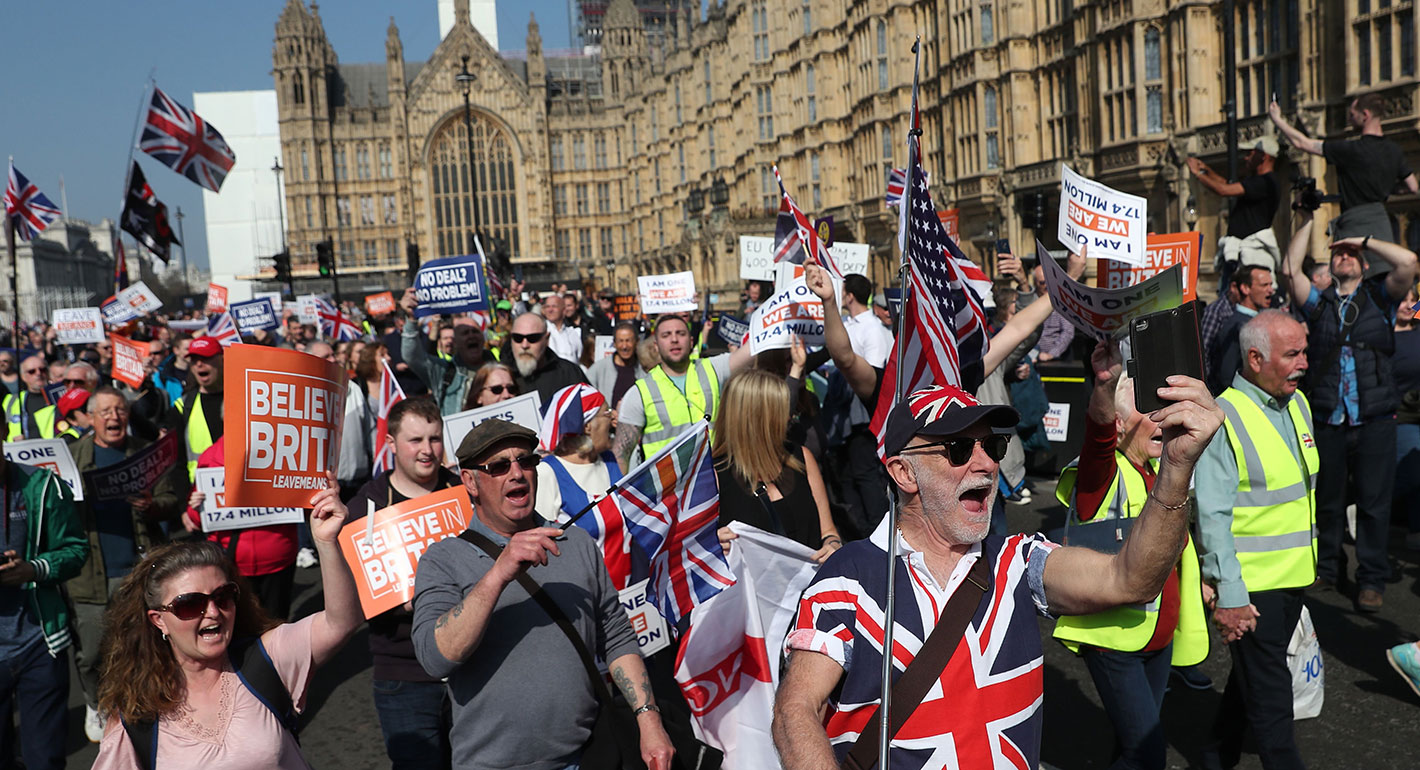
Brexit has plunged the English political system into a deep crisis and Trump has transformed American politics and perhaps the world. They have similarities that reveal some important toxins that are undermining modern democracies.
Source: El País
Sometimes elections and referendums change the course of history.
For example, in June 2016, Britain decided to leave the European Union in the famous Brexit referendum. Also in 2016, Donald Trump won the US election and found himself in the White House. And in December 1998, Venezuelans elected Hugo Chávez president.
Today Brexit has plunged the English political system into a deep crisis, Trump has transformed American politics and perhaps the world, and Chávez is responsible for a national catastrophe that is now becoming a crisis for much of Latin America.
These three cases are, of course, very different. But they also have similarities that reveal some important toxins that are undermining modern democracies.
1. Antipolitics. All three of these examples are manifestations of the troubling rejection of the established political system and the presumption that traditional politicians use politics for their personal benefit and not for the common good. Those who voted for Brexit, Trump, and Chávez felt that just evicting those who had governed in the past would improve their personal situation or, at least, serve as lesson to the powerful. “Throw them all out!” and “Nothing could be worse than what we have now!” are the common slogans that energize antipolitics everywhere.
2. Weak Political Parties. In these three examples, the unexpected election results were made possible in significant measure thanks to a weakening of the established political parties. The two traditional British parties – the Labour Party and the Conservative Party – were split internally, which prevented them from effectively confronting Brexit’s promoters. The same thing happened to the Republican Party in the US, whose fragmentation made it possible for an outsider such as Trump to become its presidential candidate. This was also the case in Venezuela, where the two historical parties had collapsed, leaving the door open for a dark horse like Hugo Chávez.
3. The Normalization of Lying. Almost immediately after the Brexit vote, it became clear that its promoters had lied, exaggerating the benefits for the UK if it left the European Union and minimizing the costs and difficulties. In his first year as president, Donald Trump – on average – lied or made misleading statements around six times every day according to a running count kept by The Washington Post. In his second year in office his average rose to more than 16 a day and, so far in 2019, he has been lying 22 times a day. The US president has normalized the lie. Hugo Chávez did the same. A quick Google search will reveal a huge collection of videos of the Venezuelan president blatantly lying.
Those who voted for Brexit, Trump, and Chávez felt that just evicting those who had governed in the past would improve their personal situation
4. Digital Manipulation. Donald Trump's Twitter account is undoubtedly one of his most powerful political weapons. Chris Wylie, the repentant former research director of the company Cambridge Analytica, told the British parliament that the company and others used social networks to influence the outcome of the Brexit referendum. Aló Presidente, the weekly Venezuelan talk show starring Hugo Chávez, became a major instrument of government propaganda and political mobilization as well as a tool for manipulating public opinion. All politicians, everywhere and always, have used the media to obtain and retain power. But few have done it with the skill, brazenness and technological sophistication with which Trump, Chávez, and the Brexit advocates have done so.
5. Foreign Interference. US intelligence agencies and special prosecutor Robert S. Mueller concluded that the Russian government clandestinely influenced the 2016 US election. Before the Brexit referendum, more than 150,000 Twitter accounts in Russian sent tens of thousands of messages in English urging the British to leave the European Union. Cuba’s influence on Venezuela had been kept secret, but today it is a widely acknowledged fact. Invasions are now cheaper, clandestine, and are carried out with computers and the weapons of the digital age.
6. Nationalism. The promises of self-determination as well as revenge against the (real or imagined) mistreatment by other countries were key to the electoral successes of Chávez, Trump, and Brexit. In all three cases, denouncing globalization, international trade and “countries that take advantage of us” yielded political dividends. Chávez blamed the US, while Trump and Brexit’s promoters railed against immigrants.
The US president has normalized the lie. Hugo Chávez did the same
These six factors illustrate the type of toxins that are infecting the political body of many countries. In some of them, antibodies have arisen that resist the toxins. Yet it is too early to say how sick each patient will get or even if they will survive. All we know is that the clash between these toxins and their political antibodies is sure to shape our changing world.

Distinguished Fellow
Moisés Naím is a distinguished fellow at the Carnegie Endowment for International Peace, a best-selling author, and an internationally syndicated columnist.
Recent Work



Rosa Balfour, Frances Z. Brown, Yasmine Farouk, …
Moisés Naím
Carnegie does not take institutional positions on public policy issues; the views represented herein are those of the author(s) and do not necessarily reflect the views of Carnegie, its staff, or its trustees.

In the discussions made possible by the State Duma election campaign, one question is being asked more and more loudly. “What next?”

Andrey Pertsev
Over the past decade, China has moved from marginal player to major producer of all things batteries. The United States, Europe, and others are aiming to balance the market.

Milo McBride
The DFC should focus on advanced, low-carbon energy sources, prioritizing areas where the United States has comparative advantages.
Noah Gordon, Liana Schmitter-Emerson
Lee’s tour shows how Seoul is reorganizing its diplomacy away from Pyongyang and toward industrial networks and the geography of the compute economy.

Darcie Draudt-Véjares
The Pentagon is calling for a rapid AI transformation. Autonomous drones offer a case study in the eight bottlenecks the U.S. military must navigate to realize that vision.
Jake Steckler