

Commentary
In Colombia and elsewhere in the region, the United States is trying to shape election outcomes—but at what cost?
Oliver Stuenkel, Adrian Feinberg
{
  "authors": [
    "Charles A. Kupchan",
    "Sinan Ülgen"
  ],
  "type": "legacyinthemedia",
  "centerAffiliationAll": "",
  "centers": [
    "Carnegie Endowment for International Peace",
    "Carnegie Europe",
    "Malcolm H. Kerr Carnegie Middle East Center"
  ],
  "collections": [
    "Turkey’s Transformation",
    "Europe’s Southern Neighborhood"
  ],
  "englishNewsletterAll": "",
  "nonEnglishNewsletterAll": "",
  "primaryCenter": "Carnegie Europe",
  "programAffiliation": "",
  "programs": [],
  "projects": [],
  "regions": [
    "Middle East",
    "North America",
    "Levant",
    "United States",
    "Syria"
  ],
  "topics": [
    "Political Reform",
    "Security"
  ]
}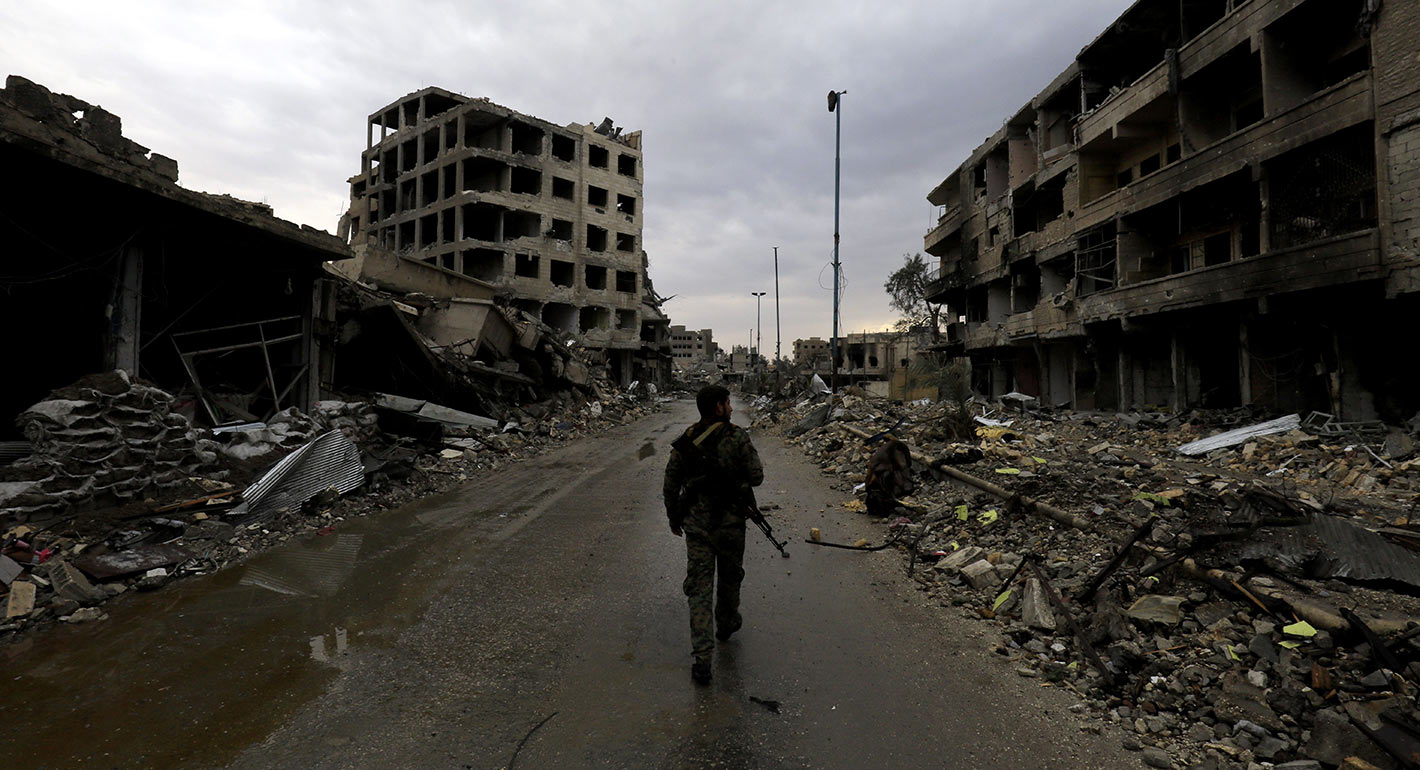
Source: Getty
By leading a new diplomatic effort to end the conflict and begin reconstruction, Trump could both extricate the U.S. from the conflict and help stabilize the region.
Source: Project Syndicate
By rushing out of Syria now, the Trump administration is ceding the field to Russia, Turkey, and Iran, all but guaranteeing another regional conflagration in the near future. By leading a new diplomatic effort to end the conflict and begin reconstruction, Trump could both extricate the US from the conflict and help stabilize the region.
While the world frets about a possible conflict between the United States and Iran, the bloodshed in Syria is escalating once again. Syrian President Bashar al-Assad’s regime has intensified its onslaught against the remaining opposition stronghold in Idlib Province, which is home to some three million people, including many who have been internally displaced. To avoid a new humanitarian nightmare and another mass exodus of refugees, the US must renew its peacemaking efforts.
Since a US-backed coalition of (mostly) Kurdish forces succeeded in dismantling the Islamic State’s (ISIS) territorial caliphate, the US has begun walking away from Syria. Late last year, US President Donald Trump announced the withdrawal of US troops there, effectively ceding negotiations over the country’s future to Russia, Iran, and Turkey.It is now clear that Trump jumped the gun. The renewed fighting in Idlib is a potent reminder that Syria remains a tinderbox. Almost one-third of the country is controlled by a Kurdish-led militia that Turkey regards as a mortal enemy. Owing to America’s support of the Kurds and Turkey’s decision to purchase Russian anti-aircraft missiles, US-Turkish relations are near a breaking point. Meanwhile, Russia has orchestrated its return to the region by backing the Assad regime, and Iran has established a Syrian foothold of its own, enhancing its regional influence and increasing the prospect of war with Israel.
Instead of ignoring these risks, the US needs to get back in the game of shaping Syria’s future. As a first step, it should launch a new contact group that includes Turkey, Russia, the European Union, and the United Nations. The initiative should have three critical objectives, the first of which is to pressure the Assad regime to end the violence and accept a decentralized state in exchange for international help with reconstruction. To end the conflict, the regime must abandon its offensive in Idlib, and the opposition groups clustered there must agree to disarm and stand down.
The political framework for peace and stability in Syria will require a new constitution that provides for a significant measure of regional devolution, while preserving the Syrian government’s monopoly over the use of force. Allowing a potpourri of autonomous militias to remain in operation would almost certainly lead to a failed state.
For the international community, marshaling the reconstruction assistance that would accompany this political compact should be a top geopolitical and humanitarian priority. Failure to rebuild Syria’s war-torn communities and restore the state’s capacity to deliver essential services would leave the door open to an extremist resurgence. Groups like ISIS prey on social distress. To start the process, the EU, backed by the UN, should take the lead on overseeing the return of refugees, raising the needed resources, and implementing a program of post-conflict reconstruction.
The contact group’s second goal should be to strike a deal with Syria’s main Kurdish party, the Democratic Union Party (PYD). In exchange for regional autonomy within a decentralized Syrian state, the PYD would end its alignment with the Kurdistan Workers’ Party (PKK), which has been waging a separatist terror campaign inside Turkey for decades. Provided that the PYD has broken ties with the PKK, the contact group should then spearhead a stabilization plan for the Kurdish region of Syria.
The US, for its part, has an obligation to secure the political rights of Syria’s Kurds, who led the fight against ISIS. But it also must repair its relationship with Turkey. The only way it can do both is to broker a rapprochement between Turkey and the PYD. To that end, the US should honor its pledge to reclaim heavy weapons that it previously transferred to the Kurds, and press the PYD to restore local control to the communities it occupied during the campaign against ISIS.
The US also needs to help keep Kurdish fighters away from the Turkish border, which could be accomplished with a safe zone in northern Syria – a proposal that is currently under discussion in Ankara and Washington. The Turkish government’s recent re-engagement in direct dialogue with the PYD leadership is an encouraging sign.The contact group’s third objective should be to reduce, if not eliminate, Iranian influence in Syria. With its forces and proxies on the ground, not to mention its considerable leverage over the Syrian government, Iran can stir up trouble not only in Syria, but also in Iraq, Lebanon, and Israel. Simply establishing a new contact group would reduce Iran’s diplomatic clout by barring it from the main forum for negotiating Syria’s future. Beyond that, the group should also make the delivery of reconstruction assistance contingent upon Assad distancing himself from the Iranians.
Trump is right to want out of Syria. But to extricate itself from the conflict, the US must first initiate a new diplomatic peacemaking effort. If Trump walks away prematurely, Syria will be left chronically unstable, and thus vulnerable to a revival of radicalism. Moreover, America’s break with Turkey will have passed the point of no return, Russia will have an unchecked proxy in the Middle East, and Iran will be empowered to foment chaos across the region. The conditions would be ripe for a renewed conflict that drags the US back into the region at an even higher cost. The choice is an easy one.
Charles A. Kupchan
Charles A. Kupchan is professor of International Affairs at Georgetown University and a senior fellow at the Council on Foreign Relations.

Senior Fellow, Carnegie Europe
Sinan Ülgen is a senior fellow at Carnegie Europe in Brussels, where his research focuses on Turkish foreign policy, transatlantic relations, international trade, economic security, and digital policy.
Carnegie does not take institutional positions on public policy issues; the views represented herein are those of the author(s) and do not necessarily reflect the views of Carnegie, its staff, or its trustees.

In Colombia and elsewhere in the region, the United States is trying to shape election outcomes—but at what cost?

Oliver Stuenkel, Adrian Feinberg
The world’s climate adaptation funds must adapt to address the ways that climate change is deepening state fragility.
Ray Salvatore Jennings, Paul Andrew Mayewski

There is an elephant in the room when it comes to the EU’s upcoming security strategy: Donald Trump. Unless European leaders acknowledge the depth of the transatlantic crisis, true autonomy will remain out of reach.

Stefan Lehne

Ongoing uncertainty in the Middle East allows Moscow to both increase its influence in Tehran and continue to enjoy the financial windfall of higher oil prices.

Nikita Smagin

To carry out its global AI agenda, Washington will need strategic relationships with emerging markets in Africa, starting with Kenya.
Jane Munga