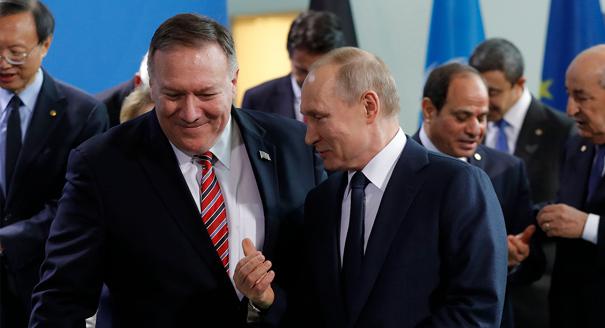
For Moscow, the global crisis provoked by the new coronavirus pandemic has provided a rare opportunity to try to reengage Washington. This is consistent with a historical pattern in which Russia tries to use a common threat to reset its relationship with the United States and look for areas of cooperation based on mutual interests. Traditionally, the U.S.-Russian relationship has always been top-heavy, with the personal connection between the two countries’ leaders playing a crucial role. This time is no different.
Hardly anyone in the Russian leadership expects a fundamental turnaround in Russian-American relations in the foreseeable future. The outlook is bleak: the current confrontation between the two countries is labeled systemic, and U.S. sanctions on Russia are deemed to be eternal. The Moscow-Washington rivalry, as asymmetric as it is, is seen as linked to the power redistribution processes changing the world order, and each country’s position and role within that order. However, tactical opportunities for even very limited engagement are not to be missed.
In a nutshell, what Russia wants from the United States is to resume dialogue based on mutual interests, and without preconditions. Moscow’s U.S. agenda is currently essentially limited to arms control issues. Following former U.S. president George W. Bush’s termination of the Anti-Ballistic Missile Treaty in 2002 and Donald Trump’s withdrawal from the Intermediate-Range Nuclear Forces accord in 2019, the New START negotiated by Barack Obama is the last major agreement in place providing strategic arms control and inspections. New START is, however, due to expire in February 2021. Russia wants it to be extended for another five years.
In 2018, when Russian President Vladimir Putin unveiled a range of new advanced strategic weaponry, he hoped that the impressive display would bring the United States to the negotiating table. Mindful of the experience of the Cold War, the Kremlin would much prefer to limit the U.S.-Russian arms race and preserve strategic stability than to engage in an unconstrained arms race. Make no mistake, though: Putin considers Russia’s deterrence of the United States to be effective and is not turning to Washington as a supplicant. Yet to this date, no substantive dialogue has begun on extending New START and developing a new strategic arms deal.
In this respect, the coronavirus outbreak has created an unexpected opportunity. The American public’s attention is focused on China as the source of the pandemic. President Trump, for whom Beijing, rather than Moscow, has always been the main adversary, is tempted to drive wedges between Russia and China. At the same time, Trump is also concerned by the plight of the U.S. shale industry amid the steep drop in global demand for oil, exacerbated by the Saudi-Russian price war. To deal with the problem, Trump leaned hard on Riyadh and reached out to Moscow. This caused a spike in direct top-level contacts between the White House and the Kremlin.
Putin readily seized this overture. On China, Trump’s efforts will predictably be in vain. Although the Russian establishment espouses a healthy realist view of China, it would be ridiculous to expect it to alienate Beijing on Washington’s behalf. On oil, Russia cooperated with the United States and was rewarded by becoming part of the newly emerged global energy troika alongside the United States and Saudi Arabia. Putin also had his own agenda, of course. He made a nod to humanitarian diplomacy by sending a planeload of medical supplies to the United States, but, most significantly, sought to engage Trump in a conversation about arms control. If New START is to be saved, the U.S. administration must work with the Kremlin on it right now.
It is hard to say, however, whether the Trump administration, which is generally more hostile toward Russia than the president himself, is prepared to do that work. If the treaty expires without extension, there will be no legal grounds for on-site inspections of nuclear arsenals, and both sides will have to rely on their national technical means. The prospects of post-START nuclear arms talks that Moscow has also proposed are even more uncertain, and largely depend on the outcome of the 2020 U.S. presidential election. If the winner is backed by a comfortable majority, and accusations of Russian election interference are muted, there might be a small chance for the dialogue to begin, but even that will not occur immediately. One thing is clear: reaching new-era arms agreements will be infinitely more difficult than before.
The ceasefire in Ukraine’s Donbas region should remain stable and allow for humanitarian and economic exchanges across the line of contact. This is the most that can be done. Ukraine never liked the 2015 Minsk agreement, which stipulates amnesty for the separatists and near federal-level autonomy for Donbas. Russia, for its part, will not abandon Donbas for a vague and most probably empty promise of an end to sanctions. A solution to the frozen conflict in eastern Ukraine will likely remain out of reach for a long time.
The longer-term consequences of the coronavirus will significantly impact the global context of Russia-U.S. relations. The most important factor will be the further intensification of U.S.-Chinese rivalry, and the emerging Sino-American bipolarity. The United States’ ongoing refocusing on itself, at the expense of its global leadership, together with the rise of nationalism in Europe, will continue to transform transatlantic ties and the nature of the European Union. In this environment, Russia’s top priority should be to carefully maintain equilibrium—though not equidistance—between the United States and China. Another priority would be to reduce concerns in Europe about the threat from Russia itself, and enhance relations with those EU countries that are more open to that. Finally, Moscow will have to draw a lesson from the spectacular fall in oil prices caused by the pandemic-linked economic recession and Russia’s ill-timed price war with Saudi Arabia.
While the context of Russian-American relations is changing as a result of the coronavirus, the relationship between Moscow and Washington is unlikely to be substantially altered by it. No new reset is in the offing, and the outlook remains negative, if generally stable. The U.S.-Russian confrontation will continue—with some guardrails around it.


