

Paper
Renée DiResta, Rachel Kleinfeld, Margot Treadwell
{
  "authors": [
    "Rachel Kleinfeld"
  ],
  "type": "legacyinthemedia",
  "centerAffiliationAll": "dc",
  "centers": [
    "Carnegie Endowment for International Peace"
  ],
  "collections": [
    "U.S. Democracy in Comparative Perspective"
  ],
  "englishNewsletterAll": "democracy",
  "nonEnglishNewsletterAll": "",
  "primaryCenter": "Carnegie Endowment for International Peace",
  "programAffiliation": "DCG",
  "programs": [
    "Democracy, Conflict, and Governance"
  ],
  "projects": [],
  "regions": [
    "North America",
    "United States"
  ],
  "topics": [
    "Political Reform",
    "Democracy"
  ]
}
Source: Getty
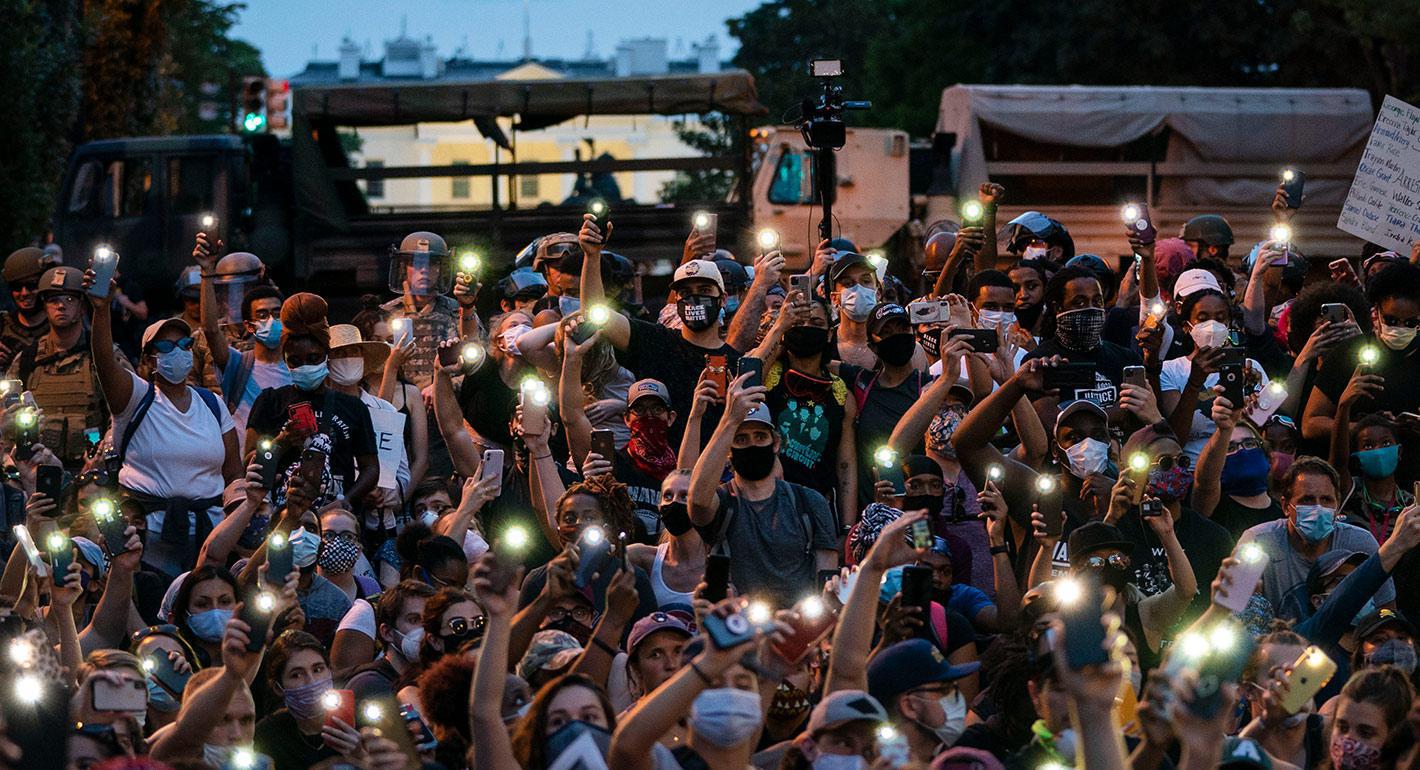
To increase the odds of successful police reform, activists and reformers would be wise to look at lessons from countries where changes succeeded and stuck.
Source: Foreign Policy
In Bogotá, the moment for long overdue reforms finally came after police raped and murdered a nine-year-old girl at a police station. In Monterrey, Mexico, it arrived years after locals began calling officers polizetas—a mash-up of policía and Los Zetas, the violent drug cartel with whom they often colluded. In the United States, the moment may have come after the brutal killing of George Floyd by Minneapolis police.
The United States is far from the only country where police brutality, corruption, or biased treatment of parts of the population have driven demands for reform. Success, however, has been rare—not because reformers don’t know what policies to implement, but because the required reforms were blocked or didn’t stick. To increase the odds of successful police reform, U.S. activists and reformers would be wise to look at lessons from countries and communities where changes succeeded and stuck.
Luckily, what works for fair and effective policing is well known. Decades of research confirm that trust between law enforcement and communities is essential, because controlling crime requires community help. In the United States and Britain, for instance, the vast majority of the crimes that people fear the most, such as homicide and rape, required public tips to solve.
Building trust, however, is based less on bringing down crime (the metric many police monitor) than on treating people with respect and fairness. Trust is enhanced by recruiting a force that resembles the community it serves (although sadly, diversity doesn’t necessarily reduce police violence). Finally, hiring more women in law enforcement—a strategy Peru used to break perceptions of widespread corruption—results in more trust and less use of force.
Once officers have gained a community’s trust, they can use public tips to implement policies proven to drastically reduce crime, such as targeting hot spots (the small number of places where most violence happens), and focusing deterrence on the tiny percentage of people responsible for the vast majority of violent crime to prevent them from resorting to violence. Executing both strategies with respect and fairness is, needless to say, essential to their effectiveness.
The problem is getting police—and political leaders—to make these changes and make them stick. In the past few weeks, the United States has taken the first steps. Politicians are on notice from the vocal, voting middle class. That step is crucial—even in Venezuela, one of the world’s most violent countries, it is the most marginalized communities with the least political power that bear the brunt of overly violent and underresponsive policing. In every democracy where systemic police abuse has been tackled, change usually began when the broader public started to care. As a result of this pressure, the U.S. House of Representatives has passed a police reform bill; various U.S. states and communities are making changes as well.
Legal changes, however, aren’t enough. Well-meaning reforms often get bogged down under the assumption that change is a technical process. But formal reorganizations don’t change behavior. Different ways of organizing police have found success as long as they kept an eye on the overall goal: a culture of community service reinforced with clear incentives and ongoing accountability.
For instance, most jurisdictions opt for selectively firing particularly abusive or corrupt officers. But some—including the countries of El Salvador and Georgia and the cities of Bogotá and Camden, New Jersey—have disbanded entire police forces, rehiring only officers who passed stringent tests.
Which is a better strategy? Trick question. Both options can bring about systemic change—but only when the initial purge is accompanied by significant, ongoing investment of political capital to reinforce a new culture through incentives, norms, and swift, ongoing, external accountability.
In Georgia, for instance, if one officer on a shift was found to take a bribe, all the officers on that shift would be fired. That ensured that customs and border guards, the most corrupt part of law enforcement in Georgia at the time, held each other accountable. Conversely, in 1995, Colombia’s police reform entailed firing 5,000 officers, but the government then cut oversight by slashing the small accountability office’s budget and eventually closing it altogether. The new police became just as corrupt and abusive as their predecessors—until the next reform effort took place.
One reason for the more extreme strategy of mass firing is that it can be among the few ways for reform-minded politicians to disband police unions that, in their quest for workers’ rights, prevent corrupt and abusive agents from being fired. Unions play an awkward role: While they are essential for democracy, in the area of law enforcement they are often obstacles to policies that enable cultural change—such as promoting best performers or putting new recruits at the cutting edge of reform so that they are immediately acculturated to where the organization wants to go.
The key to accountability is for policymakers grappling with reform to be independent from the police themselves and from ongoing political pressure. The most committed politicians prevent slippage by ensuring that their own fortunes rise and fall with the success of police reform. In Bogotá, former Mayor Antanas Mockus ran on a platform of creating a more civil, less criminal police. He demanded daily briefings from the police force and experimented with policies from mass firing to hiring mimes to regulate traffic. In Medellín, Colombia, former Mayor Sergio Fajardo required police statistics to be maintained by an independent agency and made public monthly. Such pressure kept the reform agenda front and center.
Growing crime, however, can undermine the ability of even the most reform-minded politicians to hold the line. Often, police and politicians erroneously view efforts to improve the treatment of citizens as inherently at odds with police effectiveness. Increased crime leads to public clamor for “toughness”—and tough-on-crime policies nearly always offer greater impunity for the use of force by police. Despite actually causing crime to increase, these tough-sounding policies are election winners in nearly every democracy. If crime rises, reform will backslide, even if reform is the best way to bring crime back down. While labor unions are essential for democracy, in the area of law enforcement they are often obstacles to policies that enable cultural change.
Police, meanwhile, aren’t passive subjects of reform. Unwilling officers can slow-walk any policy change—whether by willful subversion or half-hearted implementation—until attention flags or political will dissolves.
Deep reform requires that police accept change. Reforms only stick when they’re done with police, not against them. Officers must co-create a new culture that only they can realize and embody. Awkwardly, at the very moment police are most reviled, they need a vision of what they could be and an enhanced sense of their status as professionals, in their own eyes and those of the community. To achieve those goals, the president of Georgia attended the start of the first new class of cadets, and constantly spoke about the importance of democratic and honest policing.
For police to embrace reform, they must see the change as enhancing their mission and daily work. It was not hard to convince officers in Tbilisi, Georgia, where police corruption was rampant, that honesty would aid effectiveness. Sadly, while demilitarizing police forces is standard international practice for successful reform, many police in the United States and elsewhere still need to be persuaded that regulating their use of force, giving up military technology, and abandoning a military mindset will make them safer and their work more effective.
If support within the ranks of police is essential, that will require activists to change their approach. Calling for defunding or disbanding the police obviously won’t win the latter over. In other cases, it’s a matter of how demands for reform are communicated. For example, when activists call for removing mental health calls from police dockets and focusing officers only on real crime, that may actually be quite popular among police untrained in mental issues and unhappy with mission creep. Selling this as a sensible, pro-police measure—rather than as part of punishment by defunding—would require a change in messaging that activists may be unwilling to make.
If activists can make that hard pivot to try to win over police, it would also help them overcome the greatest danger to police reform—polarization. If the forces of law and order face off against those demanding equity and social justice, the fight is already lost.During Italy’s “Years of Lead” in the 1970s and early ’80s, that kind of irreconcilable polarization allowed for police to work hand in glove with neofascists, while far-left extremists turned to the terrorist Red Brigades. Police kept their fascist-era organization, ethos, and behavior while violence spiraled. The same polarization led to decades of growing state violence and stalled reform in Colombia, several countries in Central America, and other homicide hot spots.
It’s hard to ask activists or anyone else to have empathy for law enforcement now, as videos of active and retired officers murdering unarmed U.S. citizens circulate. But some level of understanding is going to be necessary for real reform. Psychologists claim that anger and violence are often fueled by fear. Many officers suffer from post-traumatic stress disorder resulting from policing a violent, armed society; the profession is grappling with high suicide rates. Honest cops fear their violent and dishonest colleagues. In the 1970s, the scholar Hans Toch found that police who were afraid but unable to admit their fear were more likely to use excessive force. Society pays the price.
With about 800,000 officers in 18,000 police forces and a long legacy of unequal or blatantly racist policing, the United States requires one of the biggest and most difficult reform efforts any country has ever faced. Lasting democratic police reform everywhere is hard and rare. Change may start with outrage, but its proponents must gird themselves with seriousness of purpose. For African Americans to be protected by and from the police, as all citizens should expect, reformers must begin now and keep the pressure on.

Senior Fellow, Democracy, Conflict, and Governance Program
Rachel Kleinfeld is a senior fellow in Carnegie’s Democracy, Conflict, and Governance Program, where she focuses on issues of rule of law, security, and governance in democracies experiencing polarization, violence, and other governance problems.
Recent Work

Renée DiResta, Rachel Kleinfeld, Margot Treadwell
Political Violence Researchers, Rachel Kleinfeld, ed., Dalya Berkowitz, ed.
Carnegie does not take institutional positions on public policy issues; the views represented herein are those of the author(s) and do not necessarily reflect the views of Carnegie, its staff, or its trustees.

Congress should ask tough questions about the agreement’s more unique features and whether they advance U.S. interests or compromise them.

Jane Darby Menton

To remain effective, organizations need to master new media and legitimacy markers to make a once-in-a-century shift.
Renée DiResta, Rachel Kleinfeld, Margot Treadwell
An overwhelming victory by a far-right-wing party in a small state in eastern Germany will have major repercussions for Chancellor Friedrich Merz’s coalition.

Judy Dempsey

Congress needs to step up and make EXIM a low-carbon financing powerhouse.
Jesse Young

Canadian Prime Minister Mark Carney has twice inspired praise for standing up to U.S. President Donald Trump: at the 2026 World Economic Forum in Davos and on Canada-U.S. trade negotiations. Is Carney showing a third way better than the EU has in dealing with the Trump administration?

Rym Momtaz, ed.