

Paper
Renée DiResta, Rachel Kleinfeld, Margot Treadwell
{
  "authors": [
    "Rachel Kleinfeld"
  ],
  "type": "testimony",
  "centerAffiliationAll": "dc",
  "centers": [
    "Carnegie Endowment for International Peace"
  ],
  "englishNewsletterAll": "democracy",
  "nonEnglishNewsletterAll": "",
  "primaryCenter": "Carnegie Endowment for International Peace",
  "programAffiliation": "DCG",
  "programs": [
    "Democracy, Conflict, and Governance"
  ],
  "projects": [],
  "regions": [
    "United States"
  ],
  "topics": [
    "Democracy",
    "Domestic Politics"
  ]
}
Source: Getty
Governments are increasingly using state power to monitor, stigmatize, and restrict civil-society organizations to reduce the reach of organizations whose views are in disagreement with their governments’.
Statement for the Record, Submitted to the U.S. House Committee on the Judiciary, Subcommittee on the Constitution and Limited Government, regarding the Hearing: “Partisan and Profitable: The SPLC’S Influence on Federal Civil Rights Policy”
Chair, Ranking Member, and Members of the Committee:
Thank you for the opportunity to submit this written testimony on how current congressional investigations into civil society organizations appear when viewed through international and historical lenses. My analysis draws on decades as a scholar of U.S. and global democracy, as well as my two most recent books, which focus on the rule of law within democracies and democracies facing extreme levels of violence. I submit it to contextualize that the current hearing regarding the Southern Poverty Law Center (SPLC) is best seen not as an isolated controversy over a single organization, but as part of a broader pattern evident both in some of the troubled periods of American democracy and in countries whose democracies are facing backsliding today. In our own past, and around the world today, governments are increasingly using state power to monitor, stigmatize, and restrict civil-society organizations to reduce the reach of organizations whose views are in disagreement with their governments’. The SPLC’s case should be considered against this backdrop.
The testimony focuses first on the global context for civil society restrictions, then describes past moments in American history, and ends with an analysis of the trends in political violence in the United States over the last decade and what could be done to reduce this violent moment.
For most of human history, governments that could do so have restricted the ability of people to organize themselves and come together freely, to speak their minds, and to hold differing opinions and beliefs. Monarchies chose their subjects’ religions; fearful authoritarians scared their populace from speaking their minds; totalitarian Communist states barred groups as innocuous as birdwatching clubs for fear that people, coming together freely, might share opinions that would disturb the power of the state.
The independence of civil society—a sector of life outside of the family and the government—was a unique attribute of American democracy, in large part due to its Evangelical Christian roots. From before America’s founding as a nation, Evangelical religious leaders had learned how to organize independent churches. They used their skills in founding independent organizations to formally organize citizens for other purposes, from bible-tract societies to universities. They spread this know-how across the United States as they settled throughout the country.1 America’s founding fathers played a particularly crucial role in enshrining the liberties of freedom of speech and association into the Bill of Rights—the first such charter in the world. As democracy spread in the twentieth century, so did the existence of a realm in which people could come together, speak their minds, and think what they wanted—even if such thoughts and beliefs were outside the norms of their societies or challenged their governments.
But over the last twenty years, the world has seen authoritarian states harden, failing democracies fall further towards repression, and even strong, established democracies slip backward. As this has occurred, governments around the globe have started to restrict the speech, organizing, and activities of independent groups that challenge their policies.2
Beginning with Russia, governments followed a common pattern. Leaders accused groups whose ideas they didn’t like of being national security threats, or even simply foreign. For instance, Russia declared the country’s only independent election monitoring group of being a foreign agent after the organization received the Andrei Sakharov Award from the Norwegian Helsinki Committee.3 They used new laws and security agencies to crack down on groups that stood for ideas the government didn’t like, such as right-leaning ideas in countries such as Venezuela (former President Hugo Chavez seizing the home and assets of a bank owner who critiqued the nationalization of banks)4 and left-leaning ideas in countries such as Hungary (Prime Minister Viktor Orbán legislating a national ban against public events held by LGBTQ organizations).5 China, under the Xi Jinping government, wanted to squelch organizations that could exert moral authority that might challenge Communist rule, so pastors of tiny Christian churches found themselves arrested and their houses of worship raided.6
Backsliding democracies began to replicate these authoritarian methods and use them to consolidate the power of the ruling party. A similar playbook spread from country to country. It included restrictions on banking and tightening of funding sources, suspensions of organizations on the basis of minor regulatory issues, and rhetorical demonization by government officials and government-linked organizations, who often spuriously connected law-abiding civil-society organizations to terrorism or to groups who were hated within their societies.
Governments generally acted legally against these targeted organizations by passing laws that justified broad discretion and then using them for crackdowns.7 Almost always, governments cited reasonable concerns, such as intentional or inadvertent support for terrorists or criminals, to justify their actions. For that reason, government actions often appeared legitimate to many of their citizens early on. Because different tactics were used against different groups—one organization’s leader might be accused of sexual impropriety, another organization would be arraigned for corruption, a third raided for regulatory compliance issues—the cases were treated as singular instances of wrongdoing. One could reasonably think that perhaps this organization had done something illegal, that perhaps that person really was corrupt. Governments often began this repression of opposing viewpoints by choosing organizations that helped the most marginalized people in their societies—organizations that might not have strong defenders—in order to pick them off one by one.
Moreover, unlike in totalitarian states during the twentieth century, the closure of civic space today is rarely uniform or total. Governments often allow charitable and politically aligned organizations to continue operating, often with government support, while targeting advocacy groups working on rights, corruption, elections, immigration, or equality for minorities.8 In Hungary, for instance, the Orbán government labeled the anti-corruption group Transparency International Hungary a foreign agent while allowing the Danube Group, a think tank whose ideology aligned with the ruling party’s, to operate, although the latter exists for the explicit goal of uniting foreigners with similar ideologies.9 The continued existence of civil society groups hid the reality that, in country after country, organizations opposed to the ideas of governing parties were being suffocated.
But as the years passed and examples piled up, it became obvious to supporters of freedom worldwide that many governments were using a shared set of tools—regulatory, investigatory, police, intelligence, rhetorical, and legal—to systematically, organization by organization, reduce their citizens’ access to different ideas and information, and prevent them from challenging the government’s viewpoints.
This phenomenon became known as “closing civic space,” a pattern that has now been documented for more than a decade.10 In India, the Narendra Modi government tightened India’s Foreign Contribution Regulation in 2020, then launched financial audits and tax-related raids against human rights and environmental organizations as well as think tanks critical of the government.11 In Poland, after large demonstrations against the previous government, women’s rights and LGBTQ organizations faced police raids, the search and seizure of their computers, and arrests.12 By 2025, Nicaragua had canceled the registration of more than 1,500 civil society groups, including hundreds of churches and Christian organizations.13 But the government’s crackdown began in 2018 by targeting human rights defenders and opposing media—then expanded to any group that could oppose the government.14
Unfortunately, recent events in the United States mirror this global trend. Though the U.S. is not yet near the levels of restriction seen in these fellow democracies and former democracies, a report I wrote in 2022 comparing international and U.S. tactics to restrict civil society compiled six pages of examples—in small type—of U.S. efforts at the state and national level to restrict organizations for their viewpoints. These ranged from an official in the State of New York urging companies doing business with the state to end ties with the National Rifle Association or risk losing their government business, to the Attorney General of Texas threatening a Catholic charity’s nonprofit status for providing shelter to migrants.15 At the state level, attorneys general have dueled over investigating conservative and progressive nonprofits for possible tax violations.16 Over the last several years, “foreign agent”–style registration regulations, spurious lawsuits, and protracted investigations that drain organizational resources and undermine their legitimacy have begun to add up, and are beginning to cause systematic harm to particular segments of American civil society.
The investigation into the SPLC is one of thirty-two investigations into nonprofit organizations conducted under this Congress; the previous year featured forty-three separate investigations.17 This is highly unusual behavior in the United States, where President George H. W. Bush used his inaugural address to praise “the community organizations that are spread like stars throughout the Nation” describing them as a “thousand points of light,”18 and President Ronald Reagan promised to foster “the system of a free press, unions, political parties, universities – which allows a people to choose their own way, to develop their own culture, to reconcile their own differences through peaceful means.”19 Indeed, civic organizations were recognized by Alexis de Tocqueville in our republic’s early years as central to American freedom and even our civilization. In comparing aristocracies of Europe to the young America, he noted that in democracies, citizens are weak when they act as single individuals, therefore “If men who live in democratic countries had neither the right nor the taste to unite in political goals, their independence would run great risks.”20
Sadly, despite the fact that American freedoms to speak, believe, and associate freely have been constitutionally enshrined for nearly 250 years, it would be inaccurate to say that threats to civil society are unprecedented. While America has a long, bipartisan history of support for a free civil society that benefits people of all ideological persuasion, we have also faced challenges to these freedoms in periods where our government’s allegiance to its founding ideals faltered.
Increased congressional scrutiny of the nonprofit sector (often accompanied by Department of Justice surveillance and raids) has been a recurrent feature of some of the darkest moments in American history, where political expedience stifled constitutional freedoms. Describing three of these periods in the twentieth century: the time around World War I; the early Cold War; and the Civil Rights era, may shed light on how today’s investigations repeat similar historical patterns.
America’s entry into World War I was marked by executive and congressional investigations into pacifist, socialist, labor, and immigrant groups. Immigrants were cast as existential threats to our country, accused of aiding enemies and bringing foreign ideas such as unionism and socialism into America, which were assumed to weaken the war effort. Peaceful and innocuous organizations—from beer brewers seen as unduly German, to mutual-aid groups for immigrants—were subjected to broad surveillance, public vilification, congressional investigation, and regulatory pressure. These forms of governmental repression were particularly targeted at organizations whose views were at odds with the government of the time, or whose vilification was politically advantageous to build support for a variety of wartime restrictions on freedom.
In the months following U.S. entry into World War I, President Woodrow Wilson became concerned that independent-minded Americans would bristle at what he saw as war-time necessities. Senator Lee Slater Overman (D-NC), a strong Wilson ally, passed the Overman Act to provide Wilson with extraordinary powers over executive agencies never before held by a president. Wilson also pressed Congress to pass laws that, in the words of the National Constitution Center, “criminalized core First Amendment speech.”21 The Espionage Act of 1917 and the Sedition Act of 1918 criminalized speech critical of the U.S. government, constitution, and military, or that otherwise conveyed information deemed harmful to the war effort, with the threat of up to twenty years in prison. These statutes were upheld by the Supreme Court at the time—though the Sedition Act lasted just three years before its repeal, and both measures were harshly critiqued later. Even at the moment of passing, their selective use was acknowledged by some of their supporters, who understood that they would be used against unions and groups that supported minorities.22
In 1918 and 1919, Senator Overman’s Committee used these new laws to investigate groups with German ties, including the United States Brewers Association, which was accused of corruption, coercion, and controlling the press. It expanded to investigate organizations it claimed were linked to Bolshevik Russia, which led to a string of witnesses vilifying Jews by falsely associating Judaism with Bolshevism. The Committee investigated pacifist, socialist, labor, and immigrant groups with virtually no actual evidence. The committee’s sensationalism was seen as a precursor to the House Un-American Activities Committee in its characterization of everyday, peaceful Americans as national security threats, as well as its failure to uncover any actual wrongdoing or achieve any real goals. Overman later became known for his leadership of a filibuster to defeat a national anti-lynching bill.
Months after the release of the Overman Committee report, a series of anarchist bombings prompted President Wilson to condemn “hyphenated Americans” who were accused of bringing foreign and violent ideas into America. The Justice Department conducted what became known as the Palmer Raids in November 1919 and January 1920. A. Mitchell Palmer’s Justice Department spread across dozens of cities and arrested thousands of immigrants accused of socialist, communist, or anarchist leanings—disproportionately targeting unions and Jews. The raids, directed in large part by a twenty-four-year-old J. Edgar Hoover, often proceeded without warrants and led to hundreds of violent beatings and arbitrary arrests of American citizens. They also caught passers-by, members of the Lithuanian Socialist chorus in the middle of their rehearsal, thirty-nine Jewish bakers forming a cooperative, and every waiter, dishwasher, and customer who happened to have the bad luck of spending the evening at a restaurant popular with socialists.23
Despite thousands of arrests, the raids uncovered virtually nothing. While launched under the pretense of ending the spate of anarchist violence, they failed to prevent the anarchist bombings that continued sporadically over the next decade. In June 1920, a judge effectively ended the raids, writing in his decision that “a mob is a mob, whether made up of Government officials acting under instructions from the Department of Justice, or of criminals and loafers and the vicious classes.”24
During the early Cold War, a series of House and Senate investigations targeted thousands of American citizens on the pretext that they were linked to the Soviet Union and subversive Communist ideology. The investigations particularly focused on labor unions, educational and artistic organizations, gays and lesbians, and foundations that supported racial equality. While almost none of the accused had done anything illegal, the investigations alone were enough to end careers, destroy organizational funding, and chill entire sectors of American associative life. Those who were named by the committees found themselves suddenly without friends and colleagues, as even close associates feared character assassination. Subpoenas, loyalty programs, blacklists, and coerced testimony about political beliefs and associations reached deep into the fabric of everyday organizations, diverting them from their work. Characterized today as witch hunts, the investigations caused many organizations to disband, decimated their membership, and weakened hundreds of legitimate labor, civil-rights, cultural, and educational nonprofits.
The House Un-American Activities Committee, created in 1938 and established as a permanent committee in 1945, was formed to investigate “disloyal” American citizens and subversive organizations. Its 1948 investigation into Alger Hiss played a real role in uncovering espionage. However, its choice of targets was generally biased against disliked viewpoints rather than towards security threats: for instance, while the committee rejected the idea of investigating the Ku Klux Klan (which one committee member declared “an old American institution”) it did investigate multiple unions and labor activists, artists, and even a Quaker children’s librarian whose pacifism—a deep tenet of the Quaker religion—was seen as subversive.25 Its notorious investigations into Hollywood led to more than 300 artists being boycotted by studios and blacklisted by the industry—including the famously anti-Hitler comedian Charlie Chaplin.26
From 1950 to 1954, Senator Joseph McCarthy (R-WI) added his distinctive investigations in the Senate to those in the House. McCarthy chaired the Senate’s Permanent Subcommittee on Investigations from 1952 to 1954. His investigations forced nearly 500 people to testify—including some of the nation’s leading artists, such as composer Aaron Copland and writer Langston Hughes. Under the leadership of the man he hired as Chief Counsel—the then 26-year-old Roy Cohn—the Subcommittee’s hearings targeted universities, cultural institutions, the Voice of America, and even the U.S. military. McCarthy also used his platform to jumpstart investigations into gays and lesbians in government—leading to the creation of two congressional committees to investigate the issue. Thousands of government employees were fired solely for their sexuality and eventually banned from government service in 1953 as security risks.27
McCarthy’s proceedings destroyed hundreds of lives, however, they failed to provide sufficient evidence to put a single person in jail for their accused wrongdoings. In the words of the Senate historian, “Either the Justice Department refused to prosecute, or the courts threw the cases out, or in the very few cases where people were convicted, all of the convictions were overturned.”28 When a Senate panel later released the full transcripts of the hearings, Senator Susan Collins (R-ME) described them as “a shameful chapter in American history, a time when hundreds of innocent people were paraded before a Senate subcommittee, with little regard for due process or their constitutional rights, a time when character assassination, mud-slinging, and guilt by association trumped the truth and fairness.”29 In late 1954, Senator McCarthy was condemned by the Senate for conduct “contrary to senatorial tradition.” He died three years later at just forty-eight years old, from alcoholism-related ailments.
Foundations were also targeted during this period. They were accused of funneling funds to subversive organizations, which generally meant groups advocating for more equality in American society. In 1952, in response to concerns that foundations were diverting funds to assist un-American activities, Congressman Edward E. Cox (D-GA) oversaw the Select (Cox) Committee to “investigate educational and philanthropic foundations and other comparable organizations which are exempt from federal taxation.” After investigating every foundation in the country with more than $10 million in assets, requiring answers to a questionnaire so detailed that some responses ran to the length of books, the Select Committee concluded that there was “little basis for the belief expressed in some quarters that foundation funds are being diverted from their intended use.”30
Unhappy with these findings, Congressman B. Carroll Reece (R-TN) formed a new Special Committee to Investigate Tax-Exempt Foundations and Comparable Organizations in 1954. However, despite immense effort, it, too, found that, with a tiny number of exceptions, “foundations have not directly supported organizations which, in turn, operated to support communism.”31 But its sensational accusations against the sector for “subversion” of American ideals (largely for supporting poverty relief and civil rights), were so lurid and “pathological” in the words of one committee member, that only two of the five committee members agreed with the final report—one issued a dissent and declared his signature “unauthorized,” and the two minority members refused to sign, instead accusing the Committee of “an evil disregard of fundamental American guarantees.”32
Claiming that communists were subverting American life by supporting movements for equality, the HUAC also investigated civil rights groups for alleged communist ties. HUAC’s work was later taken up by the Senate Internal Security Subcommittee (SISS, sometimes also described as the Senate Subcommittee on Internal Security). Under J. Edgar Hoover—who helped direct the Palmer Raids as a young man—the FBI Counterintelligence Program (COINTELPRO) surveilled American civil rights groups for decades. They found accusations leveled against leaders like Martin Luther King, Jr. to be almost entirely specious.33
The HUAC in the House and the SISS in the Senate both investigated leading civil rights groups such as the Student Nonviolent Coordinating Committee (SNCC) and the National Association for the Advancement of Colored People (NAACP) on the basis that it was “vulnerable to communist subversion.” Both committees repeatedly asked the NAACP for membership lists and accused the organization of abetting communism, largely because it worked with organized labor to fight racial discrimination. An extensive FBI investigation found that, in fact, the NAACP leaders showed “a strong tendency… to steer clear of Communist activities,” and posed no security risk. Nonetheless the Bureau continued to surveil civil rights leaders.34 The National Urban League—an even more moderate group than the NAACP—was targeted by the HUAC for misuse of federal funds, and its support for anti-discrimination laws were tarred as “radical labor agitation.”35 The Black singer and actor Paul Robeson, called before the HUAC for supposed Communism, claimed that he was there simply because he had dedicated his life to “fighting for the rights” of Black Americans. “You ought to be ashamed of yourselves,” he told the Committee.36
Groups that engaged White Southerners against racism were also particular targets of these congressional committees. Congressional findings might then be used by state legislatures who then passed information back into the congressional committees, keeping organizations answering queries and disrupting their work while they addressed the same accusations over and over. The Southern Conference Education Fund, for instance, existed to engage Whites in civil rights work through activities such as documenting how racial inequities held back the entire South. After SCEF appeared in HUAC investigations, state and local police raided their offices at the request of the Louisiana Joint Committee on Un-American Activities. Despite a judge’s ruling that the raid was unconstitutional, the records of the state legislative hearings were subpoenaed by the head of the Senate Subcommittee on Internal Security.37 Similarly, the Highlander Folk School—a leadership training institution for labor and civil rights leaders that trained both Rosa Parks and Congressman John Lewis (D-GA)—was a particular target for the HUAC. Decried as a “communist training school,” Tennessee’s state legislature cited the HUAC findings to revoke the organization’s charter in 1959, padlock the school, and seize its property.38
Across these moments in American history and throughout the globe today, the methods used to restrict civil society have been fundamentally similar. National security and public-order rationales are used as a pretext to prevent citizens from exercising their rights to freedom of speech, belief, and association. Globally and in the United States, these strategies do not aim to shut down civil society wholesale but rather selectively target organizations that support minority groups within that society or are politically convenient to attack.
In the United States, the aforementioned periods of civic repression have used fears of foreign subversion to target organizations that gave voice to immigrants, unions, and racial, religious, and sexual minorities. Declaring that such organizations were dangerous, both Congress and the Executive branch allowed law-abiding organizations to be harassed, surveilled, and subjected to regulatory pressure—while frequently ignoring private groups organized to commit actual acts of physical violence.
The history of U.S. congressional investigations—often accompanied by intelligence investigations—into U.S. nonprofits have cost innumerable hours and taxpayer dollars with negligible findings of any wrongdoing. Despite the repeated lack of findings of fact, they have had a chilling effect. Congressional investigations cause reputational damage, frighten others from associating with a group under scrutiny, scare away donors, affect staff morale, and often require onerous compliance that diverts organizations from their work. These harms have undermined and destroyed nonprofit organizations, even if they have done no wrong whatsoever.
Precedent—in both the American and global contexts—therefore suggests that scrutiny of a civil rights organization in the current moment should not be viewed merely as a concern about one organization’s activities, whatever the merits or challenges with its methodologies. It should instead be evaluated with consideration for the risks to American freedoms of speech, association, and belief. If congressional hearings and accompanying outrage become a de facto tool for delegitimizing and weakening civil-society organizations, it would replicate a strategy that has been used to roll back freedom worldwide, and which has dimmed America’s light of freedom at multiple points in our history.
While this investigation is not a useful path forward towards addressing the problem, the growth in political violence in the United States is an issue that deserves serious congressional action. There are many things Congress could do to address the rapid growth in targeted violence in order to protect its own Members, other elected and appointed officials, and the general public from this scourge.
When Rep. Gabby Giffords (D-AZ) was shot in the head while meeting with constituents at a supermarket event in 2011, violence against a political official was a shocking, and relatively isolated, event.39 But by the time Rep. Steve Scalise (R-LA) was shot during the 2017 annual congressional baseball game,40 threats and harassment against public officials and violence against targeted groups and individuals was already rising. It has since jumped to heights that should be unacceptable for a civilized nation.
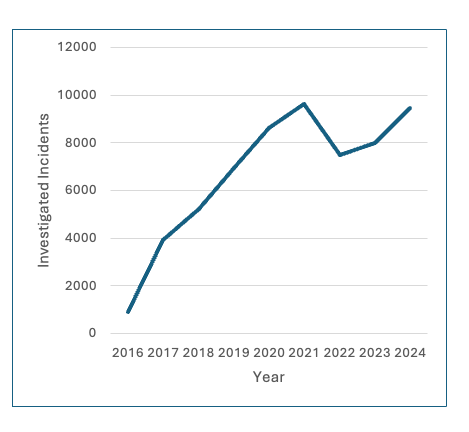
As the two charts below show, in 2016, the United States Capitol Police (USCP) investigated 902 threats against congressional members, their families, and their staff. By 2021 threats had risen more than ten-fold to 9,625, and though they have dropped slightly, threats remain more than ten times as high.
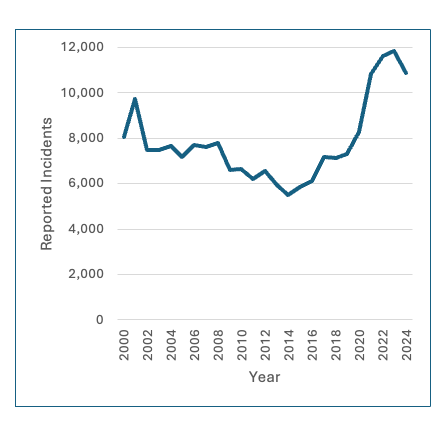
Meanwhile, hate crimes reported to the FBI for violence due to one’s religion, race, or ethnicity were on the decline from 2001 to 2014, and have since nearly doubled. Although they dropped very slightly last year, the rates remain elevated.
Threats Against Members of Congress, family and staff, 2016-202441
Hate Crimes Reported to the FBI, 2000-202442
Statistics rarely move emotions, but each of these numbers represents a family whose children are scared for their parents, a public servant who should expect to do his or her job without facing such abuse. For instance, since 2022, around a third to 40 percent of local officials report being harassed when asked on a quarterly basis, and between a fifth and 16 percent report threats.43 That includes parents who serve on schoolboards and other positions that are vital to our democracy. While some officeholders dismiss threats as the price of being an official nowadays, certain types of threats have a greater impact, particularly threats against one’s children. Both female officeholders and officeholders of color faced more threats and attacks related to their families than other officeholders.44
The threats are not idle. Just this year, the country has witnessed the murders of United Healthcare CEO Brian Thompson,45 Minnesota State Representative Melissa Hortman and her husband,46 the young leader Charlie Kirk,47 and a National Guardswoman.48
The litany of harm to all sides of the political spectrum should give pause to every American: a man setting fire to Governor Joshua Shapiro’s home on Passover night as his family slept inside;49 two attempted assassinations on President Donald Trump;50 the attempted murder of Minnesota State Senator John Hoffman and his wife by the man who succeeded in killing their colleague;51 murders of two Israeli Embassy staff and Molotov cocktails thrown at a rally for Israeli hostages;52 the attack on Rep. Nancy Pelosi’s elderly husband by a hammer-wielding assailant in their home in 2022;53 bombs sent to thirteen victims in 2018 including President Barack Obama and ten other current and former U.S. government officials; the shootings targeting New Mexico state government officials, which included bullets lodged in the bedroom of one state representative’s ten-year-old daughter as the girl lay sleeping.54
The way these threats are harming our democracy is sometimes well-known, such as the armed man outside the home of Supreme Court Justice Brett Kavanaugh.55 Other harms are less visible, such as over 100 death threats made to U.S. District Court Judge James Robart, who ruled against the Trump administration’s travel ban in 2017.56 These threats are part of a trend: the U.S. Marshall’s service reported that serious threats to federal judges jumped from 179 in 2019 to 457 in 2023. More than 100 have included anonymous pizza deliveries, which show that the sender knows the judge’s home address, and are often sent in the name of Daniel Anderl, the son of U.S. District Judge Esther Salas who was murdered in 2020 when he opened the door to a man posing as a pizza deliverer who was targeting his mother.57 Supreme Court Justice Amy Coney Barrett received an anonymous pizza delivery and a bomb threat was made against her sister after Coney Barrett voted in support of foreign aid following administration cuts.58 Rep. Marjorie Taylor Greene (R-GA) said she received anonymous pizza deliveries, bomb threats, and death threats following her disagreement with the president on the Epstein files.59
As these last two examples indicate, the desire to categorize threats as “right” or “left” is not particularly useful. Surveys of local officials show that Democrats, Republicans, and Independents are experiencing harassment, threat, and attacks at similar rates.60 Threats from the right are often made against Republicans, while threats from the left also target Democrats.
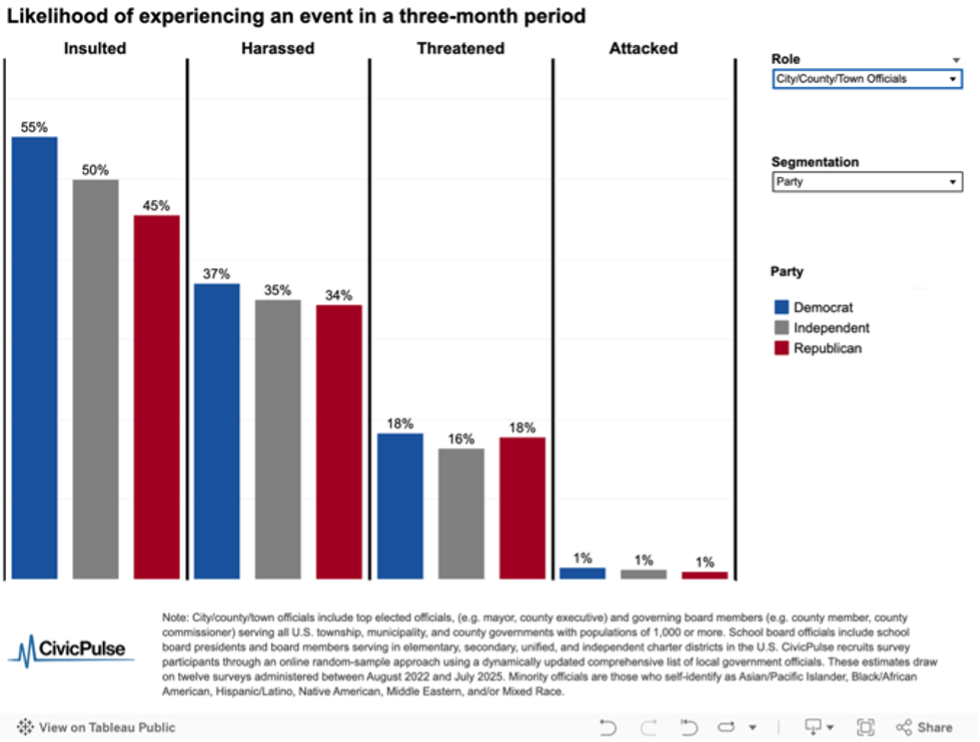
“Threats and Harassment Dashboard.”
The reality is that most people who commit acts of political violence are influenced by mental illness, personal breakdowns, and a hodge-podge of ideological impulses and conspiratorial beliefs that are often all over the map ideologically. While one can point to data showing far more violent incidents with greater death tolls in recent years perpetrated by people with right-leaning ideologies,61 as well as an uptick in support for violence from people with left-leaning beliefs,62 what is clear is that a small but growing number of disturbed people are increasingly threatening broad groups of Americans—particularly elected officials, appointed officials, judges, school board members, and every type of minority.
Organizations that track hate are not to blame for this wave of violence, but there are things that can be done by Members of Congress to reduce these threats. Congress could:
There are many things America’s elected representatives can do to reduce political violence. I hope that Members of this Committee will take it upon themselves to undertake these actions to keep the American people safe while protecting the cherished freedoms of speech, association, and belief that are foundational to keeping our country great.

Senior Fellow, Democracy, Conflict, and Governance Program
Rachel Kleinfeld is a senior fellow in Carnegie’s Democracy, Conflict, and Governance Program, where she focuses on issues of rule of law, security, and governance in democracies experiencing polarization, violence, and other governance problems.
Recent Work

Renée DiResta, Rachel Kleinfeld, Margot Treadwell
Political Violence Researchers, Rachel Kleinfeld, ed., Dalya Berkowitz, ed.
Carnegie does not take institutional positions on public policy issues; the views represented herein are those of the author(s) and do not necessarily reflect the views of Carnegie, its staff, or its trustees.

Russia spent years building a “sovereign internet,” concentrating web infrastructure exclusively within Russian territory. Ukrainian drone attacks have shown how vulnerable that approach has left the Russian internet.

Maria Kolomychenko

It signals a new era of tech diffusion and warfare.

Steve Feldstein

With its public finances in shambles, the far right polling at 35 percent ahead of the 2027 presidential election, and a growing protest movement, is France’s crisis a threat to the EU’s geopolitical awakening?

Rym Momtaz, ed.

Putin’s conservative staffing policies and search for ever greater control have cemented parliament’s transformation into a bureaucratic appendage of the executive branch.

Andrey Pertsev

Ahead of a tough winter for Ukraine, Donald Trump’s swing back toward Russia bodes ill. But instead of panicking, Kyiv’s European allies are focusing on action.
Rym Momtaz