

Commentary
Alexander Baunov
{
  "authors": [
    "Alexander Baunov"
  ],
  "type": "commentary",
  "centerAffiliationAll": "",
  "centers": [
    "Carnegie Endowment for International Peace",
    "Carnegie Russia Eurasia Center"
  ],
  "collections": [],
  "englishNewsletterAll": "",
  "nonEnglishNewsletterAll": "",
  "primaryCenter": "Carnegie Endowment for International Peace",
  "programAffiliation": "",
  "programs": [],
  "projects": [],
  "regions": [],
  "topics": []
}
Source: Getty
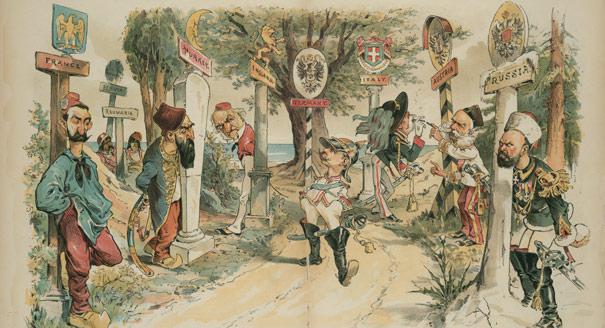
The pandemic world has splintered into something akin to self-sufficient national bubbles, and the crisis has shown once again that the European bubble does not include Russia.
For many years, it was assumed that if the United States drifted away from its alliance with Europe, that would result in Europe becoming closer to Russia. Until recently, that scenario seemed purely hypothetical. Then Donald Trump was elected U.S. president, and the theory was put to the test.
Trump’s political nationalism and opinion that Europe was a freeloading ally, his euro- and NATO-skepticism, his support for Brexit, and unilateral withdrawal from agreements that were valued by Europe—such as the Paris agreement on climate change and the Iran nuclear deal—quickly drove a wedge between Europe and the United States. The pandemic and Trump’s behavior during the 2020 U.S. presidential election only made things worse. For the first time in over half a century, Europe has been forced to distance itself from U.S. leadership.
Yet the global crisis caused by the pandemic did not lead to a rapprochement between Europe and Russia, or drive Europe to look for a quick replacement for a discredited United States. On the contrary, Europe demonstrated that it exists not just as a branch of the Greater West or Greater Eurasia, but as a separate and fully independent and self-sufficient world region. This “European isolation” (to quote the political scientist Ivan Krastev) does not, however, include Russia.
The pandemic is the first crisis in more than a century in which the United States has not played the role of a global leader, or even the leader of the free capitalist world. It has not led Europe, set an example, or been an arbiter in European affairs.
Trump paved the way for this situation with his egoistic, arrogant, and anti-European position. But even if the United States had attempted to lay claim to the role of leader and arbiter, Europe would have rejected any such notion. The images of the United States that Europeans are seeing are appalling. The richest country in the world, which spends 17 percent of its dizzying GDP on healthcare—more than the wealthiest countries in Europe—is coping less well with the situation than any of them.
Similarly to the United States, Russia entered the year of the pandemic already estranged from Europe. But that on its own doesn’t explain Russia and Europe’s failure to come closer together in the face of the crisis.
The pandemic has shown itself to be a time of self-reliance. Geographical proximity, shared borders, and even good relations are not enough to unite countries against the crisis. The pandemic world has splintered into something akin to self-sufficient national bubbles, and the crisis has shown once again that the European bubble does not include Russia, and that Russia is self-sufficient without Europe. This would not have been any different even if the relationship were more equable, or even with a more friendly, pro-Western leadership in the Kremlin.
Throughout the crisis of the pandemic, Russia and Europe have not competed or feuded, other than—like everyone else—for personal protective equipment and ventilators at the very beginning. They simply coexisted and continue to do so, without coordinating their actions. They have introduced and lifted lockdown measures separately; opened and closed their borders with various countries at different times; developed, tested, and registered their vaccines independently of each other; and are now implementing vaccination programs in parallel.
Russia’s initial high-profile attempts to build an alliance with Europe against the new coronavirus—such as sending help to Italy back in March—came to nothing, just like its previous (rejected) proposals for alliances against other common enemies such as terrorism.
The fight against the pandemic is developing along different lines in Russia and Europe. After some initial wavering, and seeing the failure of its former leader—the United States—to deal with the situation, Europe chose a milder version of China’s tough response. Sweden, which went its own way at the beginning, was quickly shamed and put in its place.
Russia, like the rest of the world, also tried at first to copy (again in a milder form) the Chinese approach, but soon rejected that model. Now, with many European countries in their third full lockdown—in some cases stricter than the first—and imposing curfews and domestic travel restrictions, Russia is seeking a middle way, without the slightest hint of the kind of official COVID dissidence shown by Trump or Belarusian President Alexander Lukashenko. Now the focus is on restrained measures aimed at protecting individuals and enforced with moderate penalties, combined with the mobilization of all the healthcare system’s emergency capacity. There is no lockdown, and theaters and restaurants remain open to the public. Russia’s self-reliance is also reinforced by the fact that the Russian state has proven less generous in handing out cash to its citizens than many European states. This is not to say that it has been a worse partner at a time of crisis: the Russian authorities have developed sufficient healthcare and vaccination capacity, and are helping businesses by trying to avoid new lockdowns.
A government’s political orientation doesn’t necessarily translate into it being included within the bubble of European isolation, and no country illustrates this more starkly than Ukraine. Despite having made its choice firmly in favor of Europe, Ukraine has been left outside the European bubble, yet can no longer be part of the Russian bubble.
Europe’s self-reliant bubble turns out to have been built upon principles that were previously more difficult to discern beneath the veneer of globalization. On the one hand, the pandemic has shown that the nation-state is very much alive and well in Europe. It is national governments that have introduced lockdowns, issued payments to their people, and are implementing vaccination programs. On the other hand, after the initial crisis within the EU over its sluggish reaction and restrictions on its much-vaunted freedom of movement between countries, it quickly became clear that on their own, European states can no longer be self-reliant spaces. The European “household bubble” was only established within the overall structure of the EU.
Accordingly, even as the EU appears to weaken, we are seeing growing demands among Europeans for more Europe-wide cooperation. This is a direct consequence of the period of European isolation. This crisis-era isolation did not include Russia, and will form Europe’s future notions of its own borders and resilience.
This article is part of the Russia-EU: Promoting Informed Dialogue project, supported by the EU Delegation to Russia.

Senior Fellow, Editor-in-Chief, Carnegie Russia Eurasia Center
Baunov is a senior fellow and editor-in-chief at the Carnegie Russia Eurasia Center.
Recent Work
Alexander Baunov
Alexander Baunov
Carnegie does not take institutional positions on public policy issues; the views represented herein are those of the author(s) and do not necessarily reflect the views of Carnegie, its staff, or its trustees.