

Commentary
Andrei Kolesnikov
{
  "authors": [
    "Andrei Kolesnikov"
  ],
  "type": "commentary",
  "centerAffiliationAll": "",
  "centers": [
    "Carnegie Endowment for International Peace",
    "Carnegie Russia Eurasia Center"
  ],
  "collections": [],
  "englishNewsletterAll": "",
  "nonEnglishNewsletterAll": "",
  "primaryCenter": "Carnegie Endowment for International Peace",
  "programAffiliation": "",
  "programs": [],
  "projects": [],
  "regions": [
    "Russia"
  ],
  "topics": [
    "Economy"
  ]
}
Source: Getty
A generational shift will take place if young Russians decide to break with the values of an antiquated state. This process could take a very long time and include periods of regression, but it could also happen much quicker than expected.
The battle for the political support of young Russians will be a key part of the confrontation between the state and civil society in the coming years. Russia’s population is aging, just like the current authorities. For now, the older generations dominate elections, but since Putin and his cronies don’t appear to be going anywhere anytime soon, it is in their interest to get young people on their side.
That will not be easy, however. It is in theory perfectly possible that young people will not change their opinions about state and society as they get older. That would mean a serious challenge to the authoritarian political model, and rising demand for medium-term modernization.
A good litmus test for political views is what Russians think of President Vladimir Putin, the symbol of the regime. Half of the respondents (48 percent) in a February survey by the Levada Center would like to see Putin stay on as president after his current term expires in 2024. That figure has not changed significantly since it dropped in 2018, returning to what it was immediately prior to Russia’s 2014 annexation of Crimea.
The results among those aged eighteen to twenty-four and those aged fifty-five and over are almost exactly reversed. In the younger group, 57 percent do not want to see Putin as president after 2024, while 31 percent do. Among those fifty-five and older, 59 percent would like Putin to stay on, compared with 31 percent who would not.
Other political issues reveal a similar picture. In the eighteen-to-twenty-four age group, 38 percent of respondents have a favorable view of the opposition protests held in January, whereas among those fifty-five and older, the rallies have the support of just 16 percent of people. A total of 36 percent of young people approve of the activities of opposition leader Alexei Navalny, compared with 12 percent of those aged fifty-five and over.
Navalny’s poisoning is seen by 34 percent of young people as an attempt by the authorities to get rid of a political opponent, a view held by just 9 percent of those aged fifty-five and over. Far more people in the eighteen-to-twenty-four age range have watched Navalny’s video about “Putin’s Palace” and generally trust the information it contains.
The way in which people acquire information is also important: those who use the internet, social media (particularly Telegram), and YouTube are far less conservative than those who receive their information and opinions from television.
In general, compared to the older generations, young Russians are less paternalistic, more tolerant of LGBT people, less accepting of domestic abuse, more engaged with the wider world, have a positive attitude to the West, show more of a tendency to volunteer and engage in civic activism, and are more likely to become entrepreneurs, according to recent Levada Center research.
Analysis showed that more often than not, young people get involved in civic activism because they are better informed (with access to more varied sources of information), and more engaged with the world (they know foreign languages, travel abroad, and are interested in politics).
The younger generation may have grown up knowing nothing but Putin, but they have also grown up in a largely modernized society with open borders, the internet, and a market economy. The authorities will further alienate young people if they embark on efforts to regulate the internet. New bans and restrictions will seriously irritate those who all but live on social media. The Kremlin will begin to lose the battle for the hearts and minds of young people.
Gradually, a group of people is emerging who want Russia to modernize and normalize (if growing authoritarianism is considered an aberration). This is not even a question of liberalism and democracy: it’s a refusal to accept an antiquated and authoritarian ruling style.
However, any conclusions about a generational shift must be made with extreme caution. Experience shows that most people become more conservative as they get older. Apart from anything else, young people have a fairly naive view of politics, and this gives the authorities opportunities for indoctrination. Young people don’t always bother to vote (and can’t bring their numerical weight to bear), so—for the time being—the authorities have the advantage.
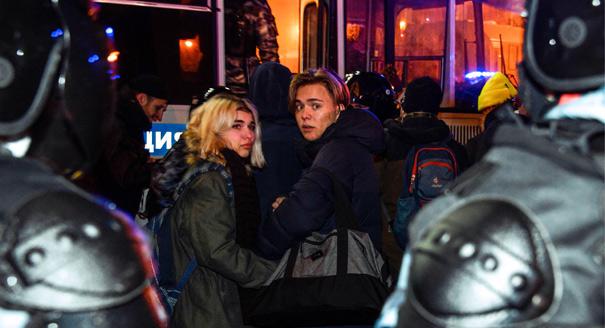
Moreover, in an economy dominated by the state, the best jobs and career prospects are in the hands of the state. And conformism and loyalty are crucial to building a successful career in the state sector. At the end of the day, the riot police who arrest opposition protesters with such brutality are also young people, as are the technocrats in their blue suits and skinny ties, focused on career progression and a fat salary. Material wealth is ultimately more important for many young people than democracy.
The future depends on which set of values society ends up choosing. What will prevail: the romanticism of patriotic games and youth military movements, or the allure of street protests? The attributes of a “modern” society may be visible, but they are not always accompanied by the crystallization of modern values, including human rights and freedoms.
Even if it likes using cutting-edge digital technology, the Russian state is imposing an antiquated cultural consensus, like the 2020 constitutional reforms that enshrined conservative values in law. But this form of consensus goes against the tide of modernizing trends that are making themselves felt in culture, society, demographics, and politics. How can you impose a ban or restrictions on abortion for reasons of “tradition,” when society has long since changed its reproductive practices?
A generational shift will take place if young Russians decide to break with the values of an antiquated state. This process could take a very long time and include periods of regression, but it could also happen much quicker than expected. The battle for the young generations and a new pantheon of values continues apace.
Former Senior Fellow, Carnegie Russia Eurasia Center
Kolesnikov was a senior fellow at the Carnegie Russia Eurasia Center.
Recent Work
Andrei Kolesnikov
Andrei Kolesnikov

Russia’s ruling party would have benefited from Putin appearing as its distant patron, but as an active frontman imposing his views on the public, he has done nothing but harm both the party’s election campaign and the ruling system overall.

Andrey Pertsev

The Bureau of Industry and Security needs to adjust its focus and practices to maintain its position as the U.S. government’s primary champion of international technological competition.

Geoffrey Irving

European Commission President Ursula von der Leyen is about to give her annual address on the state of the EU. Here’s what she won’t—but should—say.

Rym Momtaz

Depleted financial reserves and a shrinking tax base mean it is no longer possible to simultaneously deliver high defense spending, price stability, and economic growth.

Alexandra Prokopenko

Blurring the line between humans and animals is a long-standing tradition in social utopian prose. In his latest novel, Leonid Bershidsky reminds us that in social experiments, people are often treated no differently than animals.
Alexander Baunov