

Commentary
Dmitri Trenin
{
  "authors": [
    "Dmitri Trenin"
  ],
  "type": "commentary",
  "centerAffiliationAll": "",
  "centers": [
    "Carnegie Endowment for International Peace",
    "Carnegie Russia Eurasia Center"
  ],
  "collections": [],
  "englishNewsletterAll": "",
  "nonEnglishNewsletterAll": "",
  "primaryCenter": "Carnegie Russia Eurasia Center",
  "programAffiliation": "",
  "programs": [],
  "projects": [],
  "regions": [
    "North America",
    "United States",
    "Russia"
  ],
  "topics": [
    "Economy"
  ]
}
Source: Getty
Three decades after the collapse of the USSR, the mindset of Soviet-American détente and “equal, mutually beneficial cooperation” is hopelessly outdated.
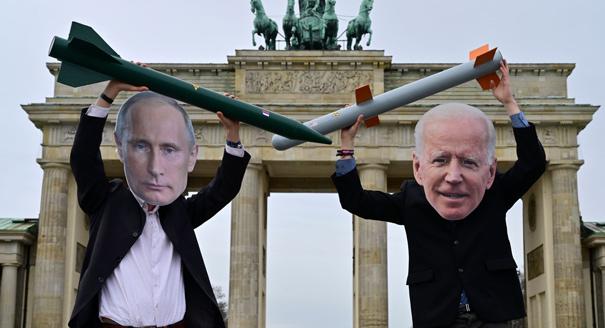
Following U.S. President Joe Biden’s recent comment indicating that he considers his Russian counterpart a killer, Russia recalled its ambassador, Anatoly Antonov, back to Moscow for consultations: an unprecedented step in the history of Russian-American relations. But even before this, bilateral relations were in need of a reassessment, one free of the emotions and illusions stirred up by the presidential clash.
Emotions compel Russia to escalate the confrontation with the United States, or even turn the fight against U.S. global domination into the central idea of Russia’s foreign—and to some extent domestic—policy. This positioning harks back to Cold War–era Soviet policy, but it’s not practicable with Moscow’s current shortage of resources.
Furthermore, overextension in foreign policy was one of the factors that led the Soviet Union into crisis in the 1980s. Letting off emotional steam through rhetoric—which is what we are seeing for now—is less dangerous, of course, but also entirely unproductive.
There is an illusion that Russia can still prove something to the United States, bring Washington to its senses, and force the United States to respect Russian national interests on the basis of a global Russian-American understanding: some sort of a grand bargain. These illusions have faded over the past four years, but the Russian elites still haven’t completely let them go.
We need to recognize that three decades after the collapse of the USSR, the mindset of Soviet-American détente and “equal, mutually beneficial cooperation” is hopelessly outdated. Furthermore, Russia’s foreign policy suffers from its fixation on relations with the United States.
Setting aside emotions and illusions, there are at least ten realistic objectives for Russia’s foreign policy.
First, continue to ensure that any incidents involving Russian and U.S. or NATO troops, aircraft, or ships are avoided or quickly resolved. This is why lines of communication exist, and these lines appear to be in good order. The main goal in U.S.-Russian relations for the foreseeable future is to prevent an unintentional armed conflict.
Second, reinforce the combined nuclear and non-nuclear deterrence of the United States as the cornerstone of Moscow’s independent position with respect to Washington. Deterrence—not arms control agreements—is the foundation for strategic stability and the guarantee of Russia’s very existence. While a costly quantitative arms race should be avoided, in the current conditions, deterrence is not limited to nuclear weapons, but increasingly involves outer space and cyberspace.
Third, begin talks on strategic stability, bearing in mind that the subject of these talks is extremely complicated, and that Washington will try to negotiate from a position of strength. This means that Russia and the United States are unlikely to reach an agreement during the five years that the recently extended New START agreement will remain in effect. Russia must therefore be ready to uphold strategic stability without an international agreement framework.
Fourth, approach the Iranian and North Korean nuclear problems based on Russia’s own assessment of the situation instead of trying to “sell” its assistance to Washington in promoting the U.S. agenda. Russia should partner with other players, such as China or European nations, to focus on an agenda that Moscow considers realistic and capable of reducing nuclear risks.
Fifth, develop cooperation on climate change and environmental protection, security in the Arctic, and the fights against pandemics and terrorism in a manner guided by Russian national interests and U.S. willingness to work together. To that end, Russia must outline a national agenda for all of these issues to promote in its dealings with the United States and other countries.
Sixth, cultivate relations with China in all sectors while maintaining an independent policy and avoiding getting drawn into the U.S.-China conflict, in the same way that Beijing steers clear of the conflict between Moscow and Washington.
Seventh, regard U.S. sanctions as a stimulus to work toward further economic, financial, technological, informational, and cultural independence amid global competition. Strengthen the sociopolitical foundation of the state by bolstering the primacy of the law, bringing the ruling elite under control, and amending economic policy so that it promotes the growth of an independent middle class. The confrontation with the United States compels Russia to implement policies favoring development.
Eighth, give up as futile any attempts to influence U.S. domestic policy. The costs of getting involved in the internal processes of another state—particularly a more powerful state—are much higher than the potential gains. There are no politicians in the United States who hold an amicable position toward Russia, and none are likely to appear in the foreseeable future. The degree of internal stability in the United States depends on domestic processes. Moscow should carefully monitor these processes, as they may have consequences for Russia; however, Moscow must be careful not to get involved.
Ninth, differentiate between the U.S. political class and media on the one hand, which hold a consistently adversarial position toward Russia overall, and other groups of U.S. society, such as the business, research, and technology communities; local governments; and public organizations. Moscow should promote the development of nonpolitical connections between Russian and U.S. society to any degree that it can.
Finally, shift away from the U.S.-centric nature of foreign policy. Russia and the United States are unlikely to achieve far-reaching and productive cooperation in the near future. Russian foreign policy also needs to target a number of other directions, from its closest neighbors to countries in East and Southeast Asia and the Middle East. Russia needs to reallocate its resources, albeit without undermining its capability to track Washington’s policy and actions.
The scandal sparked by Biden’s remark gives Russia the opportunity to take time to think and decide how to continue its relations with the United States. For the foreseeable future, Ambassador Antonov has more work to do in Moscow than in Washington.
Former Director, Carnegie Moscow Center
Trenin was director of the Carnegie Moscow Center from 2008 to early 2022.
Recent Work
Dmitri Trenin
Dmitri Trenin
Carnegie does not take institutional positions on public policy issues; the views represented herein are those of the author(s) and do not necessarily reflect the views of Carnegie, its staff, or its trustees.

Despite its flop at the box office, the film raises important questions for the climate community to answer.

Leonardo Martinez-Diaz

Russian strikes are weakening the economy sustaining Ukraine’s war effort. Closing the growing funding gap will require more European support and politically contentious reforms in Kyiv.

Balázs Jarábik

In an interview, Rozina Ali discusses her new book on the rise and manifestations of Islamophobia in the United States.

Michael Young

While the EU and European governments are embracing the much-lauded middle-power moment, this entails three difficult conundrums.

Richard Youngs

Europe is facing rising populism internally as well as external pressures from Russia, China, Turkey, and the United States.

Dimitar Bechev