

Commentary
Artyom Shraibman
{
  "authors": [
    "Artyom Shraibman"
  ],
  "type": "commentary",
  "centerAffiliationAll": "",
  "centers": [
    "Carnegie Endowment for International Peace",
    "Carnegie Russia Eurasia Center"
  ],
  "collections": [],
  "englishNewsletterAll": "",
  "nonEnglishNewsletterAll": "",
  "primaryCenter": "Carnegie Endowment for International Peace",
  "programAffiliation": "",
  "programs": [],
  "projects": [],
  "regions": [
    "Eastern Europe",
    "Belarus"
  ],
  "topics": [
    "Economy"
  ]
}
Source: Getty
The Belarusian regime has backed itself into a corner, and is now scared to ease up the pressure, fearing that if angry people are given more freedom, there could be a repetition of last August’s sweeping protests.
The Belarusian government’s move to destroy the country’s biggest non-state media outlet—the website tut.by—is more than just another salvo from the front of the Belarusian counterrevolution.
Before it was blocked, the website was attracting 3.3 million unique users per month, or 63 percent of Belarusian internet users. In other words, nearly all Belarusians who read the news online do so on tut.by—or rather, they did until May 18.
Like other media not controlled by the Belarusian state, tut.by had undergone short periods of being blocked during the protests that have swept the country since the contested presidential election last August. It had seen pressure put on advertisers; its journalists had faced fines, arrests, and criminal prosecution; and the website’s owners had been strongly encouraged to sell their business. Last year, it had its media credentials revoked.
Since the start of the political crisis last year, many Belarusian online media outlets have found themselves blocked entirely, and nearly all the remaining opposition-leaning newspapers have stopped being printed. Everyone knew it was only a matter of time before the biggest independent media organization was annihilated.
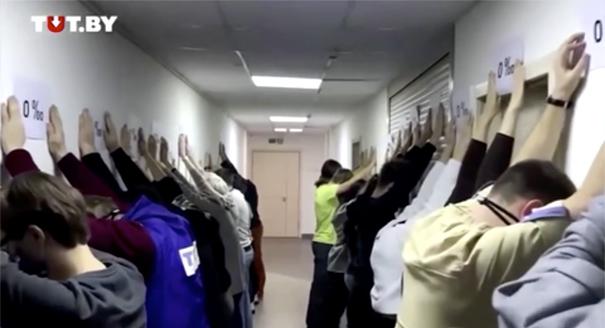
In the end, the regime turned both barrels on tut.by. The site was blocked for disseminating information from an “unregistered” organization: the Belarus Solidarity Foundation (BYSOL), whose mission is “fundraising to support victims of repression in Belarus.” Information from BYSOL has been cited by nearly all Belarusian media, including state-run outlets, but only one was ordered to be shut down over it.
That same morning, senior management staff at the website and related businesses were detained on suspicion of tax evasion. The company is accused of making illegal use of tax breaks as the resident of the Hi-Tech Park. Regular audits of the Hi-Tech Park itself, incidentally, had revealed no such irregularities.
There is a bitter irony in the use of the facility known as Belarus’s Silicon Valley to destroy the country’s main online media organization. This is one of the signs that the situation has changed: eliminating political threats isn’t just a priority, it’s the regime’s only task. If achieving that aim means shattering the image of the Hi-Tech Park—the pride and joy of President Alexander Lukashenko’s attempts at modernization—then so be it.
For the twenty years of its existence, there were three factors that protected tut.by. The first was its millions of readers: the authorities didn’t want to anger them. And after all, the site may not have been under the state’s control, but it didn’t position itself as an enemy of the regime, and was willing to adhere to regularly changing laws.
But now, the polarization between Lukashenko’s supporters, who largely get their news from the TV, and his opponents, who mostly rely on the internet, has become so great that this argument has become irrelevant. The same is true of the risk of ruining relations with the West: that relationship is already at its lowest point in the history of independent Belarus.
The second factor that has changed is that previously there were people inside the system who blocked the hawks’ attempts to get at tut.by. They weren’t always successful, but there were enough of them to prevent things from going too far. Today, when the atmosphere is not just that of a besieged fortress, but one that has been infiltrated by enemies, those opponents of repression who remain inside the system can no longer speak out against their colleagues’ initiatives without being seen as disloyal and risking harsh reprisals.
The third and final factor is that when there are no serious political threats, when the opposition is weak and unpopular, when people are apathetic, and the regime is thriving and confident, independent media can even be helpful to authoritarian regimes by identifying social problems that can then be solved before they become political. But following the contested presidential election and ensuing protests, there is no such thing as harmless criticism, as far as the Belarusian authorities are concerned.
The consequences of the demolition of the country’s main news site will be far-reaching. Its audience of more than 3 million won’t switch over to state media outlets, which call daily for a crackdown on the “fifth columnists.” Tut.by’s readers will simply turn to remaining independent platforms, such as onliner.by and nn.by, as well as sites that are blocked but can still be accessed using a VPN: naviny.by, euroradio.fm, svaboda.org, belaruspartisan.by, belsat.eu, and others. Those whose editorial staff are based in Belarus, however, will now either live in expectation of a repetition of tut.by’s fate, or resort to self-censorship.
For the most part, however, tut.by’s readers will turn to social media and Telegram channels, where the editorial staff of tut.by have already taken refuge. And if YouTube, Instagram, and Facebook can in theory be blocked, it’s much harder to shut down Telegram, as the Russian authorities learned the hard way back in 2018.
The further underground the content-creating process is pushed, the less effort journalists and editors put into fact-checking and attempts to remain neutral and observe journalistic ethics and current Belarusian law. By closing down traditional media with editorial staff and offices, the authorities are driving millions of their readers toward more polarized positions.
Pressure on the media is just one part of the ongoing turning of the screws of mass repression in Belarus. More than 35,000 people have been arrested, thousands have reported they were tortured or mistreated, and Belarus now has more than 400 people who are considered political prisoners. Over 3,000 criminal cases with political overtones have been opened: those who paid protesters’ fines, for example, are being charged with “financing unrest.”
The firing of disloyal medical staff, cultural figures, security service officers, teachers, and academics, and expulsion of students have become everyday occurrences. People have been kept in detention centers simply for having protest stickers on their laptop computers or putting paper snowflakes in their windows colored red and white (the colors of the protest movement).
Faced with the state’s heavy-handed approach, any hypothetical leader of the opposition who attempts to go down the road of peace and reconciliation with the authorities would find themselves without support from voters, destroying any chance of compromise as a way out of the political crisis. The regime has backed itself into a corner, and is now scared to ease up the pressure, fearing that if angry people are given more freedom, there could be a repetition of last August.
The West, meanwhile, doesn’t have enough influence to make a difference, and even introducing the toughest sanctions possible will only push Minsk toward even more repressive measures rather than choosing to cave and lose face.
This atmosphere of a cold civil war is not only causing Lukashenko to become more repressive, but also to put off indefinitely the political reform promised to Moscow, or to do it purely for show.
With de-escalation becoming almost impossible, society becoming polarized, and fewer and fewer people prepared to forgive the regime, the likelihood is growing of the Belarusian crisis seeing yet another spontaneous escalation of violence. This one may be the turn that breaks the screw altogether.

Nonresident Scholar, Carnegie Russia Eurasia Center
Artyom Shraibman is a nonresident scholar at the Carnegie Russia Eurasia Center.
Recent Work
Artyom Shraibman
Artyom Shraibman
Carnegie does not take institutional positions on public policy issues; the views represented herein are those of the author(s) and do not necessarily reflect the views of Carnegie, its staff, or its trustees.
Moldova’s reintegration plan was drawn up to demonstrate to Brussels that Chișinău is serious about the Transnistria issue—and to get the West to react.
Vladimir Solovyov
In key sectors such as critical minerals, specialty agriculture, and fintech, Africa can become a global powerhouse by investing more in manufacturing, value-add, and scaling.

Kholofelo Kugler, Georgia Schaefer-Brown

In the latest Five-Year Plan, the Chinese president cements the shift to an innovation-driven economy over a consumption-driven one.

Damien Ma

The continent needs to improve conditions for production of complete AI robotic systems and preserve its edge in hardware.
Pavlo Zvenyhorodskyi
Lukashenko is willing to make big sacrifices for an invitation to Mar-a-Lago or the White House. He also knows that the clock is ticking: he must squeeze as much out of the Trump administration as he can before congressional elections in November leave Trump hamstrung or distracted.
Artyom Shraibman