

Commentary
Marc Pierini
{
  "authors": [
    "Marc Pierini"
  ],
  "type": "commentary",
  "centerAffiliationAll": "",
  "centers": [
    "Carnegie Endowment for International Peace",
    "Carnegie Europe"
  ],
  "englishNewsletterAll": "",
  "nonEnglishNewsletterAll": "",
  "primaryCenter": "Carnegie Europe",
  "programAffiliation": "",
  "programs": [],
  "projects": [],
  "regions": [
    "Europe",
    "United States"
  ],
  "topics": [
    "EU",
    "Democracy",
    "NATO",
    "Security"
  ]
}
Source: Getty
Between Greenland and U.S. interference in Europe’s democracies, transatlantic relations risk rising to an unprecedented level of crisis. Amid continued arguments on how Brussels should react, tough times lie ahead for European leaders.
It took European leaders a full year after Donald Trump’s November 2024 reelection as U.S. president to realize that his White House is now squarely hostile to the EU—and to a large number of European states, be they EU members or nonmembers. Since the release of the new U.S. National Security Strategy last December, no doubts remain: The Trump 2.0 administration has launched an ideological war on the EU and intends to directly interfere in the domestic political affairs of many European countries.
In 2026, Washington’s main targets seem to be Greenland and the EU’s political system. Unfortunately, however European leaders react to any U.S. moves, there is only a small chance of seeing a conciliatory stance emerge from across the Atlantic during the year.
Initially, there was disbelief. Even after U.S. Vice President J.D. Vance’s confrontational speech in Munich in February 2025, few European leaders wanted to admit that the fundamentals of the transatlantic relationship of the past eighty years were being shattered. Now, after a year of Trump’s second presidency—with a roller coaster of statements, meetings, agreements, disagreements, and the publication of the 2025 National Security Strategy—at least some clarity has been achieved.
From Brussels’s perspective, America’s partners are confronted with a whole new U.S. policy approach with four central elements.
The first is the primacy of absolute force. The Trump administration has conducted military operations both big, as in Iran and Venezuela, and small, as in Nigeria, in Syria, and on the high seas. It has interfered in elections in Germany, Poland, and Romania, with more such opportunities to come. It has deployed imperial narratives to argue that the United States “need[s] Greenland” and that Canada should become the fifty-first U.S. state. And it has launched trade wars by imposing tariffs on goods from around the world.
Second, the White House engages in billion-dollar diplomacy. In countries and territories from Russia and Gaza to Venezuela and Greenland, most U.S. initiatives now come with a large economic and financial objective in the form of real estate or access to underground resources.
Third, Washington has embarked on an ideological operation to erase the foundations of the EU as a political entity, seeking to return Europe to a collection of nation-states and weaken the union’s rulemaking role, in particular in the digital realm.
Fourth, the United States has retreated from a plethora of international commitments by withdrawing from the Paris Agreement on climate change, UNESCO, the UN refugee agency, the WHO, and sixty-six other organizations, conventions, and treaties.
Yet, amid a flurry of actions and lots of noise, little or no progress has been achieved in areas of major interest to Europe. For example, a ceasefire is still elusive in Ukraine, where Washington was largely aligned with Moscow from the outset, while the fate of the Palestinians in Gaza and the West Bank remains tragic.
Along the way, the so-called rules-based order—largely crafted with U.S. leadership in the immediate aftermath of World War II—has gone to waste, and the role of the UN has been reduced to very little. Russia, by contrast, is both comforted by the U.S. alignment with Moscow’s neo-imperialist objectives and imitated by a U.S. president who bases his foreign policy moves on land possession and primary resources. What is more, the mutual connivance of the White House and the Kremlin puts pressure on European states and, in particular, the EU. The debate about the transatlantic relationship has intensified since the U.S. operation on January 3 to exfiltrate Venezuela’s then president Nicolás Maduro.
To put it mildly, most European leaders are puzzled by the abysmal decline of the transatlantic relationship. So are reputable analysts. Even the leaders most inclined to visit the U.S. president’s Florida resort, Mar-a-Lago, and pander to Trump end up perplexed. Ultimately, leaving aside the transatlantic debate on peace in Ukraine, there are two litmus tests for the America-Europe relationship in 2026: One is Greenland, and the other is the preservation of the EU’s political system.
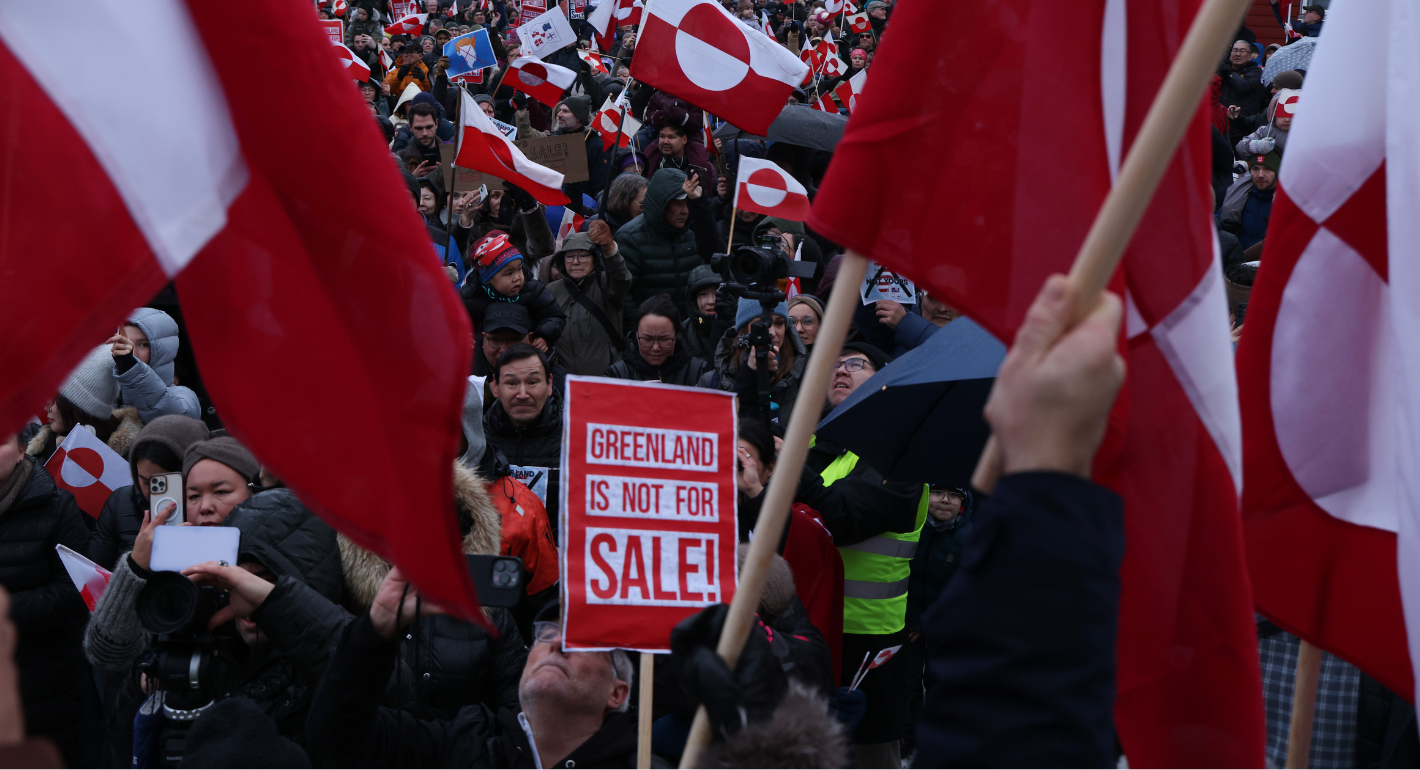
First, Greenland. Recent pronouncements by Trump on the Danish territory have resulted in a clear stance from leaders both in and outside the EU. On January 6, one statement was issued by the leaders of Denmark, France, Germany, Italy, Poland, Spain, and the UK, while another came from the foreign ministers of the five Nordic countries. Both statements conveyed identical positions—that while the security of the Arctic region must be discussed collectively, the future of Greenland belongs to Greenlanders alone.
Diplomatic statements, even when issued at the highest level, are the bare minimum expression of a political position on a divisive issue. In the Trumpian world, such words are unlikely to stop the White House’s disruptive narrative, but they have the advantage of putting down on paper Europeans’ deep-rooted feelings about Greenland.
Other responses are harder to craft. In principle, the best option would be a common plan to improve the security of the Arctic under the NATO umbrella, which would preserve the role of the United States and its Pituffik military base while involving European countries and maintaining Greenland’s integrity. This was an explicit goal in both recent European statements.
Another argument is whether Greenland is a part of the EU and would therefore benefit from the union’s mutual-assistance clause. Formally, Greenland is mentioned not as part of the bloc but as one of its overseas countries and territories (OCTs). The applicability of the mutual-assistance clause continues to be intensely debated by legal experts. This debate has immense implications, since several EU members control land with OCT status.
Beyond the legal debate, the issue looks entirely political: Can European countries, EU or non-EU, silently accept a U.S. takeover of Greenland, whether on purely financial terms or under some sort of coercive action?
Subject to a full political deliberation among all the parties concerned, the answer seems clear: Any annexation of Greenland by the United States would be unacceptable for European leaders and all non-U.S. members of NATO, since it would create an unthinkable precedent for all nineteen OCTs linked to Denmark, France, the Netherlands, Portugal, Spain, and the UK in the Atlantic, Indian, and Pacific Oceans, the Arctic, and the Antarctic.
Predictably, the short meeting between the foreign ministers of Denmark, Greenland, and the United States on January 14 ended in deadlock: A “fundamental disagreement” over the island’s future remains, and the parties agreed only on a joint working group. Starting on January 15, military personnel from Denmark, France, Germany, the Netherlands, Norway, Sweden, and the UK met in Greenland to consider new contributions to the security of the Arctic.
Going forward, if Washington’s views on the territory remain unchanged and if no common ground is found with European countries and NATO for joint military activities in Greenland, the results will be a complete freeze of NATO in the short term and an unprecedented transatlantic crisis.
The second test is the integrity of the EU’s political architecture. Given the policy intentions announced in the new U.S. security strategy, this looks set to be another minefield in transatlantic relations for 2026.
Clearly, the Trump White House intends to work closely with countries like Hungary, the Czech Republic, and Slovakia as well as so-called patriotic political parties across Europe, among them the National Rally (RN) in France, the Alternative for Germany, Brothers of Italy and the Northern League parties in Italy, and the Party for Freedom in the Netherlands. In the words of the strategy, “the growing influence of patriotic European parties indeed gives cause for great optimism.” Incidentally, U.S. support for these “patriotic” political actors mirrors Russia’s political and financial backing for them.
Based on the experience of Germany’s February 2025 federal election, it can be expected that the Trump administration will seek to exert direct influence on forthcoming elections in countries deemed vital to U.S. interests across Europe. Presumably, the first such occasion will be April’s legislative election in Hungary, where Prime Minister Viktor Orbán’s Fidesz party will be challenged by Péter Magyar’s center-right Tisza party. An Orbán victory would please both the White House and the Kremlin.
The next major opportunity for interference will be the 2027 presidential election in France, where President Emmanuel Macron will not run and the far-right RN will be the main contender. Here, too, an RN victory would be welcomed by both the White House and the Kremlin and might well seal the fates of Ukraine and NATO. Similarly, Slovakia’s 2027 legislative election will determine whether Prime Minister Robert Fico’s largely pro-Russia, anti-EU Smer party remains in power.
Another arena for U.S. interference is the EU regulatory domain, described by the U.S. National Security Strategy as “regulatory suffocation.” At stake is the EU Digital Services Act, which entered into force in February 2024 and has been criticized by the White House for infringing on American free speech and targeting U.S. tech giants.
All things considered, 2026 looks like a difficult year for transatlantic relations.
Those who favor optimism will underline the following words of the U.S. strategy: “Europe remains strategically and culturally vital to the United States. Transatlantic trade remains one of the pillars of the global economy and of American prosperity. . . . Not only can we not afford to write Europe off—doing so would be self-defeating for what this strategy aims to achieve.”
Others advocate a resolute decision by European leaders to make their continent stronger—militarily, economically, and politically. German Chancellor Friedrich Merz is a strong voice in this camp.
Yet most Europeans will likely opt for continued dialogue with Washington, an avenue that is both indispensable and frustrating, since there is little reason in today’s context to expect any views amenable to Europe to emanate from the White House in 2026. In a U.S. midterm election year, forging ahead on Greenland and disrupting Europe further will help the U.S. administration to hide its domestic difficulties and its lack of success in Ukraine and Gaza.

Senior Fellow, Carnegie Europe
Marc Pierini is a senior fellow at Carnegie Europe, where his research focuses on developments in the Middle East and Turkey from a European perspective.
Recent Work
Marc Pierini
Marc Pierini

The DFC should focus on advanced, low-carbon energy sources, prioritizing areas where the United States has comparative advantages.

Noah Gordon, Liana Schmitter-Emerson
Lee’s tour shows how Seoul is reorganizing its diplomacy away from Pyongyang and toward industrial networks and the geography of the compute economy.

Darcie Draudt-Véjares
The Pentagon is calling for a rapid AI transformation. Autonomous drones offer a case study in the eight bottlenecks the U.S. military must navigate to realize that vision.
Jake Steckler

Most migrants may have left Ceuta, but the effects may linger.


Alejandro Martin Rodriguez, Sarah Yerkes

Saied’s main accomplishment has been to destroy a decade’s worth of democratic progress.
Sarah Yerkes