• Research
  • Emissary
  • About
  • Experts
Carnegie Global logoCarnegie lettermark logo
DemocracyIran
  • Donate
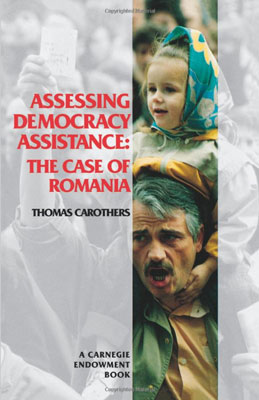
Assessing Democracy Assistance: The Case of Romania
Book

Assessing Democracy Assistance: The Case of Romania

This landmark study, an examination of U.S. democracy assistance efforts in Romania, is the first comprehensive analysis of the workings—and failings—of U.S. democracy assistance in one country.

Link Copied
By Thomas Carothers
Published on Jan 1, 1996

Additional Links

Paperback - $23.28
Program mobile hero image

Program

Democracy, Conflict, and Governance

The Democracy, Conflict, and Governance Program is a leading source of independent policy research, writing, and outreach on global democracy, conflict, and governance. It analyzes and seeks to improve international efforts to reduce democratic backsliding, mitigate conflict and violence, overcome political polarization, promote gender equality, and advance pro-democratic uses of new technologies.

Learn More

Source: Washington

In recent years, assistance aimed at promoting democracy abroad has become a major component of U.S. foreign aid and of the U.S. government's post-Cold War policy of seeking to enlarge the international community of democratic nations. Despite its rapid growth, however, democracy assistance remains poorly understood in practice, and its value is frequently questioned.

This landmark study, an examination of U.S. democracy assistance efforts in Romania, is the first comprehensive analysis of the workings—and failings—of U.S. democracy assistance in one country. Based on the author's extensive field research, the study provides widely applicable answers to key questions about the value, strategies, methods, and future of such assistance.

Advance Praise

“This is a thoughtful account of how projecting the values of one culture into another for the best of motives can go wrong, and it deserves to be read by all those committed to seeing East Europeans enjoying the life chances and liberties that we take for granted in the Atlantic democracies.”
—Europe–Asia Studies

About the Author

Thomas Carothers

Harvey V. Fineberg Chair for Democracy Studies; Director, Democracy, Conflict, and Governance Program

Thomas Carothers, director of the Carnegie Endowment for International Peace’s Democracy, Conflict, and Governance Program, is a leading expert on comparative democratization and international support for democracy.

    Recent Work

  • Commentary
    When Do Mass Protests Topple Autocrats?
      • McKenzie Carrier

      Thomas Carothers, McKenzie Carrier

  • Article
    The Trump Administration’s Tangled Talk About Democracy Abroad
      • McKenzie Carrier

      Thomas Carothers, McKenzie Carrier

Thomas Carothers
Harvey V. Fineberg Chair for Democracy Studies; Director, Democracy, Conflict, and Governance Program
Thomas Carothers
Eastern Europe

Carnegie does not take institutional positions on public policy issues; the views represented herein are those of the author(s) and do not necessarily reflect the views of Carnegie, its staff, or its trustees.

More Work from Carnegie Endowment for International Peace

  • Commentary
    Strategic Europe
    Europolis, Where Europe Ends

    A prophetic Romanian novel about a town at the mouth of the Danube carries a warning: Europe decays when it stops looking outward. In a world of increasing insularity, the EU should heed its warning.

      Thomas de Waal

  • An elderly woman stands on the balcony of her damaged home following a shelling on the town of Bakhmut in Donetsk region, on October 25, 2022,
    Paper
    Ukraine’s Regional Shift: Realignments in Wartime and Beyond

    Regional disparities in investment, labor markets, and government transparency mean that regional development will be a key feature of Ukraine’s postwar future.

      Mariya Levonova, Balázs Jarábik

  • Commentary
    Strategic Europe
    Unpacking Europe’s Deterrence Dilemmas

    The debate on the future of European deterrence has intensified, as NATO allies seek to balance three key aims. Going forward, they will need to cooperate more deeply to craft a coherent strategy for confronting new threats.

      Sophia Besch, Jamie Kwong

  • Commentary
    Strategic Europe
    Babiš’s Victory in Czechia Is Not a Turning Point for European Populists

    A populist movement has taken power in Czechia, reinforcing the steady rise of far-right parties across Central Europe. While united by the idea of regaining sovereignty, these forces remain divided on vital issues such as their stance toward Russia.

      Judy Dempsey

  • Moldova Election Russia Europe
    Article
    Moldova’s Election Is a Test for Russian Influence in Europe

    Moldova’s parliamentary election is make-or-break for the country’s European future. The outcome will test whether Chișinău will stay on the EU accession path or fall prey to Russia’s multi-domain interference campaign.

      Oana Popescu-Zamfir

Get more news and analysis from
Carnegie Endowment for International Peace
Carnegie global logo, stacked
1779 Massachusetts Avenue NWWashington, DC, 20036-2103Phone: 202 483 7600Fax: 202 483 1840
  • Research
  • Emissary
  • About
  • Experts
  • Donate
  • Programs
  • Events
  • Blogs
  • Podcasts
  • Contact
  • Annual Reports
  • Careers
  • Privacy
  • For Media
  • Government Resources
Get more news and analysis from
Carnegie Endowment for International Peace
© 2026 Carnegie Endowment for International Peace. All rights reserved.