

Commentary
Alexey Malashenko
Source: Getty
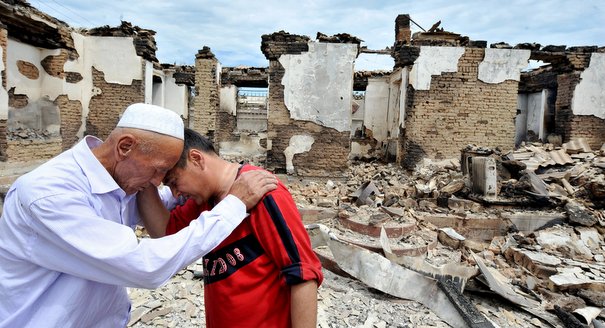
As Moscow grapples with the question of whether to intervene to stop the violence in southern Kyrgyzstan, it is forced to confront a vexing issue: can Russia utilize its political and military potential to help resolve local and regional conflicts in Central Asia?
As Moscow grapples with the question of whether to intervene to stop the violence in southern Kyrgyzstan, it is forced to confront a vexing issue: can Russia utilize its political and military potential to help resolve local and regional conflicts in Central Asia?
There are several ways in which Russia could intervene.
In the first scenario, troops from the member states of the Collective Security Treaty Organization (CSTO), led by Russian units, would enter Kyrgyzstan. Because it is hard to imagine Kazakh or Tajik troops in Osh or Jalalabad, a peacekeeping contingent from the CSTO would inevitably be predominantly Russian.
The decision for the CSTO to intervene in the Kyrgyz conflict must come from the members’ heads of state, who are in no hurry to make a decision.
The second scenario would be for Russian troops to enter Kyrgyzstan as part of a bilateral agreement. The Kyrgyz provisional government has requested Russian assistance, and Moscow could oblige. But Moscow has made no final decision as of yet, limiting itself to technical support, which, though important, is insufficient to alter the situation on the ground.
Direct military support would be provided only if the Kremlin is certain that it will achieve a rapid and decisive victory, without running the risk of being drawn into a protracted civil war.
Meanwhile, it is unclear how Kyrgyzstan’s neighbors would react to Russian intervention in Kyrgyz affairs. The Uzbeks in particular would be distressed to see foreign troops on their borders.
The United States, on the other hand, would be relatively more supportive of decisive Russian action, driven by Washington’s desire to avoid further tension in the Afghan neighborhood.
The third scenario would be for Russia to abstain, declaring the “slaughter,” as some Russian media have dubbed the events in Kyrgyzstan, an internal Kyrgyz matter. That, however, would lay bare Russia’s weakness, bordering on helplessness, in Central Asia. Russian passivity would also undermine the new Kyrgyz authorities, who have repeatedly sworn loyalty to Moscow and openly called for help. If Russia remains inert and limits itself to rhetoric, its authority in the region will suffer irreversible damage.
Any decision will be difficult for Moscow. The Russian government is stalling for time, in hopes that the situation in Kyrgyzstan will resolve itself and the local authorities will consolidate their power. But even if that does come to pass, Moscow’s indecisiveness will leave a bad taste in the mouths of Kyrgyz leaders.
And all of this serves as further confirmation of the helplessness of Russia’s pet project, the CSTO.
Former Scholar in Residence, Religion, Society, and Security Program
Malashenko is a former chair of the Carnegie Moscow Center’s Religion, Society, and Security Program.
Recent Work
Alexey Malashenko
Alexey Malashenko
Carnegie does not take institutional positions on public policy issues; the views represented herein are those of the author(s) and do not necessarily reflect the views of Carnegie, its staff, or its trustees.

China’s political future will be shaped between now and next October. As the Communist Party enters its intense “campaign season” to prepare for a major political transition in 2027, reading Beijing's actions and responses may become more difficult as domestic politics weigh on its behavior more than usual.

Damien Ma

The EU can impose sanctions but struggles to enforce them without the United States. With Washington increasingly disinterested in backing European interests, the bloc must now fend for itself.


Nicu Popescu, Tiago Antunes
Global and rising powers will need to engage with Africa’s priorities and agency in order to secure the continent’s increasingly attractive partnerships.

Fonteh Akum

Rubio’s recent visit brought welcome attention, but more capital requires governance changes that may be a hard sell for regional governments.

Jennifer B. Murtazashvili

America’s foreign-policy objectives have grown more demanding while Americans have demanded greater focus on their own affairs.

Stephen Wertheim