• Research
  • Emissary
  • About
  • Experts
Carnegie Global logoCarnegie lettermark logo
DemocracyIran
  • Donate
Political Crisis in a Multiethnic Country

Source: Getty

Article
Carnegie Russia Eurasia Center

Political Crisis in a Multiethnic Country

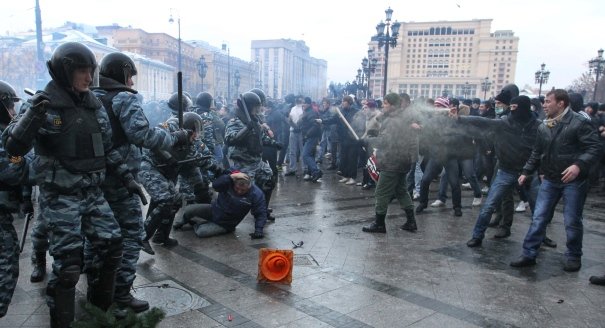
The mass unrest in Moscow this December has demonstrated the failure of the authorities to maintain stability in a multi-ethnic and multi-faith country.

Link Copied
By Alexey Malashenko
Published on Dec 20, 2010

The recent mass riots in Moscow should be recognized as a political crisis, or at least the warning sign of a crisis on the way. The riots were sparked by the murder of Yegor Sviridov, a Spartak football fan killed in a fight near a Moscow bus stop by Caucasian natives. Assessing these events requires extreme caution; it is all too easy to write an analysis that looks like a provocation for more violence, or, on the other extreme, seems entirely indifferent to the riots, as though nothing out of the ordinary happened at all. Russians must not exaggerate the situation, but neither can they ignore it. 

First of all, Russians need a clear picture of exactly what happened during the recent unrest. There are two points of view on this. The first says the riots were simply a case of massive “disruptive behavior” tinged by ethnic tension, and the second says this was an interethnic clash packaged in the form of football fans’ brawls. 

The first assessment is more convenient from the authorities’ point of view. It is easier to deal with hooligans. The second assessment requires a more serious approach and recognition of a real increase in the level of interethnic confrontation in Russia with the consequences that entails. This is not simply an academic matter. The official narrative of these events will determine what charges are pressed against those detained in Moscow and other cities for taking part in the riots: charges of engaging in a brawl are one matter, but charges of inciting interethnic tension are quite another.

But society seems inclined toward the second assessment.

If the authorities also end up taking this view of the December tragedy (and tragedy is the right word here), they should attempt to prevent a further rise in interethnic and religious tension. Any conflict with an interethnic element is complicated by the fact that it is impossible to clearly distinguish which party is in the right and which is wrong. This viewpoint clashes with the authorities’ general preference to operate on a simpler “black-and-white” paradigm.

To call the unrest a political crisis may sound a bit exaggerated, but it is true nevertheless. Unrest that brings thousands of people into the streets in Moscow, St Petersburg, and other Russian cities is indeed a political crisis for a multiethnic and multi-faith country such as Russia. This unrest reflects the authorities’ failures and their inability to maintain stability in a country of this diverse makeup. Evidence of the Kremlin’s unwillingness to face this issue can be found in the latent civil war in the North Caucasus, which has somehow grown commonplace and continues without significant public notice.

Is it not bad enough that the greater part of Russian society supports letting the North Caucasus separate from Russia? This is impossible in principle, but the number of people willing to get rid of the Caucasus and Caucasians will no doubt grow even higher after the December events.

These recent events represent a crossroads, not only in terms of interethnic relations but also with regard to the internal situation in Russia in general. What happened this December could happen again at any place and any time in Russia. A pretext for violence can always be found.

Of course, the authorities could be tempted to use this rise in interethnic tension to further their own personal aims and to suppress various forms of protest activity and clamp down further on society in general. But whether they are capable of calming the interethnic situation—which is also in their interest—is another matter.

About the Author

Alexey Malashenko

Former Scholar in Residence, Religion, Society, and Security Program

Malashenko is a former chair of the Carnegie Moscow Center’s Religion, Society, and Security Program.

    Recent Work

  • Commentary
    What Will Uzbekistan’s New President Do?

      Alexey Malashenko

  • Commentary
    Preserving the Calm in Russia’s Muslim Community

      Alexey Malashenko

Alexey Malashenko
Former Scholar in Residence, Religion, Society, and Security Program
Alexey Malashenko
CaucasusRussiaPolitical Reform

Carnegie does not take institutional positions on public policy issues; the views represented herein are those of the author(s) and do not necessarily reflect the views of Carnegie, its staff, or its trustees.

More Work from Carnegie Endowment for International Peace

  • Commentary
    Carnegie Politika
    Is Frustration With Armenia’s Pashinyan Enough to Bring the Pro-Russia Opposition to Power?

    It’s true that many Armenians would vote for anyone just to be rid of Pashinyan, whom they blame for the loss of Nagorno-Karabakh, but the pro-Russia opposition is unlikely to be able to channel that frustration into an electoral victory.

      Mikayel Zolyan

  • Commentary
    Carnegie Politika
    Will Hungary’s New Leader Really Change EU Policy on Russia and Ukraine?

    Orbán created an image for himself as virtually the only opponent of aid to Ukraine in the entire EU. But in reality, he was simply willing to use his veto to absorb all the backlash, allowing other opponents to remain in the shadows.

      Maksim Samorukov

  • Commentary
    Strategic Europe
    How to Join the EU in Three Easy Steps

    Montenegro and Albania are frontrunners for EU enlargement in the Western Balkans, but they can’t just sit back and wait. To meet their 2030 accession ambitions, they must make a strong positive case.

      Dimitar Bechev, Iliriana Gjoni

  • Commentary
    Carnegie Politika
    Is There a Place for Russia in the New Race Back to the Moon?

    Despite having the resources and expertise, the Russian space industry missed the opportunity to offer the United States or China a mutually rewarding partnership in the lunar race.

      Georgy Trishkin

  •  A machine gun of a Houthi soldier mounted on a police vehicle next to a billboard depicting the U.S. president Donald Trump and Mohammed Bin Salman, the Crown Prince and Prime Minister of Saudi Arabia, during a protest staged to show support to Iran against the U.S.-Israel war on March 27, 2026 in Sana'a, Yemen.
    Article
    Amid Iran War, Gulf Countries Slow the Pace of Reforms

    The return of war as the organizing factor in Middle Eastern politics has predictable consequences: governments are prioritizing regime stability and becoming averse to political and social reform.

      • Sarah Yerkes

      Sarah Yerkes, Amr Hamzawy

Get more news and analysis from
Carnegie Endowment for International Peace
Carnegie global logo, stacked
1779 Massachusetts Avenue NWWashington, DC, 20036-2103Phone: 202 483 7600Fax: 202 483 1840
  • Research
  • Emissary
  • About
  • Experts
  • Donate
  • Programs
  • Events
  • Blogs
  • Podcasts
  • Contact
  • Annual Reports
  • Careers
  • Privacy
  • For Media
  • Government Resources
Get more news and analysis from
Carnegie Endowment for International Peace
© 2026 Carnegie Endowment for International Peace. All rights reserved.