• Research
  • Emissary
  • About
  • Experts
Carnegie Global logoCarnegie lettermark logo
DemocracyIran
  • Donate
True Partners? How Russia and China See Each Other
Report
Carnegie Russia Eurasia Center

True Partners? How Russia and China See Each Other

Despite the overlapping interests of Russia and China, the two countries are not allies. Moscow will not accept a junior position vis-à-vis Beijing, while the Chinese regard Russia as a fading power.

Link Copied
By Dmitri Trenin
Published on Feb 29, 2012

Additional Links

Full Text
Project hero Image

Project

Eurasia in Transition

Learn More

Source: Centre for European Reform Report

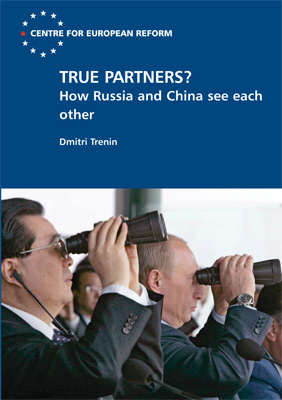
This report compares Russian and Chinese security perceptions and explains how they shape the two countries’ policies towards each other. It argues that the modern relationship between the two countries, formed in the late 19th and 20th centuries, was turned on its head at the start of the 21st century. China has now become a powerful factor affecting a whole range of Russian policies, both domestic and foreign. The paper also argues that, while Russia is not central to China’s foreign relations, and non-existent in China’s domestic politics, good relations with Moscow are an important supporting element in Beijing’s overall strategy of reclaiming China’s “rightful place in the world.” It concludes that while both countries need each other and would benefit from a stable political relationship and close economic ties, both Moscow and Beijing lack the long-term strategies to create such a bond.

As great power relationships go, the reversal of China’s and Russia’s fortunes at the close of the 20th century could not have been more dramatic. For the first time in their recent history, Russians have to deal with a China which is more powerful and more dynamic than their own country. To contemporary Russia, China holds out a number of opportunities, economic as well as political, as a market for Russian raw materials, a locomotive of economic development in the Russian far east and a fellow non-Western partner on the world stage. At the same time, however, China presents Russia with major challenges, particularly in Siberia, to which Russia has yet to respond. So far, Moscow has been able to sustain a tolerable modus vivendi in relations with Beijing, but the future beyond a ten or 15 year horizon is less clear. Russia will only be able to develop a long-term view of its relationship with China when Russian elites start to think more strategically about their country and what its global role should be.

To the Chinese, by contrast, Russia’s decline from being a Soviet-era superpower to its present status as a second tier power is but one of a number of great changes in the emerging international system. In overall GDP, China has overtaken Japan to become the world’s second largest economy. In terms of foreign trade volume, it has replaced Germany as the world’s top exporter. The UK’s handover of Hong Kong to China in 1997, and Portugal’s withdrawal from Macau in 1999, symbolized the end of a century and a half of humiliating Western occupation of parts of China’s territory. During the eurozone crisis, China was even being touted as a possible financial savior of the European Union. As for Russia, Beijing has learned to use its former mentor-turned-enemy-turned-partner as a source of raw materials, especially energy. It has also been able to rely on Russia as a strategic cushion, to strengthen its hand in opposing Western-led liberal interventionism. Beyond this, however, the Chinese do not seem to have a strategy for dealing with Russia.

The paper begins with a parallel description of Moscow’s and Beijing’s “strategic universes”—their respective security outlooks—and the place of the other country therein. With reference to Russia, it stresses that China’s rise has made Moscow’s view of the world far less Western-centric. With reference to China, it explains how and why the Russia relationship stands out among links with the major world powers, and what value it holds for Beijing.

The paper then assesses the two countries’ principal interests in key areas: global governance; regional issues; trade and investment, with a particular attention to energy; and arms transfers and their strategic implications. Despite the growing inequality of the relationship, the paper seeks to go beyond an assessment of the balance of power by analyzing each party’s interests and motives. The paper ends with reflections on the future of Sino-Russian relations, in bilateral, regional and global contexts.

About the Author

Dmitri Trenin

Former Director, Carnegie Moscow Center

Trenin was director of the Carnegie Moscow Center from 2008 to early 2022.

    Recent Work

  • Commentary
    Mapping Russia’s New Approach to the Post-Soviet Space

      Dmitri Trenin

  • Commentary
    What a Week of Talks Between Russia and the West Revealed

      Dmitri Trenin

Dmitri Trenin
Former Director, Carnegie Moscow Center
East AsiaChinaCaucasusRussiaPolitical ReformDomestic PoliticsForeign Policy

Carnegie does not take institutional positions on public policy issues; the views represented herein are those of the author(s) and do not necessarily reflect the views of Carnegie, its staff, or its trustees.

More Work from Carnegie Endowment for International Peace

  • Delegates watch as U.S. President Donald Trump speaks onstage at the World Economic Forum (WEF) on January 21, 2026 in Davos, Switzerland.
    Article
    Unstrategic Ambiguity: Trump’s Erratic Approach Leaves Europe Guessing

    The behaviors, public statements, and policies of Donald Trump’s administration have perverted America’s strategic posture toward Europe.

      Dan Baer, Erik Brown

  • Commentary
    Strategic Europe
    On NATO, Trump Should Embrace France Instead of Bashing It

    Donald Trump’s repudiation of NATO goes against the Make America Great Again vision of a U.S.-centered foreign policy. If the goal is to preserve the alliance by boosting Europe’s commitments, leaning into France’s vision is the most America First way forward.

      • Rym Momtaz

      Rym Momtaz

  • Commentary
    Carnegie Politika
    Conspiracy Theories Are Eclipsing the Real Dangers of Russia’s Messaging App Max

    The internet is awash not only with instructions from digital security experts, but also with urban legends and conspiracy theories that divert attention away from the real dangers of Max.

      David Frenkel

  • Commentary
    Emissary
    Russia Will Be More Dangerous After the War with Ukraine

    Putin’s blunder has created new and enduring security challenges for Russia and Europe.

      • Eugene Rumer

      Eugene Rumer

  • Ukraine's President Volodymyr Zelensky (R) and Poland's Prime Minister Donald Tusk attend a press conference at the Mariinskyi Palace in Kyiv on February 5, 2026, amid the Russian invasion of Ukraine.
    Article
    Kindred Nations, Uneasy Neighbors: Polish-Ukrainian Relations in the Crucible of Russia’s War

    The full-scale invasion cemented Ukraine’s determination to sever its ties with Russia; reimagining the Poland-Ukraine partnership can accelerate Kyiv’s westward alignment and improve the security of both countries.

      Eric Green

Get more news and analysis from
Carnegie Endowment for International Peace
Carnegie global logo, stacked
1779 Massachusetts Avenue NWWashington, DC, 20036-2103Phone: 202 483 7600Fax: 202 483 1840
  • Research
  • Emissary
  • About
  • Experts
  • Donate
  • Programs
  • Events
  • Blogs
  • Podcasts
  • Contact
  • Annual Reports
  • Careers
  • Privacy
  • For Media
  • Government Resources
Get more news and analysis from
Carnegie Endowment for International Peace
© 2026 Carnegie Endowment for International Peace. All rights reserved.