

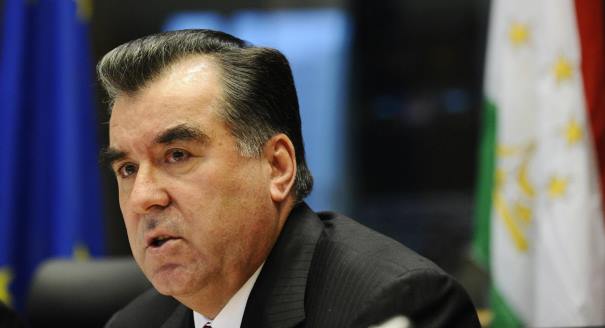
Source: Getty
The Rahmon Phenomenon: New Challenges for Tajikistan’s Long-Standing President
Tajikistan’s President Emomali Rahmon faces a number of complex tasks, which make maintaining a high degree of stability increasingly difficult.
Emomali Rahmon’s reelection as president of Tajikistan in 2013 testifies to his regime’s stability and its capacity for self-preservation. He now faces a number of complex tasks, which include undertaking economic reforms, counteracting religious extremism, and resolving conflicts with neighboring countries. It is becoming increasingly difficult to maintain a high degree of stability under these conditions.
Key Themes
- Tajikistan is the most impoverished nation in Central Asia. Local natural resources are being depleted, and the regime will soon be unable to provide its people with even a minimal level of sustenance. Economic reforms are long overdue.
- Popular demand for a strong opposition force to the regime is growing. An alliance that sought to challenge Rahmon’s reelection came up short but may learn from its mistakes before parliamentary elections scheduled for 2015.
- The political influence of the Islamic Renaissance Party of Tajikistan as well as Islamic radicals is increasing.
- Tajikistan is vulnerable to penetration by Islamic extremists from Afghanistan after the scheduled 2014 withdrawal of the International Security Assistance Force (ISAF) from the country, especially if the Taliban reemerges to control Afghanistan.
- The regime has proclaimed a state monopoly on Islam and has acted to regulate religious life.
- Disagreement with Uzbekistan over the Rogun hydroelectric power plant, which is being constructed in an earthquake-prone zone, has complicated Tajik-Uzbek relations.
Challenges Ahead
The economic clock is ticking. Until reforms are implemented, Tajikistan urgently requires external economic and financial assistance. Without external support, the country will find itself in a permanent crisis that could result in a social explosion.
Opponents need an outlet. The country’s type of authoritarianism allows for a multiparty system and permits criticism from the outside. But unless the leadership finds a way to let opponents meaningfully participate in the system, more radical opposition could develop.
Attempts to regulate Islam could backfire. Some Muslims support the regime’s efforts while others are critical. There is a risk that some disgruntled believers could join with fundamentalists.
The conflict over Rogun must be resolved quickly. The disagreement with Uzbekistan is making it more difficult for Tajikistan to solve other problems. An Uzbek offer to help build hydroelectric stations not in earthquake-prone regions provides a potential way to move forward.
The line of succession runs close to home. President Rahmon, serving his last term, must start grooming a successor. This person may come from either the president’s immediate family or his “extended family” in the Kulob clan.
Read Full Text
About the Authors
Former Scholar in Residence, Religion, Society, and Security Program
Malashenko is a former chair of the Carnegie Moscow Center’s Religion, Society, and Security Program.
Азиз Ниязи
Carnegie does not take institutional positions on public policy issues; the views represented herein are those of the author(s) and do not necessarily reflect the views of Carnegie, its staff, or its trustees.