

Commentary
The acknowledgment has sparked fears of a new arms race with China and Russia.
Chris O’Meara
Source: Getty
Is the salience of nuclear topics viewed differently by subject-matter experts than it is by elite opinion shapers? A survey of nuclear-themed editorials and policy articles published between 2001 and 2013.
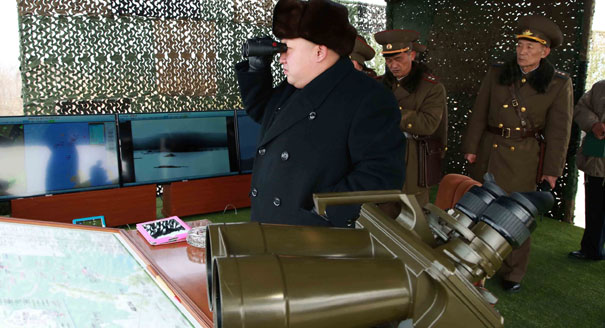
On February 12, 2013, amid threats to attack the United States with nuclear weapons, North Korea conducted its third nuclear explosive test. The resulting 5.1-magnitude earthquake was detected by the United States Geological Survey and other monitors and soon reverberated in media across the globe.
In the year that followed the test, four major U.S. newspapers published thirteen separate editorials on North Korea’s nuclear program, suggesting that elite media took the threat it posed seriously.
For the nuclear policy expert community, however, North Korea’s test did not result in nearly the same level of attention. Over the same time period, the top-five foreign policy journals and magazines carried just five articles on North Korea’s nuclear weapons.
Do these contrasting numbers indicate a divergence between policy experts and mainstream media on the relative level of attention that should have been given to North Korea in 2013 as compared to other nuclear threats? Are there other nuclear topics on which expert and elite opinion, as measured by policy journal articles and newspaper editorials, respectively, diverge and converge? In other words, is the salience of nuclear topics viewed differently by subject-matter experts than it is by elite opinion shapers?
One way to answer these questions was to survey twelve years of nuclear-themed editorials and policy articles published in those newspapers, journals, and magazines between September 2001 and September 2013. These included the New York Times, the Washington Post, the Los Angeles Times, and the Wall Street Journal, as well as Foreign Policy, Foreign Affairs, the Washington Quarterly, the National Interest, and Survival.1 Totaling the number of articles and then normalizing them as percentages facilitated a comparison of specific nuclear topics as portions of all nuclear-related writing.
It is interesting to note that the numbers of relevant editorials and articles published over this period on nuclear issues are relatively small: 861 editorials and 292 articles. For the sake of comparison, in the same time period, the same newspapers produced more than twice that coverage of nuclear issues on climate change.
There were both stark contrasts and interesting convergences in the level of media and expert attention to nuclear threats over the twelve-year period (see addendum for year-to-year information).2 For example, both groups focused on the negotiations with Iran over its nuclear program, but they paid far less attention to the threat posed by nuclear terrorism or conflict escalation in South Asia (see figures 1 and 2).
Yet, elite and expert opinions on the importance of nuclear topics also diverged in some cases, for instance on the issue of North Korea and on the status and future of the United States’ nuclear arsenal, as well as proliferation as a general phenomenon.


Expert and media opinions both considered Iran’s nuclear program to be the most salient of all nuclear issues: concerns over Iran’s nuclear program made up more than one-third of all newspaper editorials and foreign policy articles published between September 2001 and 2013.
Interestingly, elite and expert opinions also converged in giving relatively little attention to nuclear terrorism and the risk of nuclear escalation in South Asia.
Less than 10 percent of the editorials and articles covered nuclear terrorism over the twelve-year period, even though U.S. President Barack Obama hosted a major nuclear security summit in 2010 motivated by this threat.
And, despite a common refrain among nuclear experts that South Asia is the region most at risk for nuclear conflict (see, for example, Carnegie scholars George Perkovich and Toby Dalton), this issue barely figured on the list of noteworthy threats for either group.
If media and expert opinions converged on the importance of Iran’s nuclear program, the threat of a nuclear North Korea was a different matter.
As a percentage of overall coverage of nuclear issues, North Korea’s nuclear program was discussed twice as much in editorials as it was in policy articles between September 2001 and 2013.
In contrast, nuclear policy experts gave more focus than editorial writers to the current and future state of the U.S. nuclear arsenal. Only 8 percent of all editorials between September 2001 and September 2013 covered this issue, but 21 percent of policy articles debated the topic.
Finally, it is interesting to observe that no editorial dealt with proliferation as a phenomenon over the entire period, while 14 percent of foreign policy journal and magazine articles covered the issue.
Media and expert opinions agreed on what have constituted the most critical nuclear threats to the United States and the world over the last decade.
Both groups focused foremost on Iran’s nuclear program and gave far less frequent consideration to nuclear terrorism and the risk of nuclear escalation in South Asia.
The major areas where media and expert opinions diverged, however, were on the salience of the threat posed by North Korea and the significance of the U.S. nuclear arsenal.
While media opinion has given a relatively significant amount of space to debating North Korea’s nuclear program, experts have been much more preoccupied with the future of the United States’ nuclear arsenal as well as nuclear proliferation.
1. Peer-reviewed journal articles from quarterly and biennial publications were not studied because they have longer publication intervals and would not provide enough material to examine.
2. Nuclear safety issues are not included. Articles on country-specific proliferation, such as Iran and North Korea, appear under the country-specific titles, whereas articles that discuss proliferation as a phenomenon appear under the title proliferation.
Kristine Bergstrom
Former Deputy Editor, Nuclear Policy Program
Carnegie does not take institutional positions on public policy issues; the views represented herein are those of the author(s) and do not necessarily reflect the views of Carnegie, its staff, or its trustees.
The acknowledgment has sparked fears of a new arms race with China and Russia.

Chris O’Meara

Smaller powers cannot go it alone, but Canadian history shows that integration with the United States will not always be benign.
Paul Samson
The summit may be remembered as a fatal blunder, when Washington, Beijing, and the AI industry collectively chose ceremony over action.

Jeffrey Prescott

European NATO countries are wrestling with the possibility of U.S. disengagement from the alliance. With the continent’s security increasingly uncertain, governments must restore the credibility of their collective defense.



Hans-Dieter Lucas, Adam Thomson, Pierre Vimont
Soft power on its own is insufficient to meet U.S. national security needs, but hard power also has its limits. Soft power allows for more effective and efficient use of hard power than hard power alone, as it encourages cooperation and compliance which deters the need for hard power.

Sarah Yerkes