The European song contest has a long history of boycotts and bans. Its future as an instrument of soft power remains an open question amid rising attempts to abuse its stage.
Link Copied
By Charles H. Johnson
Published on May 12, 2026
Artists from thirty-five countries will perform for upwards of 240 million viewers at the seventieth Eurovision Song Contest (ESC) today in Vienna, Austria. While the world’s attention will be focused on performers’ vocals and staging, global politics once again threaten to steal the spotlight in a pattern of controversy that has plagued the contest’s recent iterations.
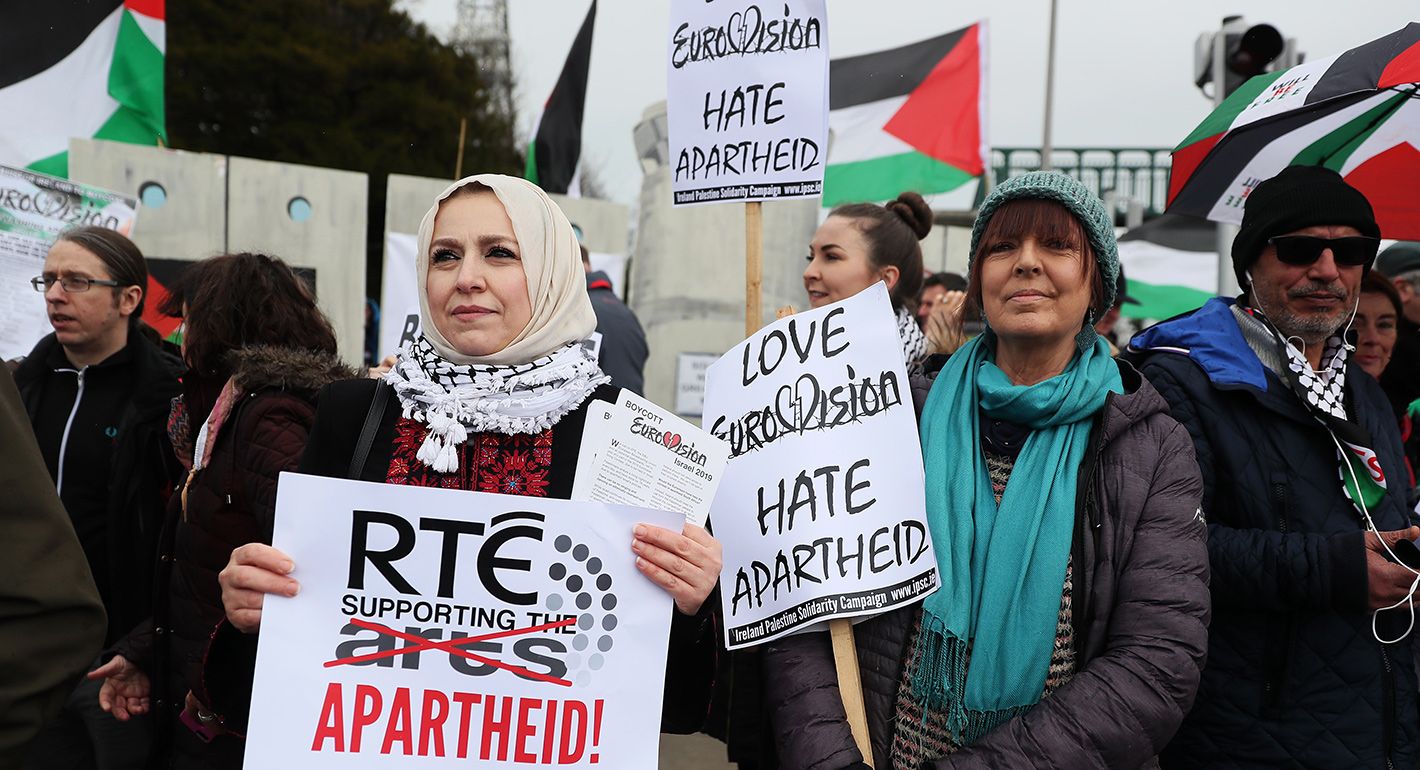
At the epicenter of this year’s drama has been Israel’s participation. Last December, the contest’s organizer, the European Broadcasting Union (EBU), avoided a vote to suspend Israel over its interference with contest results and ongoing violence in Gaza, instead offering rule changes as a compromise. In protest, five national broadcasters from Iceland, Ireland, the Netherlands, Slovenia, and Spain withdrew from the contest, followed by trophy returns from past winners and boycotts from potential contestants and avid fans. ESC Director Martin Green responded by warning against “attempts to turn [Eurovision’s] stage into a place of geopolitical division,” invoking the contest’s latest slogan adopted in 2023: “We are, and always will be, United by Music.”
However, Eurovision has never been free from politics; rather, political boycotts and bans have been a feature of the contest since its inception. During the Cold War and into the early 2000s, the contest successfully weathered these disruptions, pursuing a more interconnected continental broadcast by maintaining a clear-eyed understanding of the institution’s place in the prevailing global order. But as Europe once again faces a multipolar world, Eurovision must reassert its vision for a free and unified media landscape by taking a stronger stance against expansionist authoritarianism looking to abuse the contest’s stage.
United Against Sovietism (1956–1989)
Eurovision has been no stranger to complicated geopolitical dynamics. With its inaugural contest in 1956, the competition quickly became part of the Cold War’s political fabric, offering partners a platform for technological prestige and political belonging through participation in an unspoken coalition against the Soviet bloc. This approach proved controversial at times, leading to some of Eurovision’s earliest boycotts.
Dictatorships in Greece, Portugal, Spain, and Yugoslavia all flocked to the Eurovision stage throughout the 1960s and early 1970s. Even then, these inclusions were understood as political. When Spanish singer Massiel won ESC 1968, earning Spain the right to host in 1969, Austria withdrew to protest Francisco Franco’s dictatorship, registering the first political boycott in the competition’s history.
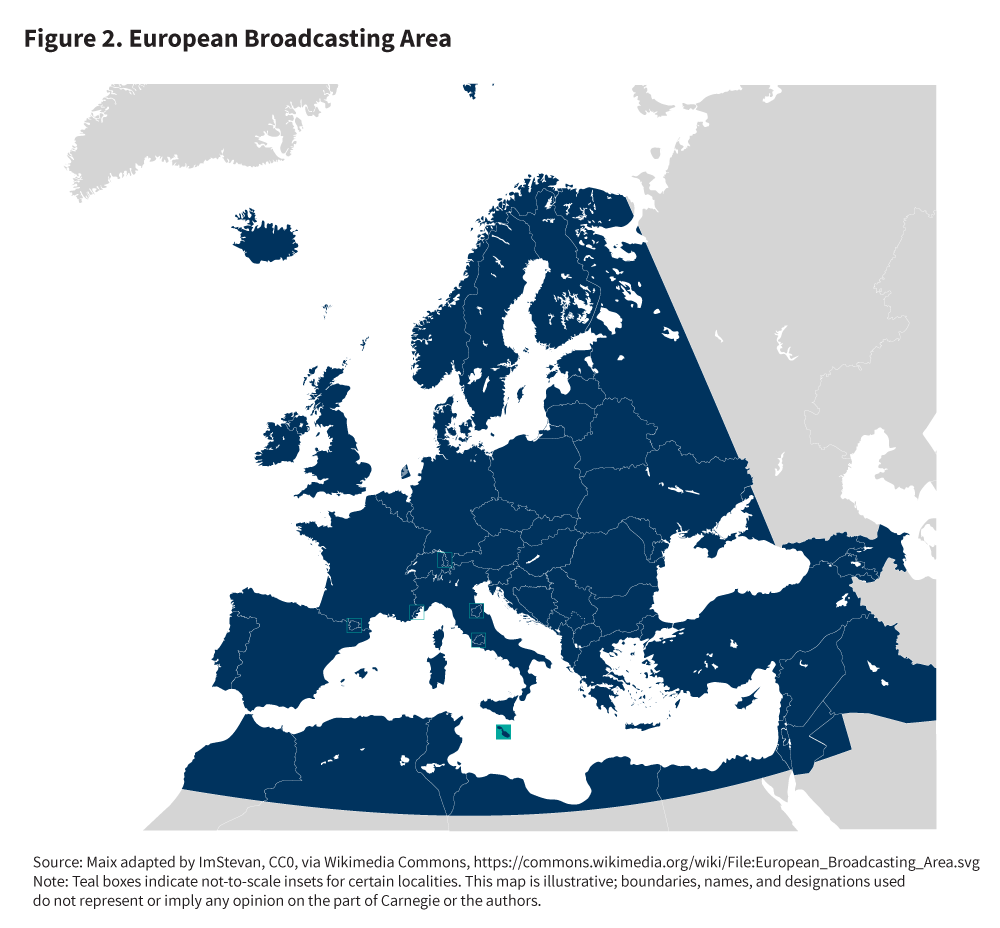
Rather than adopt Austria’s anti-authoritarian stance, the EBU restricted participation solely based on public service broadcasters’ EBU membership status. The criterion effectively excluded broadcasters—and their associated states—in the Soviet-led International Radio and Television Organisation but opened the prospect of participation to other countries on the organization’s foundational map, the European Broadcasting Area. Because it was originally drawn to favor British and French colonial interests in the Levant and to prevent radio interference with North Africa, the map extended potential EBU membership to countries beyond Europe’s traditionally conceived borders. States surrounding the Mediterranean soon joined, introducing political dynamics outside Europe and outlasting the contest’s Cold War considerations.
A glaring example of these politics was Turkey’s 1975 debut, only a year after the country’s invasion of Cyprus. In response, Greece boycotted ESC 1975 before returning in 1976 with an overtly political entry on the horrors of war, prompting a Turkish boycott through 1977.
Israel’s first appearance at the contest in 1973 proved similarly political, triggering an Arab League boycott in solidarity with Palestinian human rights and national aspirations among broadcasters in Algeria, Jordan, Lebanon, Morocco, and Tunisia. Five years later, Tunisia would abandon its attempt to participate in the contest over EBU requirements to air all contestants, including Israelis. In 1978, Jordan refused to air Israel’s winning act, and the kingdom named the runner-up the victor. Turkey boycotted ESC 1979 under pressure from Arab states protesting the contest, staged in Jerusalem, where Israel extended its sovereignty in violation of international law. And Morocco has prevented nationals from participating every year except 1980, when Israel opted out.
Nevertheless, these controversies were political sideshows outside the Mediterranean, as the Cold War in Europe took center stage. Therefore, the EBU appeared to prioritize neutrality to further its aims of a unified continental broadcast, welcoming contestants from authoritarian states so long as they were outside the Soviet sphere of influence.
United in Liberalism (1990–2008)
The end of the Cold War transformed the EBU’s approach. With the collapse first of the Soviet Union and then Yugoslavia, states rushed to join the EBU and its signature song contest, ultimately leading to the contest’s expansion, peaking at 43 participants by 2008. Emboldened by this growing interest, the EBU implemented contest standards with some latitude, soon transitioning from semi-neutral contest organizer to an active proponent of the liberal world order.
The most notable exercise of this expanded role occurred when the EBU excluded Yugoslavia from 1993 to 2001 due to UN sanctions over Serbian nationalist Slobodan Milošević’s military campaigns in the Balkans. Only after extensive peace negotiations could contestants from Serbia and Montenegro rejoin the contest. While Kosovan EBU membership remains unresolved due to issues of the state’s political recognition, the banning and reincorporation of Balkan states showcased Eurovision participation standards in practice.
The EBU would again take a stronger stance over participation when Israel reemerged as a political sticking point. In 2005, Lebanon withdrew its first Eurovision entry over requirements that it air Israel’s performance, as Lebanese law prohibited broadcasting any Israeli content. The EBU responded by imposing a three-year ban on Lebanon from participating in the song contest. Differing from Yugoslavia, Lebanon’s ban was more procedural than political but nevertheless reflected a more active EBU role in policing participant behavior.
During this period, the EBU also began scrutinizing entries more closely, expanding the Eurovision rulebook to prohibit “lyrics and/or performance of a song [that would] bring the Contest into disrepute.” After Ukraine performed an Orange Revolution anthem in 2005, the EBU further clarified the rule, stating, “No lyrics, speeches, gestures of a political or similar nature shall be permitted during the Eurovision Song Contest.”
Through these case-by-case bans and broad rules against political speech, the EBU sought to curb the contest’s politicization. Much like the expedience of selective neutrality during the Cold War, an apolitical contest seemed the preferred course at the height of liberal consensus.
United by Music? (2009–Present)
Overly broad rules prohibiting political content, however, soon became Eurovision’s defining liability. Instead of depoliticizing the contest, the new rules transformed the EBU into Eurovision’s political watchdog. Moreover, the EBU has struggled to remain consistent in handling controversies amid the liberal order’s retreat, spurring a resurgence of boycotts.
Some of these boycotts may have been unavoidable, as some states withdrew unilaterally, weaponizing the contest’s growing LGBTQ+visibility to score points in domestic politics. For example, Turkey’s indefinite withdrawal following ESC 2012, though officially attributed to procedural concerns, was later explained by President Recep Tayyip Erdoğan labeling contestants “Trojan horses of social corruption.” Hungary’s 2020 exit, widely linked to former prime minister Viktor Orbán’s anti-LGBTQ+ platform, followed similar logic. While using participation as a political cudgel may have gone against Eurovision desires, the EBU was spared from making any decisions over these exits.
Yet, the EBU soon became embroiled in questions over media freedom among some participating states at Eurovision. When Azerbaijan was set to host the contest in 2012 after winning in 2011, observers began to scrutinize the Azerbaijani government’s human rights record, including its smear campaigns against journalists and nationalist rhetoric against ethnic Armenians—part of long-standing hostilities between the two countries at the contest and beyond. Armenia boycotted the contest altogether as the EBU avoided taking any concrete action. Still, the organization felt pressured to declare “democracy and media freedom at its heart.” This stance later led the EBU to uphold the value of media freedom in 2021 when it expelled Belarus following repeated submissions of overtly political songs and deteriorating media freedom under the country’s national broadcaster.
Where these bellwethers indicated a concerning rise in authoritarianism at the contest, the true focal point of Eurovision politics during this period was Russia. Partially responsible for the 2006 rule against political messaging, Russia soon inspired another controversial entry, this time involving Georgia’s 2009 submission “We Don’t Wanna Put In,” a thinly veiled commentary on President Vladimir Putin’s 2008 invasion of Georgia. Deemed too political under the 2006 rule, the Georgian broadcaster withdrew rather than rewrite the lyrics.
By 2016, though, the EBU dropped its pretensions of political neutrality. Ukrainian national Jamala won the contest that year with “1944,” which was a clear allusion to Russia’s 2014 annexation of Crimea. The following year, the Ukrainian hosts banned Russian contestant Julia Samoylova for an unsanctioned visit to Crimea, prompting Russia’s withdrawal from ESC 2017. These politics reached a fever pitch following Russia’s full-scale invasion of Ukraine in 2022. The EBU immediately banned Russia from participating, arguing that “in light of the unprecedented crisis in Ukraine . . . [any Russian act] would bring the competition into disrepute.” Kalush Orchestra subsequently won that year’s contest for Ukraine.
Where Turkish and Hungarian exits from the contest were voluntary, the EBU’s definitive breaks with Belarus and Russia temporarily positioned the organization as a willing, if inconsistent, defender of basic liberal values, particularly media freedom and self-determination.
This position collapsed after the Hamas attack on Israel on October 7, 2023, and Israel’s military assault on Gaza immediately thereafter. The Eurovision stage offered a platform for political commentary on either side of the political divide. Like with Russia’s case, the EBU struggled to keep the contest apolitical. Though Israel’s 2024 entry, Eden Golan’s “October Rain,” was initially deemed too political, Israeli President Isaac Herzog intervened, and Golan was allowed to perform the lyrically reworked “Hurricane.” A controversy-ridden contest ensued, with allegations of prerecorded applause to hide anti-Israel boos, reprisals against pro-Palestinian imagery, and accusations of harassment both from and against the Israeli delegation. Meanwhile, thousands protested outside the event against Israel’s bombardment of Gaza, which had killed nearly 35,000 Palestinians by the contest’s May 7 opening.
The subsequent year was slightly more subdued but featured an overt social media campaign from the Israeli government to encourage voting for the Israeli entry, culminating in an Instagram post from Prime Minister Benjamin Netanyahu himself the day of the event. The campaign nearly worked, and the Israeli entry was only defeated by the final remaining contestant after ten minutes at the top of the results.
The EBU announced in September 2025 that a vote would be held on whether to allow Israel’s participation in 2026. When that vote arrived last November, however, EBU public broadcasting members were first asked to consider a package of reforms introducing stricter voting rules and prohibiting external campaigning. Only if these reforms were rejected would the body proceed to vote on Israel’s participation. Thirty-one countries voted for the reforms, eleven voted against, and five abstained. Israel would remain.
Toward a Values-Based Eurovision
The EBU’s distinction between the participation of Russia and Belarus on the one hand and Israel on the other certainly warrants scrutiny. But the issue of which states participate and which do not naturally leads to a more fundamental question over Eurovision’s future amid the eroding liberal world order. The EBU’s past precedents may offer some guidance for the contest’s survival.
The EBU’s 2006 rule prohibiting political lyrics represented an overreach, forcing the contest’s organizers into a position of political arbitration they were ill-equipped to handle with consistency. However, a truly apolitical approach would forfeit the EBU’s control over an important tool of soft power. The move could further the EBU’s goal of a unified European broadcast but would require reconsideration of Belarus and Russia’s exclusion—an unlikely scenario. Furthermore, perceived hypocrisy over exclusions may accelerate the contest’s hemorrhaging of talent, viewership, and funding. As international norms erode and European politics fracture, the EBU must find a middle ground between political overreach and feigned neutrality, one free of any double standards.
First, the EBU must recommit itself to the principle of media freedom. This principle is foundational to the media organization, and EBU precedent supports the move: Lebanon’s ban indirectly punished censorship laws, and Belarus’s 2021 expulsion reflects an even clearer commitment to this ideal.
At the same time, the arbitrary nature of “media freedom” leaves room for over-politicization. Where the EBU has partnered in initiatives identifying European press freedom abuses, a more objective, independent approach may be better suited for determining Eurovision eligibility. Most promising in this regard is Reporters Without Borders’s Press Freedom Index, which tends to reflect the EBU’s countries of concern through its 100-point scale. Belarus, expelled after dropping below 50 in the index, offers a reasonable benchmark: participation limited to states more press-free than not.
If the EBU relied on that index for inclusion and exclusion in the contest, it would resolve or formalize breaks between Eurovision and EBU members in recent years. Belarus is the clearest case, but Turkey’s exit would also become policy, having fallen below 50 on the index since 2016. Azerbaijan would likewise lose this platform, currently sitting below Belarus in the press freedom rankings. In this way, the metric would serve as a positive vision for states to improve their media landscapes in exchange for Eurovision’s soft power platform.
Second, and even more fundamental, the EBU must draw a red line over breaches of national sovereignty. Territorial integrity is a core interest of members’ governments—indeed, all governments—and is essential to the EBU’s goal of continental connectivity. Moreover, Russia’s expulsion and Yugoslavia’s ban both provide precedent for an anti-invasion prerequisite.
This standard is potentially even more fraught than the issue of press freedom. To be sure, a rule against active invasion of another state would reinforce Russia’s ban while reframing Turkey’s absence as a direct product of occupation in the northern part of Cyprus. Complications arise nonetheless, with Ukraine’s 2024 retaliatory invasion of Russia and Serbia’s relationship to Kosovo two potential sticking points in continental border politics.
The EBU might be tempted to resolve these edge cases through carveouts: acts of self-defense would not be disqualifying, and disputes involving non-EBU members (like Kosovo and Palestine) would be deferred to external bodies. While such an approach may be attractive, EBU values cannot simply stop at contested borders. As seen through successive exploitations of the Eurovision stage, unchecked authoritarianism begets further abuse. Though Palestine is not an EBU member, Lebanon has been with the organization since its inception—and Israel now threatens to permanently occupy the country’s south after having displaced over a million of Lebanon’s residents while ignoring a ceasefire. The EBU must therefore offer a stronger stance against expansionist trends within its ranks.
Enforcing the rules in this way would not so much represent an evolution of EBU policy but rather a return to the multipolar landscape of Eurovision’s Cold War origins: The institution would hold the line at fundamental questions of a liberal world order while offering a positive vision for the region’s broadcasting landscape. Through consistency and integrity on these fronts, Eurovision could move from a reactive institution beset by controversy to a leading model for other cultural institutions struggling with the same questions.
Neither the EBU nor its song contest can stop the precipitous rise in authoritarianism, let alone its resultant conflicts. Yet the current lack of ambition to curb cynical behavior at the competition risks reducing Eurovision’s name to a sad irony.
Resolving Eurovision’s relationship with Israel and authoritarianism more broadly will therefore require greater imagination for a vision of Europe that the contest’s disaffected so clearly crave. The institution has weathered authoritarianism before, but only through providing a clear, limited, and principled framework of engagement can organizers ensure the competition will weather it again.
About the Author
Charles H. Johnson
Research Assistant, Middle East Program
Charles H. Johnson is a research assistant in the Carnegie Middle East Program.
Carnegie does not take institutional positions on public policy issues; the views represented herein are those of the author(s) and do not necessarily reflect the views of Carnegie, its staff, or its trustees.
More Work from Carnegie Endowment for International Peace
Today’s global democratic recession is partly rooted in a common perception that democracies have a delivery problem, with many citizens in both autocracies and democracies alike now believing that strongmen can achieve better governance outcomes. But a study of four countries in Africa reveals that democratic-leaning governments have demonstrated better governance performance than autocratic governments.
Soft power on its own is insufficient to meet U.S. national security needs, but hard power also has its limits. Soft power allows for more effective and efficient use of hard power than hard power alone, as it encourages cooperation and compliance which deters the need for hard power.