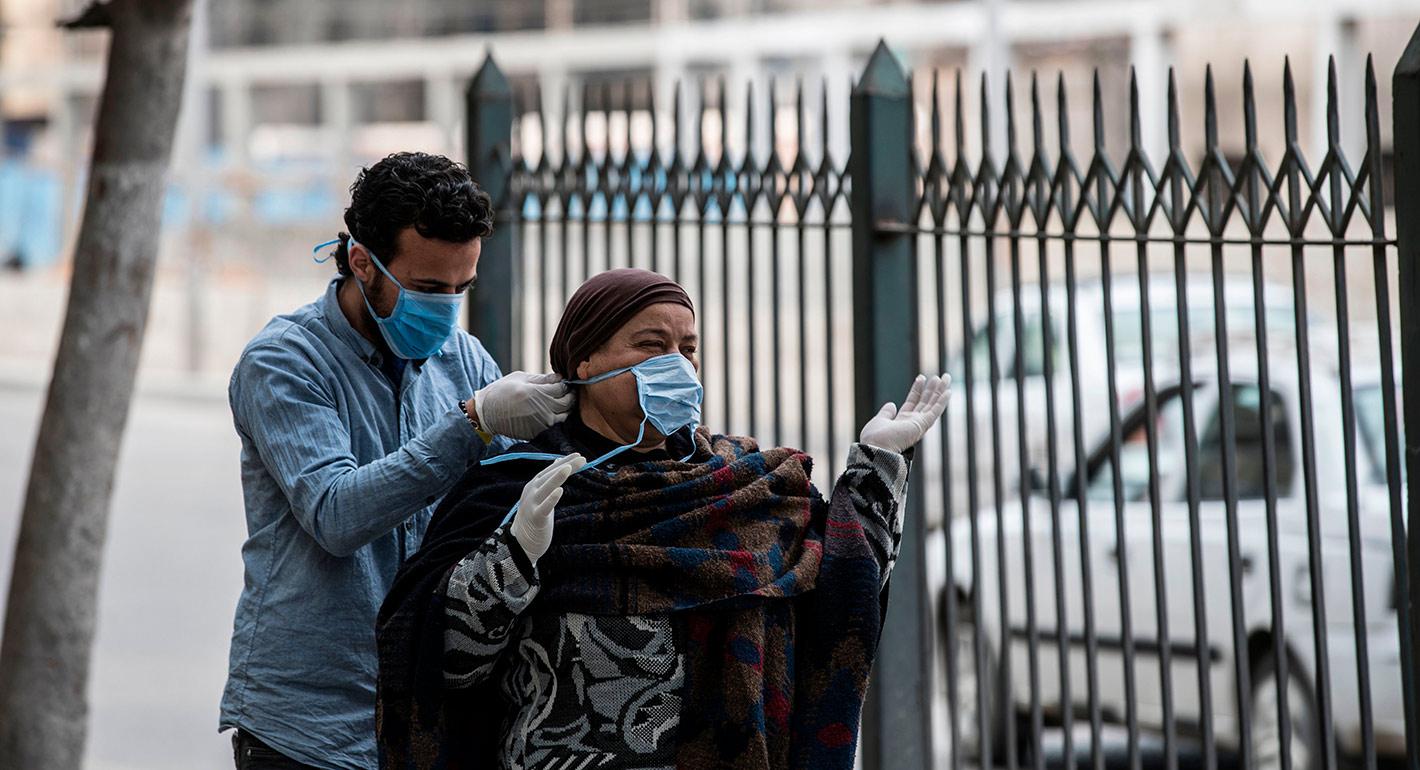
“Swine flu is more dangerous than the hydrogen bomb…it is a punishment from God,” declared a leading Muslim Brotherhood figure at a symposium held in Cairo in April 2009, a day after the People’s Assembly passed a motion to slaughter 300,000 pigs. The government chose to take this measure based on Egypt’s previous experience with H5N1 (avian flu), despite the evidence that humans cannot contract H1N1 (swine flu) by eating pork. The affair has re-ignited claims by some Coptic groups and human rights organizations of systematic discrimination against the Christian/Coptic community, who comprise 10-15 percent of the population and who are the largest breeders of pigs in Egypt.
Most pig rearing in Egypt, and particularly Cairo, takes place in informal settlements known as ashwa’yat. One of the largest such settlements, Manshiyet Nasser, is located on the Muqattam Hills in east Cairo, and is also home to the zabaleen, or rubbish collecting community. The zabaleen, who are traditionally Coptic, have for over thirty years collected Cairo’s household waste, sorting and recycling it. They feed the vegetative waste to pigs, which are then slaughtered and sold as pork, mostly to upper class Cairo shops.
The order to slaughter the pigs came amidst an ongoing government campaign to modernize and privatize the collection and disposal of domestic waste, which had already angered and alienated some sectors of the Coptic community. Coptic Pope Shenouda III, who is extremely careful to cultivate good relations with the Mubarak government, has refused to participate in the debate, claiming that most Copts do not even eat pork. By contrast, Coptic groups outside Egypt, particularly in the United States, have been vociferous in their criticism of what they view as President Hosni Mubarak’s many concessions to Islamists.
The slaughter of the pigs, carried out with a brutality that received broad media coverage, also created some unexpected political bedfellows. The ruling National Democratic Party found an unlikely ally in the largest opposition group, the Muslim Brotherhood, in passing the parliamentary motion. The Egyptian population in general, however, was repulsed by the slaughter, particularly after the independent newspaper al-Masry al-Youm reported in May 2009 that pigs were being thrown into a pit and covered in the caustic chemical quicklime due to the lack of facilities to dispose of such a huge number of animals. The backlash was immediate not only from animal rights activists but more importantly from the former head of Islamic law at al-Azhar University, Sheikh ‘Abd al-Moatti Bayoumi. Using Quranic verses, Bayoumi declared that all God’s creatures should be treated with respect and dignity, thus calling into question the government action.
The government is also using the H1N1 outbreak as an impetus to implement a longer term strategy to relocate some of Egypt’s 870 ashwa’yat away from Cairo and other metropolises, in an attempt to correct a long-term failure to deal with urban sprawl and planning. In addition, a new tax which links water and modern refuse collection accompanies this social and urban engineering. Since 2001, the government has hired five foreign waste-management companies to serve the cities of Cairo and Alexandria, a major blow to the zabaleen. The new companies dispose of their collected waste in landfills, which are less environmentally viable than the traditional zabaleen methods.
While at first glance the swine flu saga seems to epitomize government ineptitude, in reality it reveals a much broader phenomenon. The slaughter of pigs and the relocation of farms and parts of the ashwa’yat represent the systematic alienation of Egypt’s poorest communities, Copt and Muslim alike, by the government. Not only are the poor being moved further from the cities where their livelihoods are located, but they are losing the lucrative business of refuse collection to private foreign companies just when unemployment in Egypt is at an all time high.
Vivian Ibrahim is currently an Honorary Historian and Post-Doctoral researcher at the University College Cork on European-Muslim identities in Ireland. She is the author of The Copts of Egypt: The Challenges of Modernisation and Identity (IB Tauris, October 2010).