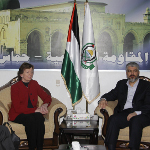
Khalid Mishal, the head of Hamas’ political wing, announced in an interview with Newsweek on October 14, 2010 that “there is a position and program that all Palestinians share. To accept a Palestinian state on the 1967 borders with Jerusalem as the capital. With the right of return. And this state would have real sovereignty on the land and on the borders. And with no settlements.” Mishal added that Hamas would accept any agreement with the Israelis upon which the majority of Palestinians agreed, before going on to say that “the American administration should hear from us directly.”
Mishal’s positions are nothing new for Hamas, which has taken fairly pragmatic positions on such issues since winning a majority (74 out of 132 seats) in the Palestinian legislature in January 2006 and forming the tenth Palestinian government. Since this electoral victory, Hamas has sought to show its more politically pragmatic side, particularly its acceptance of a political solution to the Palestinian problem. The solution calls for the formation of a Palestinian state stretching from the 1967 border to the Jordan River. This view was set forth in the
Palestinian Reconciliation Document (also called the Prisoners’ Document, an agreement among jailed activists from Hamas and other Palestinian factions, which was amended in June 2006). The movement has also announced on various occasions its willingness to halt armed resistance and establish a ten-year truce in exchange for a Palestinian state on the 1967 territories.
Mishal’s statements, which coincided with the stalling of the Israeli-Palestinian negotiations as well as the resumption of reconciliation talks between Hamas and Fatah, sent two important messages, one to a domestic audience and the other to a foreign audience. The message to outsiders was clear enough—Hamas is a viable partner and its inclusion would not mean the end of negotiations—and was directed particularly at Europe, where several countries are increasingly inclined to speak directly with Hamas.
The Domestic Message: Hamas’ Pragmatism and Fatah’s Fear
Mishal’s statements were also intended to show Palestinians that Hamas is pragmatic and confident, while the Palestinian Authority (PA) and Fatah are on the defensive. The contradictory PA and Fatah responses to his statements reflect Ramallah’s dire straits; negotiations with Israel are at a stalemate and Fatah is as weak as ever. Adnan al-Damiri, the official spokesman for the Palestinian security services, accused Hamas of seeking to “be a stand-in for the Palestinian leadership.” Meanwhile, Osama al-Kawasimi, the media spokesman for Fatah, welcomed Mishal’s statements, saying that they showed “a complete compatibility with the political positions adopted by the Palestinian leadership in 1988” and that they would make “the Palestinian partnership more realistic.”
Hamas’ efforts to demonstrate pragmatism and openness towards at least some international parties are a constant source of irritation for the PA. During the last few years, Hamas has shown a higher degree of perseverance and political maneuverability than many expected. Recently, Hamas has begun to break down the political embargo that isolated it internationally. It demonstrated its ability to control the security situation in the Gaza Strip and manage security agreements with the Israeli side, including a truce with Israel reached through Egyptian mediation.
For its part, Fatah fears that it will lose its preeminent position should international parties open up to Hamas. The strategy of late President Yasser Arafat and Fatah since the launch of the Oslo negotiations in 1993 has relied on contrasting their own moderation with Hamas’ hardline positions and tendency towards violence. President Mahmoud Abbas has been following the same strategy since 2005, particularly since the intra-Palestinian rift emerged in mid-2007.
While Hamas’ control over the Gaza Strip and the failure of negotiations to produce any Israeli concessions have weakened Abbas’s position, Fatah-Hamas reconciliation could bolster his role at home and abroad, while supporting moderate members within Hamas. After all, in the National Accord, Hamas agreed not to oppose the Palestinian president’s conduct of direct negotiations with Israel, and Hamas could reiterate this point in a future agreement.
Attitudes of Hamas’ Supporters
Hamas’ supporters also have more pragmatic attitudes toward peace than many imagine. Polls conducted by the Ramallah-based Palestinian Center for Policy and Survey Research in the years before and after the 2007 rift show that Hamas followers were not relentlessly pro-violence, contrary to the popular misconception.
A majority of Hamas supporters described themselves as being broadly in favor of the peace process (55 percent on average in the polls conducted from March 2006 to December 2008, compared to 86 percent of Fatah supporters). Moreover, in a March 2006 survey conducted in the West Bank and the Gaza Strip 70 percent of Hamas supporters and 84 percent of Fatah supporters also backed full reconciliation between the Palestinian and Israeli peoples if a Palestinian state were established and recognized by Israel. Paradoxically, according to an October 2010
poll, a larger percentage of Palestinians living in the Gaza Strip describe themselves as supportive of the peace process (69 percent), compared to only 58 percent of Palestinians in the West Bank.
Looking at the various options that Hamas and Fatah partisans could accept as a starting point for a unified Palestinian national project, polls show that majorities in both camps support a political solution based on the formation of a Palestinian state on the territories occupied in June 1967. Seventy-six percent of Hamas supporters and virtually all Fatah supporters (96 percent) concur that the goal of the Palestinian people is to create an independent Palestinian state on all of the territories occupied in 1967 with Jerusalem as its capital. Fatah and Hamas supporters also agree on the right of return for refugees and the release of all prisoners, as guaranteed by the UN according to a June 2006 poll. The same poll showed that a narrow majority of Hamas supporters (56 percent) and the overwhelming majority of Fatah supporters (86 percent) are in favor of building a national consensus based on international and Arab resolutions, as laid out in the Prisoners’ Document.
What these data show is that Hamas’ support base has been shifting towards wanting to achieve a peace that secures Palestinians’ most basic rights as stipulated in UN resolutions—at least until the rift of 2007 and the Israeli war on Gaza. Hamas has repeatedly stated that it will respect the attitudes of its supporters and those of the broader Palestinian public in any future settlement. Perhaps Hamas’ supporters are more cynical now, after several years of a rift with Fatah, isolation in Gaza, and repression in the West Bank. But Mishal’s statements show that Hamas leaders are still prepared to show a pragmatic side, providing hope for the evolution of new perspectives within the organization.
Mahmoud Jaraba is the author of “Hamas: Tentative March toward Peace” (Ramallah: Palestinian Center for Policy and Survey Research, 2010).