Talaat Harb Square: A demonstrator holds Egyptian flags beside the statue of Talaat Pasha Harb, founder of the
... Show More >
Bank of Egypt, in the square that bears his name. Wide boulevards were constructed outwards from the square in all directions in the late 19th century including Qasr el Nil Street, location of the mural. Photo by Ahmed Hassan
< Show less
The creative team assembles before heading out to work during the night of June 27. The frame was found thrown
... Show More >
away on a Cairo street and would be used to exhibit photographs for the Qasr el Nil mural in Downtown Cairo. From l to r: Artists Alaa Abd El Hamid, Jan Nikolai Nelles and Ammar Abo Bakr (front row). From l to r: Artist Nora Al-Badri and writer Ahmed Aboul Hassan (back row). Photo by Ahmed Hassan
< Show less
Sculptor Alaa Abd El Hamid prepares the wall, soon to be the site of the Qasr el Nil mural in Downtown Cairo, on the
... Show More >
night of June 27, scraping off layers of existing paint and graffiti. Photo by Ahmed Hassan
< Show less
Sculptor Alaa Abd El Hamid's three "downed" gypsum eagles, akin to a flag being flown at half-staff, appear as part of
... Show More >
the Qasr el Nil mural in Downtown Cairo. The Egyptian eagle is the national coat of arms. Photo by Abdelrhman Zin Eldin
< Show less
Artist Ammar Abo Bakr at work on the Qasr el Nil mural during the night of June 27 in Downtown Cairo. Hung
... Show More >
overhead are statues by sculptor Alaa Abd El Hamid, painted to resemble the Ba or personality, one of five parts the Ancient Egyptians believed made up the soul. Photo by Ahmed Hassan
< Show less
As morning breaks after the team's first night at the wall, sculptor Alaa Abd El Hamid (l) and artist Rami El Fass (r)
... Show More >
hang El Hamid's statue of the Ba above the outline of a female portrait, which would become the Qasr el Nil mural's centerpiece. Photo by Ahmed Hassan
< Show less
Artist "Snoopy" of the Mona Lisa Brigades street art group comes to the aid of the Qasr el Nil mural team in the early
... Show More >
morning of June 28 after they spent their first night working at the wall. Photo by Ahmed Hassan
< Show less
Calligrapher Sameh Ismael recounts the words of writer Ahmed Aboul Hassan, whose poetry recalling Ancient
... Show More >
Egyptian history first inspired the Qasr el Nil mural in Downtown Cairo, as the work continues over the night of June 28. Photo by Ahmed Hassan
< Show less
Calligraphy by Sameh Ismael spells out poetry from Ahmed Aboul Hassan on the Qasr el Nil mural. Photo by Abdelrhman Zin Eldin
Sameh Ismael uses greens of various hues in his calligraphy on the Qasr el Nil mural in Downtown Cairo. Photo
... Show More >
by Abdelrhman Zin Eldin
< Show less
Artist Ammar Abo Bakr works on his shimmering portrait of a young Egyptian woman during the night of June 28.
... Show More >
Ancient Egyptian artists used a shimmering yellowish-buff color in their portraits of women. Photo by Ahmed Hassan
< Show less
Artist Ammar Abo Bakr details his portrait that serves as the centerpiece of the Qasr el Nil mural. Alaa Abd
... Show More >
El Hamid's statue, painted to resemble the ancient Egyptian Ba or personality, is mounted to her head, similar to the upright cobra depicted on the heads of goddesses. Photo by Abdelrhman Zin Eldin
< Show less
As morning dawns, artist Ammar Abo Bakr paints a blue, red and yellow beaded collar draped across his portrait's
... Show More >
neck and shoulders, giving her the regal symbols of Ancient Egypt. Sameh Ismael's multicolored calligraphy, which recounts the poetry of Ahmed Aboul Hassan, surrounds the emotional portrait. Photo by Abdelrhman Zin Eldin
< Show less
A close-up of the emotional portrait, centerpiece of the Qasr el Nil mural. "Like the portrait, Egypt is beautiful, but
... Show More >
she is sad," says artist Ammar Abo Bakr, who organized the project. Photo by Ahmed Hassan
< Show less
A close-up of Sameh Ismael's whimsical, yet edgy calligraphy on the Qasr el Nil mural in Downtown Cairo. Above
... Show More >
hangs one of Alaa Abd El Hamid's statues representing the Ba or personality in ancient Egyptian philosophy. Photo by Ahmed Hassan
< Show less
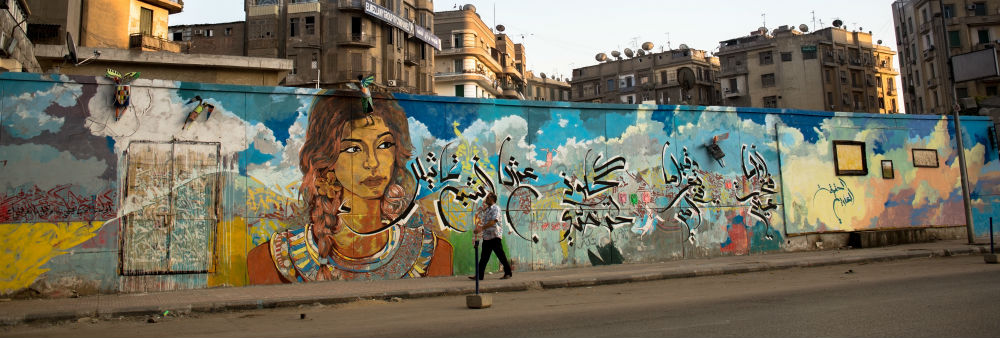
A long view of the Qasr el Nil mural in Downtown Cairo. While the emotional portrait by Ammar Abo Bakr serves
... Show More >
as its centerpiece, hanging high above are multicolored statues by Alaa Abd El Hamid surrounded by the whimsical calligraphy of Sameh Ismael, recounting the poetry of Ahmed Aboul Hassan. At far right, a photo-series of wheat fields by Germany-based artists Nora Al-Badri and Jan Nikolai Nelles, a comment about the role of food insecurity in social uprisings. Photo by Ahmed Hassan
< Show less
A dialogue of form and topic in the public space: A passerby walks the length of the Qasr el Nil mural in Downtown
... Show More >
Cairo, Egypt. Photo by Ahmed Hassan
< Show less
An ongoing mural project in Cairo prompts viewers to engage in its public expression of Egypt’s heritage and to reflect on the ideas of Egyptian identity, the loss of culture, social division, beauty, and art.
Artist Ammar Abo Bakr, who organized a mural on Qasr el-Nil Street, one of Cairo’s main boulevards that passes through Tahrir Square, explains of the piece: “Art must be in the street now with the people.” Abo Bakr set out to create the 25-meter long by 4-meter high (82 by 13 feet) mixed-media mural with a group of artists ahead of the June 30 demonstrations, at a time when other artists were resigning from their positions in protest of the feared stifling of the arts by the then Muslim Brotherhood government. Well before this, however, Abo Bakr and his fellow artists have been creating artworks in the street, driven by a conviction that art belongs in the public, rather than private space. To create this mural, Abo Bakr is joined in his work by a sculptor, a calligrapher, and a number of photographers. The result is a dialogue of form and topic, where the viewer can appreciate ancient Egyptian symbols amid poetic calligraphy and sculpture in a work designed to bring beauty and color to Egypt’s dusty, trash-lined streets.
The work fuses the visual and literary arts: calligraphy, painting, poetry, and sculpture. Most notably, the art infuses verses of a poem by writer and journalist Ahmed Aboul Hassan. Penned before the revolution, his words are meant to convey an ancient history often forgotten in a country struggling with a myriad of ongoing socio-economic challenges. Aboul Hassan says, “We have so much history and life that everyone should know about, because the future is mixed between peoples.”
For this mural, a young Egyptian woman painted in shimmering gold and wearing a blue, red, and yellow beaded necklace draped across her neck and shoulders stands out as the centerpiece. It calls on the passerby to identify with the image—a common Egyptian face with braided hair that takes on the regal symbols of ancient Egypt. The portrait is adorned with the collar of the famous Nefertiti Bust and surrounded by layers of Sameh Ismael’s calligraphy in red, black and yellow that brings to life the poetic verses of Aboul Hassan, repeated many times across the length of the mural.
“This piece is a way to remind people of what they’ve lost,” says Abo Bakr, who teaches at the Faculty of Fine Arts in Luxor. “Egypt has 7,000 years of history that should be defended—a great civilization that left behind amazing beauty and history. We need to defend all of Egyptian civilization.” The comment is a veiled reference at Islamists who have, for example, taken aim at the display of nude Pharaonic statues, which they say conflict with Islamic sensibilities. “But that is not right,” argues Abo Bakr. “Art is close to religion—it’s in our ancient temples and Sufi tombs.”
Like the Mexican muralists in the early twentieth century, Egyptian artists make use of ancient and religious symbols in their indirect political commentary. Re-appropriating cultural heritage is a defiant act when deliberate policy keeps local communities walled away from archaeological sites appreciated by foreign tourists.
Now run down from neglect and covered in a thick layer of dust and grime, downtown Cairo’s wide boulevards were once home to a flourishing cultural scene. Just a stone’s throw from the mural is Qasr el-Nil Theater, which once served as the location for the legendary Oum Kalthoum’s recorded concerts, although it’s largely closed its doors as of late. Amid this eerie backdrop, on June 27 the artists scraped clear a wall covered with Arabic graffiti, mismatched paint, and a large real estate advertisement. Abo Bakr says, “Everything has become so ugly in our cities over the years. We need to give people a chance to appreciate beauty again.”
For members of a construction crew working across the street from the mural, viewing art is something far removed from their daily lives. Mohamed, 21-year-old, says, “In our schools, there are too many students. No one cares if we have art classes or music. For me, democracy in Egypt would mean all Egyptians have better schools.” With decreasing budget allocations to education, the arts remain sidelined or simply nonexistent. This denies young people—often marginalized despite 32 percent of Egyptians being under the age of fifteen, according to government statistics—the chance for self-reflection and dialogue that accompany arts education.
Alaa Abd El Hamid, a 27-year-old sculptor and fine arts lecturer, agrees: “A lot of my students come from villages and are afraid to even use their name and photo on Facebook and talk openly about things. Street art in Egypt is its own kind of revolution. We are breaking taboos and fighting a system that denies us our dreams.”
For the mural, El Hamid contributed four winged statues made out of discarded car parts meticulously painted to resemble colorful birds by Abo Bakr. The statues were previously part of El Hamid’s first solo exhibit, The Solution is the Solution, a play on the Muslim Brotherhood’s famous slogan “Islam is the solution.” Although held more than two years ago, El Hamid recently found posters advertising his exhibit in the streets around Cairo. “This really made me think about how the posters had so much more freedom than my sculptures,” he says. “The only people who go to exhibitions today are artists, collectors and journalists. Normal people don’t know anything about the art scene. This is why I decided to put my statues in the street and my work in other cities.”
The final panel of the mural becomes the work of Germany-based artists Nora Al-Badri and Jan Nikolai Nelles. The artists had wanted to create a billboard out of their photographs of German wheat fields as a comment on how speculation had driven up food prices in 2010 to the point where the UN Food and Agriculture Organization had actually predicted riots. Although self-sufficient in food production prior to the 1960s, Egypt is now the world’s single largest wheat importer—making the country extremely sensitive to world grain price fluctuations. In 2011, the FAO food price index was at its highest since it began measuring food prices back in 1990.
Al-Badri and Nelles mount their three photographs to the wall in frames they found thrown away on a Cairo street, but not before first tearing down a billboard advertisement for a real estate mogul at the urging of filmmaker Ahmed Hassan, who tells them, “We’re against these kinds of big businessmen here in Egypt.” According to a report by the Egyptian Center for Economic and Social Rights released in May 2013, over 40 percent of the country’s people live on less than $2 a day, while 2 percent of the population controls 98 percent of the economy. The report goes onto say that a corruption-riddled private sector has sold subsidized housing units intended for low-income people at very high prices. An estimated quarter of the population now lives in informal housing, an urban and environmental disaster in one of the world’s most rapidly urbanizing nations. Social justice, one of the aims of the revolution, is far from being achieved.
Thus, the mural on Qasr el-Nil Street serves as a kind of critical media and dialogue, as well as to re-appropriate cultural heritage and as a source of much-needed beauty in the neglected public space. “The wall is our newspaper, our media,” says Abo Bakr. “Over the past sixty years Egypt has lost a lot of things, and we’re asking people to study this country’s history for its future.”
The mural’s creation, a kind of public exhibition, prompts dialogue between the artists and the public around the ideas of Egyptian identity, the loss of culture, social division, beauty, and art.
Angela Boskovitch is a Cairo-based writer, researcher, and cultural producer.