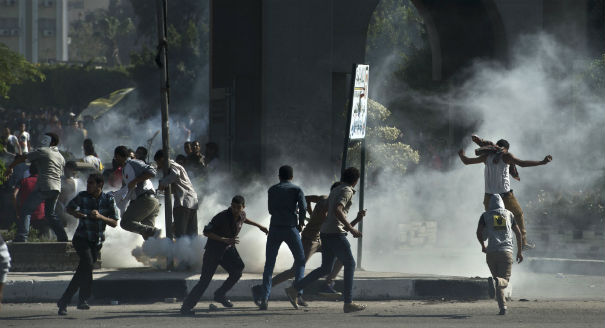
The battle between the Muslim Brotherhood and the military since the fall of former Egyptian President Mohammed Morsi quickly spread to universities with the start of the academic year in September. On October 31, the transitional government announced a decision to deploy the police on the campuses of 22 state universities, as well as Al-Azhar University, aiming to stop pro-Muslim Brotherhood student demonstrations that condemned the military coup and called for the return of Morsi to power. The move was widely praised by the Egyptian media as a positive reaction to pro-Brotherhood students who had stormed the administrative building at Al-Azhar University the day before. However, this ongoing struggle between the military and the Muslim Brotherhood on campuses threatens the independence of Egyptian universities. Most concerning is the possible return of the University Guard, an Interior Ministry force disbanded in 2010 that had cracked down on student political movements and checked academic freedom in recent decades.
The decision to use security forces to curb student protests was arguably the military’s last resort. They had first relied upon independent pro-army students to organize counter-protests against (or physically attack) protests or marches organized by the “Students Against the Coup” movement, an alliance of pro-Brotherhood students and a few independents and Islamist groups. However, over the first six weeks, the military failed to build up a student bloc capable of mobilizing support for the military, especially as the more influential liberal and left-wing student movements were reluctant to support either, in the hopes of leaving the door open for a third political option. Although these groups had cooperated with pro-Brotherhood students during the revolution and in came together again in the post-revolution efforts to oust pro-Mubarak university leadership, they allied against them during the protests that brought down Morsi. And since that experience, liberal and left-wing student movements have become adamant about remaining neutral.
In the first half of November, the police intervened on various campuses (in accordance with the government’s decision that requires either a request from the president of the university for police intervention or permission from the public prosecutor to protect lives and property during protests) to break up student demonstrations at the universities of Assiut, Fayoum, Zagazig, and Mansoura. During these interventions, the police used birdshot and tear gas to disperse students. The intervention aggravated tensions in the universities, with dozens of injuries and dozens more arrests and detentions of pro-Brotherhood students. At Al-Azhar University, the confrontation between police and pro-Brotherhood students escalated, resulting in the death of a student on November 20.
The following day, on November 21, the transitional government expanded the police’s right to intervene, removing the previous restrictions (university president’s request or the prosecutor general’s permission), which led to greater use of excessive force by police. On November 28 another student was killed on Cairo University’s campus during a march against the military coup.
These developments have not been isolated from the broader struggle in Egyptian society between the Brotherhood and the military. After the Brotherhood had exhausted its energies in the sit-ins at Rabia al-Adawiya and Al-Nahda, and lost the ability to amass large protests in the main squares, the military authorities kept up the pressure with the arrest of hundreds of Brotherhood members. Universities offered the Brotherhood a safe area to regroup—the student communities were still brimming with energy, and they traditionally reject military intervention in student political affairs and are protective of their freedoms. The Brotherhood looked to its student wing, which is strongest at Al-Azhar University, hoping to open a new front to oppose the military, garner student sympathy, and ease the burden on the organization.
However, the military authorities were unwilling to concede any foothold for the Brotherhood in universities, while state security wanted to once again tighten their control over campuses. Meanwhile, voices within certain universities—concerned with the increase in political activity they deemed had no place on campuses—called for the return of the Interior Ministry’s University Guard to campus. For the first time since the January 25 Revolution, the confrontation between the military and the Brotherhood has jeopardized what little and newfound freedoms student movements gained following the revolution.
A wide range of student groups such as political movements, student unions, and independent activists oppose the return of state security control, particularly after liberal and left-wing groups began to feel targeted. This included dispersing protests and arresting left-wing and Dustour Party activists. Students and faculty began mobilizing, with hundreds holding a vigil in front of the Cairo University dome on December 1 to protest the police intervention and demand an investigation into the fatal shooting several days earlier.
The pro-military media has persistently accused the student movements of being led by the Brotherhood, portraying student demonstrations as a Brotherhood conspiracy to disrupt studies. Yet after student demonstrations that included liberal and left-wing protesters, the military seemed somewhat confused about how to respond. At Cairo University, the police left the campus, whereas at other universities they aggressively pursued anti-coup protests and made arrests on campus.
Despite attempts to defuse tension, notably during a meeting that took place on December 11 between student union presidents and representatives of the military and Interior Ministry, the military shows little sign of giving up its attempts to reestablish security control in universities. As end-of-semester exams approach, the military has yet to take any steps toward resolving one of the key causes of student discontent: the issue of student detainees, who number at least 400 according to the Student Freedom Campaign.
The ongoing struggle between the military and the Muslim Brotherhood could deal a serious blow to the freedoms gained after the revolution and bring back Mubarak-era repression to Egypt’s universities.
Mohamed Abdel Salam is a researcher for the Association for Freedom of Thought and Expression in Cairo.
This article was translated from Arabic.