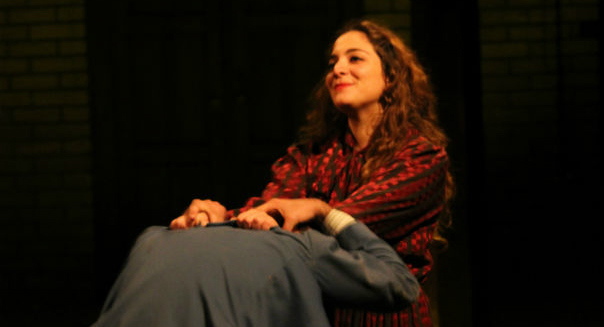
A scene from the Egyptian STAMBA performance Happiness of a Little Family. Here, actor Mohamed Fouad carries actress Nadah El-Shazly on his back in a scene where he’s also carrying home bags of fruits. The playful scene abruptly stops when Fouad begins moving about the stage in pained movements, representative of the daily humiliation suffered. Photo by Saif Al Ghanime
Dejected but dutiful, the male character played by Mohamed Fouad in Happiness of a Little Family returns home with bags of fruits for his wife to prepare in the kitchen. “In Egypt, we learn from birth that the man has to take care of his family,” director Mohamed Shafik says. “Fouad’s character speaks throughout the play indirectly with the system as he sells everything of himself until he’s symbolically naked.” Photo by Saif Al Ghanime
A scene from Happiness of a Little Family. Although the character played by actress Nadah El-Shazly sings beautifully at times, at others she commands the male character played by Mohamed Fouad. Her voice, in English, stands in for the external power structure in Egyptian society that demands subservience. “There’s this other cliché I wanted to break that speaking English is directly related to economic success,” said director Mohamed Shafik. “English allows us to raise our social status while we disregard our own language.” Photo by Saif Al Ghanime
At the end of Happiness of a Little Family, actor Mohamed Fouad pours cups of juice prepared during the play for the audience, a riff on Arab generosity. “The audience represents all the Arab countries,” director Mohamed Shafik said. “We watch everything that’s going on, but we drink and don’t care about what’s really happening around us. The idea of revolution in the Arab World is a cliché—it’s a dream.” Photo by Saif Al Ghanime
Part of the closing scene from the Egyptian STAMBA performance Happiness of a Little Family. Photo by Saif Al Ghanime
A STAMBA panel discussion in Baghdad, Iraq where the performing troupes discussed the themes of their plays with the audience and an expert panel. Photo by Saif Al Ghanime
Egyptian director Mohamed Shafik discusses his play Happiness of a Little Family during a STAMBA panel discussion. About STAMBA’s treatment of clichés, Shafik said, “Every day we speak the same words in different situations. So we live in all kinds of clichés. With our performance, we really wanted to bring an image on stage that related to this idea of cliché.” Photo by Saif Al Ghanime
The Egyptian play Happiness of a Little Family, part of a larger theater project including Egypt and other countries looks at authoritarianism through the prism of the family. By examining the dominant and subservient relationships of authoritarianism and the acceptance of such power relations, the play sheds light on an Egyptian social and political culture that continues despite the revolutionary events of January 25, 2011, and it calls for a new relationship between people and power.
The play grapples with the gender-based authoritarianism enshrined in society. Egypt’s constitution states that the family is the nucleus of society and that the state will “ensure its cohesion, stability and the establishment of its values.” According to Madiha El-Safty, professor of sociology at the American University in Cairo, authoritarianism is part of the culture. “It’s not a political system, but a culture of authoritarianism, and that includes both Christianity and Islam, where the patriarchal family is a microcosm of society. Any relationship between a man and woman is still only though marriage, where the intent is to form a family unit and the father has authority over everyone else, although the mother affects decisions in an indirect way.”
Yet the unbalanced household dynamic in Happiness of a Little Family also looks critically at the paternalistic structures that continue to govern the society and country. When Abdel Fattah el-Sisi appeared on Egyptian state TV on July 3, 2013 to announce the military’s takeover of power following mass country-wide protests, he was flanked by the Coptic Pope and Grand Sheikh of Al-Azhar, legitimizing the move before the country’s most powerful social institutions. The cult-like status that sprung up around him as defense minister evidences the paternalistic role a charismatic leader takes on in a time of crisis. The official statement announcing his decision to run for the presidency on March 26 used such an image, reading, “The State needs to regain its posture and power that suffered much in the past period of time.” State TV now runs advertisements showing four military presidents that end with Hosni Mubarak warning about chaos in the country and concluding with Sisi announcing his presidential bid.
For Adel, a 28-year-old telecommunications engineer who says he’s not political but has participated in demonstrations to fight for his rights, Sisi’s announcement caused despondence. “It feels like nothing’s changed and we haven’t even been able to get our rights since January 25. But many people are willing to give up their rights in return for this promised stability. They want a strong father figure who’s going to lead us with a firm hand out of the mess we’re in.”
After three years of economic and political turmoil, many welcome such a leader. The country’s 2014 growth rate is estimated at only 2.6 percent, well below the average of 4.9 percent from 2001 to 2010, and many blame this on the political chaos of the past three years. The low numbers don’t bode well for job creation, with nearly three-quarters of the unemployed under thirty years old and educated youth unable to find jobs in the limited private sector. The January 25 uprising was fueled in part by youth discontent between expectations for economic mobility and their ability to find jobs, yet a June 2012 Word Bank study found that more than one in two Egyptians follow in the same occupations as their parents, relegating them to the socio-economic status of their families. This is in large part due to ongoing authoritarian structures, which cultivate patronage networks that encourage widespread corruption and grant economic privileges only to the well-connected.
Despite all this, many Egyptians seem willing to accept a Sisi candidacy in return for an illusory stability that mirrors the closing scene in Happiness of a Little Family. Despite their strained relationship, the two characters go about their lives in a kind of ignorant bliss, somehow ignoring the situation around and between them. At the play’s end, the juice Nadah El-Shazly’s character prepares throughout the performance is shared with those in the audience. “The audience represents all the Arab countries,” explained the director, Mohamed Shafik. “We watch everything that’s going on, but we drink our tea and don’t care about what’s really happening around us. The idea of revolution in the Arab World is a cliché.” Events marking the third anniversary of the January 25, 2011 revolution were similarly reported in a happy narrative by Egyptian media. While joyful citizens amassed in Tahrir Square waving flags and holding portraits of Sisi, young anti-Islamist and anti-military demonstrators were met with teargas and lethal violence in Cairo, and 103 people were killed nationwide, according to WikiThawra. Despite the loss of life on the streets, on January 26 all the major newspapers published front-page stories with smiling, flag-waving demonstrators enthusiastically supporting Egypt’s military government.
Replacing structures that demand subservience with those that support social and economic equality continues to be a challenge for young people who’ve defied their families’ wishes and become politically active over the past three years. According to El-Safty, cultural change is taking place: “People are saying we can’t accept what we don’t want, and there is more egalitarianism in the family now, but it’s taken people a long time to revolt.” However, this dynamic is gradual, as is the shift on the national political stage. “There hasn’t really been change in Egypt so far, but rather an ongoing revolution against a kind of slavery and submissiveness,” Shafik says. “We hope there will be a new relationship between people and those in power, but we can’t just blame the system because someone can fight against this in many ways, and this is especially the case in our private relationships and also in our families.”
Angela Boskovitch is a Cairo-based writer, researcher, and cultural producer.